
Luxury · NW Metro Atlanta
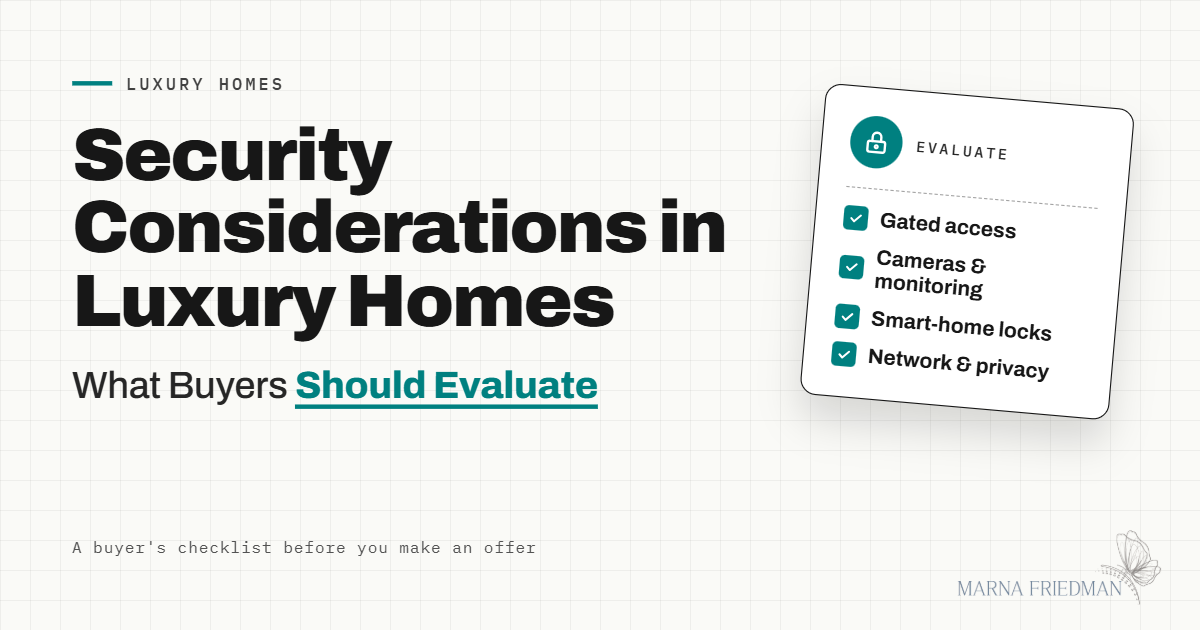
Security features in luxury homes come up more often during a transaction than most buyers expect. Cameras, smart locks, monitoring contracts, gate codes, access systems. The question for a buyer isn't how to evaluate the security itself (that's a specialist's job) but what to ask the listing agent and seller, what conveys and what doesn't, and what transfers at closing. For a seller, it's being prepared with the answers before buyers walk through. From a REALTOR's view, luxury home security is really a due diligence and contract conversation, not a hardware one.
Key Takeaways
- Security topics come up more in luxury transactions than standard ones.
- Questions to ask the listing agent matter more than evaluating hardware.
- Hardware usually conveys; monitoring accounts often don't.
- Insurance and disclosure both have specific implications worth understanding.
- Specialists make the technical judgments; your REALTOR surfaces the questions.
"When buyers tour luxury homes across Cherokee, North Fulton, and west Cobb, security features are one of those things that often get glossed over on the walkthrough. The buyers who ask thoughtful questions get real information. The ones who skip the subject sometimes end up with cameras they can't access or monitoring accounts they didn't know existed."
Marna Friedman, REALTOR®, Atlanta Communities
Why does security come up more in luxury transactions?
At the luxury tier, several things make the security conversation more complex than in a standard home purchase:
- More systems in place: many luxury homes have cameras, smart locks, alarms, gate systems, and sometimes integrated home-automation platforms that include security.
- More accounts and subscriptions: monitoring, cloud camera storage, smart-lock apps, and remote-management services are often tied to the current owner's accounts.
- Hardware is often custom: installations may require specific dealer relationships to service or update, which affects what the next owner can do.
- Insurance implications are bigger: higher-value homes carry higher-value insurance, and documented security often affects premiums.
- Privacy considerations during showings: active cameras that record buyer tours have real legal and ethical considerations in Georgia.
- Gated-community overlays: homes in Governors Towne Club or similar gated luxury pockets have community-level security that layers with the individual home's setup.
None of these require you to become an expert on security systems. They just mean the questions matter more. See my luxury homes guide for broader context on luxury home evaluation.
What should buyers actually look at on a tour?
A luxury home tour isn't the place to evaluate how good the security is. It's the place to notice what exists and generate your list of questions. Worth observing:
- Cameras: approximately how many and where. Not whether they're "good."
- Smart locks or keypads: at entry doors, service doors, garage.
- Alarm panels or keypads: inside doors, at the equipment hub.
- Gates: at the property entrance, with any associated keypad, intercom, or vehicle recognition.
- Equipment room: a closet or dedicated space where the network, AV, and security hardware lives. Its organization and apparent age tell you something.
- Monitoring signage: yard signs or window stickers naming an alarm company.
- Community-level signage: if the home is in a gated community, what security services the community provides.
You're building a mental checklist to turn into questions for the listing agent. You're not grading the home's security posture. That's a specialist's work after you're under contract.
What usually conveys with the home, and what doesn't?
The convey-or-not question is where buyers most often get caught by surprise after closing. The table below shows the typical pattern, though specific terms always come down to what's written into the purchase contract.
| Item | Usually conveys | Usually doesn't convey |
|---|---|---|
| Hardwired cameras and alarm panels | Yes (as fixtures) | N/A |
| Smart locks and keypads | Hardware yes | Owner's app account doesn't |
| Monitoring service | N/A | Buyer sets up new account |
| Cloud camera storage | N/A | Tied to owner's account |
| Prior recorded footage | N/A | Seller keeps or deletes |
| Gate remotes and transponders | Usually, specify in contract | N/A |
| Dealer or integrator service contract | N/A | Buyer renegotiates or replaces |
| System documentation and passwords | Should convey; ask explicitly | N/A |
The pattern: physical hardware tends to convey, service relationships rarely do. Spell out specifics in the contract rather than assuming.
What questions are worth asking the listing agent?
A short list of practical questions:
- What security systems are currently installed and roughly how old are they?
- Which local dealer or integrator services them, and is that relationship transferable?
- What monitoring service covers the home, and what are the contract terms?
- What camera coverage exists, and where is footage stored?
- Will all the physical hardware, remotes, keypads, and documentation convey?
- Are there smart-lock accounts or app subscriptions tied to the seller that will need to be reset?
- If the home is in a gated community, what services does the community provide?
- Will cameras be active and recording during buyer tours and the inspection?
Listing agents on well-prepared luxury homes have good answers. Vague answers tell you something too. See my luxury home automation post for the broader integrated-systems picture.
What should sellers of luxury homes prepare?
For sellers, having the answers ready prevents the buyer confidence problem that comes from "I'm not sure, let me check." Worth preparing before listing:
- A documentation packet: system info, dealer contacts, monitoring account details, app accounts, and the status of each.
- A conveys list: which items of hardware you intend to leave; what remotes, keypads, and devices come with the home.
- A plan for recorded footage: what you'll keep, what you'll delete, when you'll do it.
- A monitoring transition plan: which contracts you'll cancel at closing versus leave in place for the buyer to transition.
- Clarity on showing-period recording: cameras actively recording buyer tours have real considerations in Georgia; discuss with your agent and attorney about disabling, disclosing, or leaving as-is.
- A short answer for the common questions: what's installed, who maintains it, what conveys. Buyers ask the same questions; prepared answers build confidence.
My preparing a luxury home to sell post covers the broader seller preparation framework.
How does security intersect with insurance and disclosure?
Several practical implications worth understanding on both sides of the transaction:
- Insurance premium effects: many insurers offer discounts for professionally monitored systems. Buyers should discuss with their insurance agent what the home's current setup supports and what new accounts would mean for coverage and rates.
- Disclosure considerations: sellers may need to disclose active audio recording and the general scope of surveillance. Georgia's recording laws differ from some other states; your attorney is the right person to walk you through specifics.
- Appraisal effect: integrated security typically doesn't appraise as a separate value, though it can contribute to how comparable analysis treats a home.
- Home warranty considerations: standard home warranties don't typically cover security systems; manufacturer and dealer warranties do, when transferable.
- Documented footage as claim support: for homeowners who do experience incidents, retained camera footage can support insurance claims.
None of this is REALTOR territory to resolve. It's REALTOR territory to flag so you can bring in the insurance agent, attorney, or specialist who can.
Who should actually evaluate the systems?
For buyers who want technical evaluation beyond the surface tour, several specialists are the right call:
- Certified low-voltage integrator: for a technical assessment of camera, alarm, and smart-home infrastructure.
- Licensed electrician: for wiring, panel, and electrical integration questions.
- Insurance agent: for how the home's current systems affect your coverage and rates.
- Georgia real estate attorney: for disclosure, recording, and contract language questions.
- Security consultant (independent): for an evaluation of whether the setup fits your specific priorities and whether changes are warranted.
I help clients identify which specialists make sense for a specific home. The right question for a particular property shapes which professional to engage. See my luxury home inspections post for how specialty inspections fit the broader due diligence framework.
Frequently Asked Questions
What should I ask the seller about security on a luxury home tour?
Focus on what's installed, who services it, what monitoring is in place, and what will convey. The specifics (how the cameras are configured, whether the alarm is "good") are specialist questions after you're under contract. The transaction questions are what matter during the tour.
Does the alarm system usually convey with the home?
The hardware typically conveys as a fixture. The monitoring contract usually doesn't; the buyer sets up a new account. Confirm in the purchase contract rather than assuming either way.
Can cameras keep recording during buyer showings and inspections?
In Georgia, this touches on recording-consent law and depends on whether audio is captured. Sellers should discuss with their agent and attorney before letting active surveillance continue through showings. Buyers can ask whether cameras will be disabled or active during their tour.
Do I need a specialist to evaluate security during due diligence?
For most luxury transactions, the general home inspector doesn't dig into security systems. If security capability matters to you, a certified integrator or an independent security consultant can do a technical assessment during due diligence. Discuss with your agent whether it fits your specific situation.
What happens to the monitoring account at closing?
The seller cancels their account; the buyer sets up a new one with the same company or a different one. The hardware stays. Make sure the contract covers access codes, documentation, and dealer contacts needed to transition cleanly.
Considering a luxury home in NW Metro Atlanta?
Security topics are one of several areas where luxury transactions involve more questions than standard ones. I help buyers across Cherokee, North Fulton, west Cobb, and the Cedarcrest corridor evaluate luxury homes and the right questions to ask. Read my luxury homes guide, my luxury lifestyle page, or reach out to discuss what matters most in your search.
Marna Friedman is a licensed REALTOR® with Atlanta Communities Real Estate Brokerage serving NW Metro Atlanta. This article is general guidance, not legal, insurance, or technical advice; consult the appropriate professionals for your specific situation. Information is deemed reliable but not guaranteed. Equal Housing Opportunity.
Check out this article next