55+ Active Adult · NW Metro Atlanta
The cleanest way to move from a longtime home into a 55+ community is to prepare both transactions in parallel: get your current home market-ready and priced while you shortlist communities, then choose sell-first, buy-first, or contingent based on your finances and the inventory you find. There is no single right order, but there is a right order for you, and it is knowable before you list anything.
I help homeowners across NW Metro Atlanta coordinate exactly this move, drawing on specialized transition training and years of these linked sales, often out of a home they have owned for twenty or thirty years. Here is how to think through the timing, the money, and the practical work of the transition.
Key Takeaways
- Decide the order of operations first: sell-first gives certainty of funds, buy-first gives certainty of destination, and a contingency splits the difference.
- New construction in a 55+ community can solve timing on its own, because a build schedule gives you months to sell.
- Start decluttering and light prep 60 to 90 days before listing; longtime homes carry decades of contents.
- Confirm the destination community's 55+ status under HOPA and review its HOA documents before you commit.
- Line up your team early: agent, lender (if financing), closing attorney, and a mover experienced with long-held households.
"Many of the homeowners making this move have been in their Cobb or Cherokee home for decades, often moving only a few miles, from an established Marietta or Woodstock neighborhood into a 55+ community nearby. The sale is emotional and the timing is technical, and the plan has to respect both."
Marna Friedman, REALTOR®, Atlanta Communities
Should you sell first or buy first?
Sell-first means you list, close, and then purchase, often with a short rental, a rent-back from your buyer, or a stay with relatives in between. You know exactly what your sale netted, you shop as a non-contingent buyer, and your offer on the new home is strong. The cost is an interim housing plan and a second move for some belongings.
Buy-first means you secure the new home before listing. You move once, on your schedule, and you can prepare the old house for market while it is empty, which usually helps it show. The cost is carrying two homes briefly and needing the financial capacity, through savings, bridge financing, or a home equity line arranged before you list, to close without your sale proceeds in hand.
A home sale contingency writes your purchase so it depends on your current home closing. It protects you from owning two homes, but in a competitive situation a contingent offer is weaker, and some sellers and builders will not accept one. Your equity position, income, and risk tolerance point to the right structure, and that is a conversation to have before touring anything.
Why does new construction make the timing easier?
Many of the area's age-restricted communities, including Soleil Belmont Park and Crescent Pointe at Great Sky in the Canton area, offer new construction. A to-be-built home comes with a construction timeline measured in months, and that window is a gift: you contract on the new home, then prepare, list, and close your current home while it is being built, aiming both closings at the same season.
Quick move-in homes compress that window but still usually allow 30 to 60 days. I cover the build-side details in building new in a 55+ community. Whichever path you choose, confirm the community's age-restricted status is legally established under the Housing for Older Persons Act (HOPA) and read the HOA covenants before signing; my 55+ active adult guide explains what qualifies.
How do the three timing strategies compare?
| Strategy | Strengths | Trade-offs | Best fit when |
|---|---|---|---|
| Sell first | Exact proceeds known; strong non-contingent offers | Interim housing; possible double move | Proceeds fund the purchase and certainty matters most |
| Buy first | One move; empty home shows well; no housing gap | Carrying two homes; needs bridge funds or strong finances | Equity or savings can close without sale proceeds |
| Contingent purchase | Never own two homes; sale and purchase linked | Weaker offer; not accepted everywhere; timeline pressure | Market conditions favor buyers and the seller will accept it |
| Build new (hybrid) | Months-long window to sell on your terms | Build timelines can shift; requires coordination | The destination is a new construction 55+ community |
What does preparing a longtime home for market involve?
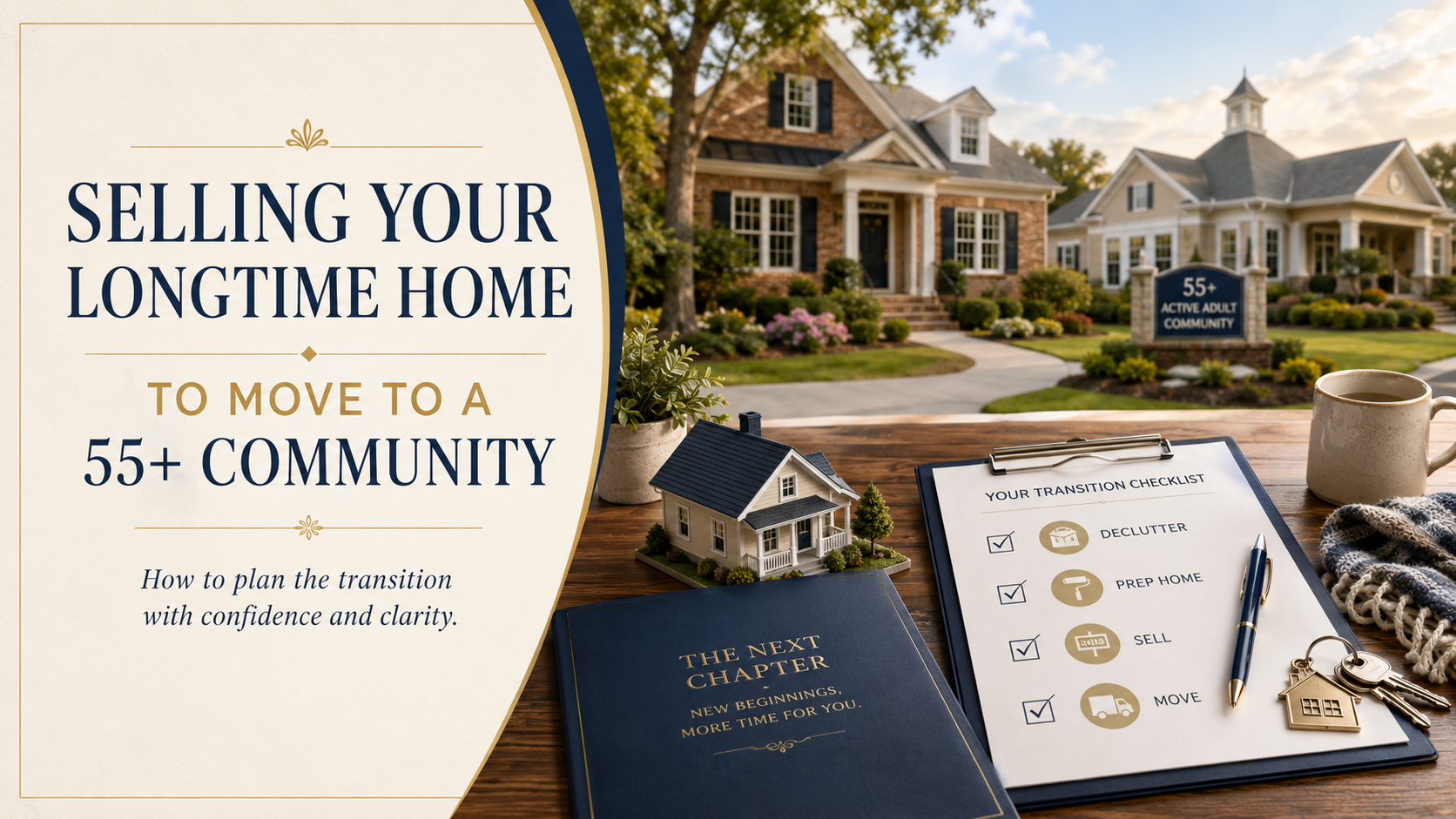
A home owned for decades usually needs more runway than a typical listing, mostly because of contents, not condition. Start 60 to 90 days out:
- Sort in passes, not marathons. One room or category at a time: keep, gift, sell, donate, discard. Estate sale companies and donation pickups handle volume you should not move yourself.
- Handle the deferred small stuff. Dated light fixtures, worn caulk, sticking doors, and touch-up paint return more than their cost. My guide to maintenance that pays off before selling ranks the priorities.
- Stage for space. Fewer, well-placed pieces make rooms read larger; see staging room by room.
- Gather the paperwork. Survey, warranty records, system ages, and any open permits speed both disclosure and closing.
- Price on today's data. Decades of ownership can anchor expectations high or low; a current market analysis resets them. Start with what's my home worth.
What should you confirm about the destination community?
Before the contract, verify four things in writing: the community's HOPA-qualified 55+ status and its occupancy rules; the HOA dues and precisely what they cover (my post on 55+ HOA dues breaks this down); any capital contribution or initiation fees due at closing; and the rules that touch daily life, such as guest stays, leasing, and parking. Tour at different times of day, and if the community is still building, ask which amenities are complete versus planned, with dates.
How do you pace the emotional side of leaving a longtime home?
The logistics of this move are plannable; the feelings arrive on their own schedule, and pretending otherwise is how transitions stall. A house that held decades does not sort itself in a weekend, and it should not have to. The pacing that works, over and over, is small and steady: one room at a time, one category at a time, begun months before any listing date, so no single week ever has to carry the whole goodbye. Start with the spaces that hold storage rather than memory, the utility room before the study, and momentum builds before the harder rooms arrive.
Give the memories their own channel so the belongings can move through theirs. Photograph rooms as they are, keep a small box of true keepsakes per person, and let relatives and friends claim meaningful pieces early, which turns dispersal into giving. For everything else, the practical machinery, estate sale professionals, donation pickups, consignment, junk haulers, exists precisely so you are not hand-carrying every decision. A senior move manager can run the entire sequence when the scale calls for it, and the referral network for all of this is part of what you should expect from your agent.
Two guardrails keep the process kind. First, deadlines with slack: target dates for each phase, set generously, beat one looming date that turns sorting into panic. Second, the decision rule for hard objects: if it will live in the new home, mark it now; if it will not, decide its destination this week rather than moving it twice. And through all of it, remember what the effort is buying, a home scaled to the life you actually want next, which is the point of the whole move.
Frequently Asked Questions
How far in advance should I start planning the move?
Six months is comfortable for most households; longtime homes with full basements or decades of contents benefit from a year. The sorting takes longer than anyone expects, and starting early keeps it from becoming a crisis.
What is a home sale contingency?
Contract language making your purchase dependent on your current home closing. It protects you from owning two homes but weakens your offer, and some sellers and builders decline contingent contracts.
Can I make an offer on a 55+ home before mine is listed?
You can, but expect the seller or builder to want evidence you can close: a listing date, a pre-approval that works without sale proceeds, or a contingency they are willing to accept. Preparation strengthens every version of this.
What kind of agent experience helps with this move?
Experience with exactly this pattern: timing linked sales, working with estate-sale and move-management resources, and communicating with the relatives and advisors the owner wants involved. Specialized transition training supports it; recent, local experience proves it.
Do I have to move everything at once?
No. Many clients move essentials first, then handle the remaining contents through an estate sale or cleanout after the new home is set up. Rent-back agreements can also add weeks of flexibility after closing.
The move out of a longtime home is as much a project plan as a transaction, and it goes best with one person coordinating both sides. If a 55+ community is in your future, browse 55+ communities in NW Metro Atlanta, and when you are ready to talk timing, reach out. I will build the sequence around your situation.
Marna Friedman is a REALTOR® with Atlanta Communities serving NW Metro Atlanta. Age-restricted communities operate under the Housing for Older Persons Act; confirm each community's current status and rules directly. This article is general information, not legal or financial advice. Equal Housing Opportunity.
Check out this article next