55+ Active Adult · NW Metro Atlanta
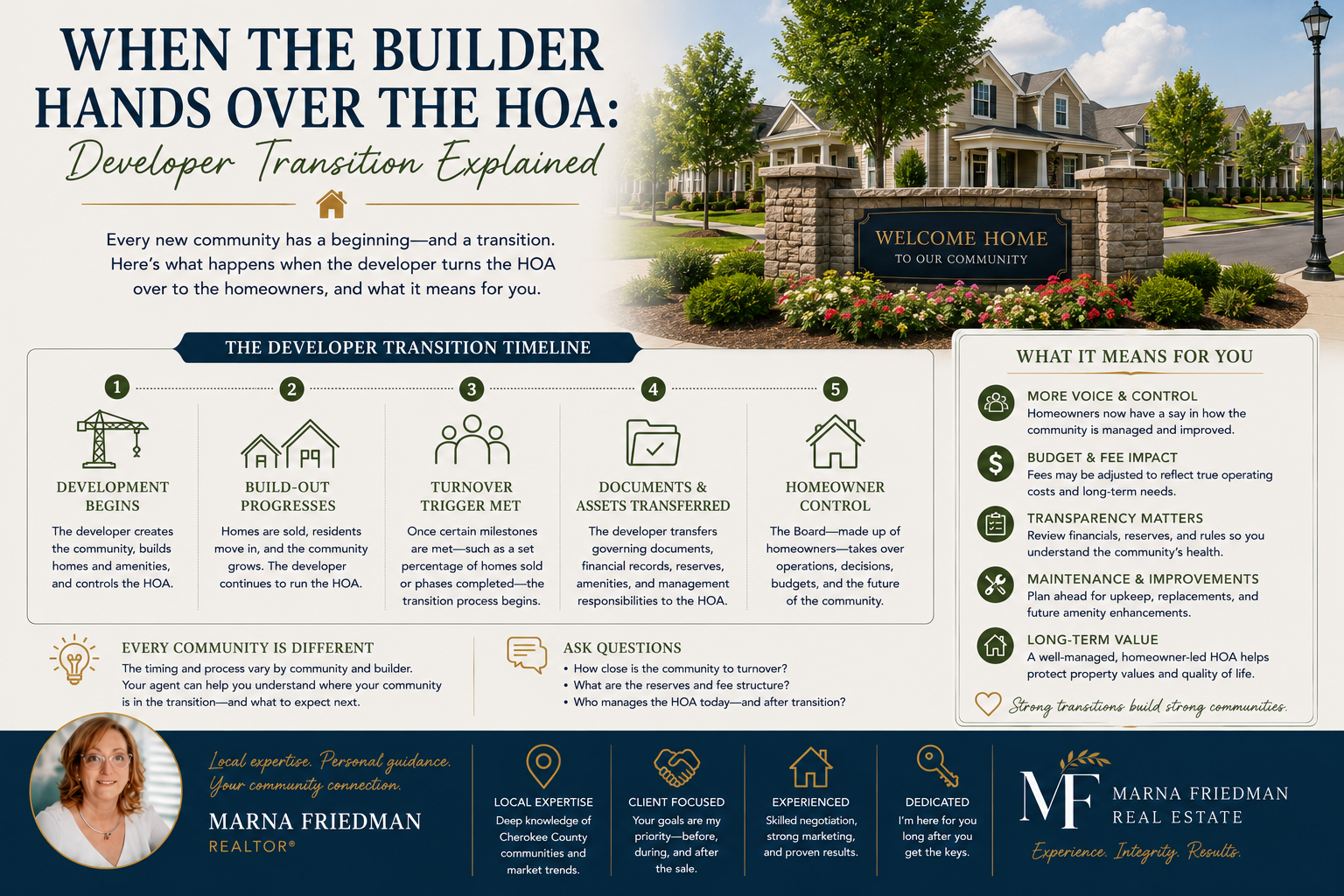
Every new community's homeowners association begins under the developer's control and eventually transfers to the residents, a milestone called developer transition or turnover. During the build-out, the developer typically appoints the board and sets the budget under its declarant rights; at transition, defined by triggers in the community's documents, commonly a percentage of homes sold or a stated date, residents elect their own board and take over the association's finances, contracts, and common property. Where you buy relative to that milestone shapes your dues stability, your voice in governance, and what questions matter most before contract.
Transition matters everywhere, but it matters intensely in 55+ communities, where the association typically runs more of daily life, lawn care, amenity programming, sometimes exterior maintenance, than in a standard neighborhood. I walk buyers through this timeline constantly in communities across NW Metro Atlanta at every stage of build-out. Here is how the arc works, what changes at handover, and the questions that protect you at each stage.
Key Takeaways
- Developer control is normal and necessary during build-out; the covenants define exactly when and how it ends.
- Dues during the developer period may be supported by the developer in ways that change after turnover; ask how today's budget maps to a resident-run future.
- At transition, residents inherit the association's finances, contracts, and common property, and a well-run handover includes a financial review and a close look at what is being inherited.
- Buying early means amenities and rules still forming; buying after transition means a track record you can read. Both work; they are different purchases.
- In 55+ communities, also confirm how the age-restriction policy and its administration carry through transition.
"Every community, from Great Sky's newer phases in Canton to long-established neighborhoods near Acworth, is somewhere on the transition arc, and knowing where changes what you ask. The best-governed associations I see in this area are resident-run 55+ boards."
Marna Friedman, REALTOR®, Atlanta Communities
How does developer control work during build-out?
The community's declaration of covenants, drafted by the developer, reserves what are called declarant rights: the power to appoint the board, set budgets and dues, amend documents within limits, approve design standards, and generally steer the community while homes are still selling. This is not a red flag; it is how new communities function. A half-built community cannot elect a stable resident board, and the developer has every incentive to keep the association presentable while sales continue, which is why developer-period communities are often immaculately maintained.
The buyer's job during this period is to understand the arrangement rather than fear it. Read the declaration's transition provisions: what triggers turnover, what the developer's obligations are through it, and what rights residents hold in the meantime, some documents seat resident board members in stages as sales milestones pass. Ask how the current budget really works: whether the developer is subsidizing operations or funding shortfalls while amenities outpace the dues base, a common and legitimate practice whose relevance is what happens to dues when the support ends. The reading skills from what 55+ dues cover apply directly, with a time dimension added.
What actually happens at transition?
When the trigger arrives, control transfers in a sequence: resident elections seat a homeowner-controlled board, the developer delivers the association's records, finances, contracts, and common property, and the new board begins governing. A well-run transition is a project in itself, and the practices that mark one are worth knowing because they are what buyers inherit: the new board typically engages its own professionals, commonly an attorney experienced in association transitions and an accountant for a financial review, examines the reserve funding and the condition of common elements it is receiving, reviews the contracts the developer signed on the association's behalf, and establishes its own management arrangement, whether continuing the existing company or selecting new.
The period right after turnover has a personality of its own: budgets get their first fully resident-set review, priorities sometimes shift from sales-office polish toward long-term funding, and governance finds its footing as volunteers replace appointees. In 55+ communities this stretch matters doubly, because residents are taking over not just landscaping contracts but the amenity programming and service scope that define the community's daily life. Most transitions in well-documented communities proceed smoothly; the ones that struggle usually trace to underfunded reserves or deferred common-area work, which is precisely what the buyer questions below are designed to surface early.
How does buying before vs. after transition compare?
| Factor | During developer control | After resident control |
|---|---|---|
| Dues | Set by developer; may reflect support that ends later | Set by resident board with a visible history |
| Governance voice | Limited; board largely appointed | Full member voting and board eligibility |
| Amenities | May be phased; promises need written timelines | Built and operating; condition is inspectable |
| Community character | Still forming as homes sell | Established and readable |
| What to scrutinize | Transition provisions, budget realism, reserve funding plan | Reserve study, assessment history, minutes and priorities |
Neither side of the milestone is the wrong time to buy. Early buyers get selection, new construction, and often first-phase pricing, with the trade that the community's mature form is a projection; later buyers get certainty at the market's price for it. The comparison framework from comparing 55+ communities simply gains a column: where is each community in this arc, and how well is that stage being run?
What should buyers ask at each stage?
In a developer-period community, ask: What are the transition triggers in the declaration, and where does the community stand against them today? How is the current budget funded, and what does the developer project dues to be at build-out? What is the reserve funding plan, and what common property will the association receive? Which amenities exist versus which are promised, with what written timeline? And in a 55+ community specifically, how is the age-restriction policy administered now, and how does that administration carry through turnover, the verification discipline from age-restricted vs. age-targeted applies across the whole arc.
In a recently transitioned community, ask for the transition's paper trail: the financial review, the reserve study, the first resident-set budgets, and the minutes that show what the new board found and how it responded. Steady dues with explained changes, funded reserves, and a board communicating clearly are the signatures of a handover done well. In a long-established community, the transition is history, and the ordinary health checks, reserves, assessment record, minutes, from questions to ask on a 55+ tour tell the story. At every stage, the association documents come with your purchase for a reason; read them, and bring your agent and, where warranted, an attorney into the reading.
Why does this matter more in 55+ communities?
Because the association's scope is the product. In a standard neighborhood, an HOA might tend entrances and enforce covenants; in a 55+ community, it commonly runs lawn care, amenity operations, a programming calendar, and sometimes exterior maintenance, the whole value proposition of lock-and-leave living. When more of daily life routes through the association, the quality of its governance and the durability of its finances matter proportionally more, and the transition is the moment both get tested. The good news is symmetrical: well-run 55+ communities attract engaged resident boards precisely because residents are present, invested, and often bring long professional experience to the table, and the best-governed associations I see in this area are resident-run 55+ boards. The transition is not a hazard to avoid; it is a milestone to understand, and understanding it is one more way of buying well.
Frequently Asked Questions
What is HOA developer transition?
The transfer of a community association's control from the developer to resident homeowners, triggered by provisions in the covenants, commonly a sales percentage or date. Residents then elect the board and govern the association.
When does transition usually happen?
Per the community's declaration, most often when a stated share of homes has sold, sometimes by a set date or at the developer's election within limits. The exact triggers are written in the documents you receive at purchase.
Will dues go up after the developer leaves?
Not automatically, but budgets can change when developer support ends or resident boards adjust priorities and reserve funding. Ask how today's budget maps to build-out, and read the projections before contract.
Is it risky to buy before transition?
It is a different purchase, not a riskier one by default: you trade an established track record for selection and first-phase advantages. The protections are written transition provisions, realistic budgets, and a reserve plan you have read.
Do residents have any say before transition?
Often some: many declarations seat resident board members in stages as sales milestones pass, and members can attend meetings and review records per the documents. The specifics vary by community.
Does the 55+ age restriction survive the transition?
The restriction lives in the recorded covenants and continues under resident control, with the association administering the HOPA-compliant policy. Confirm each community's current status and administration in writing at purchase.
Every community you tour is somewhere on this arc, and knowing where changes what you ask. If you are weighing 55+ communities at different stages across NW Metro Atlanta, start with my 55+ active adult guide, then reach out, and we will read each community's stage, and its paperwork, together.
Marna Friedman is a REALTOR® with Atlanta Communities serving NW Metro Atlanta. Association structures, transition provisions, and practices vary by community and are governed by each community's recorded documents and applicable law; review them with appropriate professionals. This article is general information, not legal advice. Age-restricted communities operate under the Housing for Older Persons Act. Equal Housing Opportunity.
Check out this article next