
Finished Basement vs. No Basement: Does It Matter in NW Atlanta?
In most of the country, basements are standard. In NW Metro Atlanta, they're a decision — and one with real implications for how you live, what you pay, and what your home is worth when you sell.
In much of the Midwest and Northeast, a basement is simply part of the house — expected, standard, unremarkable. In NW Metro Atlanta, basements are both more present and more significant than in many Southern markets, thanks to the region's rolling topography and the sloped lots that make below-grade construction practical. But not all basements are equal, and the decision between a finished basement, an unfinished basement, or no basement at all has real implications for how you live in a home, what you pay for it, and what you receive when you sell.
Here's the honest breakdown — for buyers evaluating their options and sellers deciding what to do before listing.
How Basements Actually Work in Georgia
Georgia basements are not the dug-out underground cellars common in the Midwest and Northeast. Builders in this region don't excavate flat ground to create below-grade space — the terrain has to lend itself to a walkout or daylight configuration naturally. When a lot slopes enough from front to back or side to side, the builder can frame the lower level into the hillside, leaving one or more walls exposed at grade on the downhill side. The result is a walkout or daylight basement: a lower level with direct exterior access, natural light, and windows that open to the outdoors.
This means basement availability in NW Metro Atlanta is fundamentally topography-driven. Communities built on flatter land — or where lots were graded level during development — simply don't have basement homes. In communities where the natural terrain varies, some lots will yield a basement and others won't, depending on where the home sits relative to the grade. Buyers specifically seeking a basement home need to search for it as a feature, and sellers with basement lots should understand they're offering something that isn't universally available in their market.
It also means that within a given community, basement availability can be limited and concentrated in specific sections. Two streets over from a cluster of walkout basement homes, the lots may be flat enough that basements simply weren't built. This lot-by-lot variation is worth understanding for both buyers evaluating their options and sellers assessing their competitive position.
One practical implication that surprises many buyers — particularly those coming from other markets: in Georgia new construction, builders designate lots as either basement lots or slab lots, and they build accordingly. A builder will not sell a basement lot as a slab home, nor will they build a basement on a lot that isn't graded for one. If you're buying new construction and a basement is important to you, you need to specifically find and select a basement lot. If a slab is what you prefer — for maintenance simplicity, price point, or any other reason — you're looking at slab lots only. The two are not interchangeable, and understanding this upfront prevents a significant amount of confusion and disappointment during the new construction search process.
Buyers should also understand the cost structure of a new construction basement lot. In most NW Metro Atlanta communities, a basement lot carries two layers of additional cost above a comparable slab home: a structural cost increase built into the base price — reflecting the additional framing, foundation work, and materials required for the lower level — and a separate lot premium charged by the builder for the basement lot itself. These are distinct line items, and together they can add meaningful cost to the total purchase price compared to a slab home of equivalent above-grade square footage. Buyers evaluating new construction basement homes should ask the builder's sales team to itemize both costs clearly so the full premium is understood before making a selection.
Finished Basement: What It Actually Adds
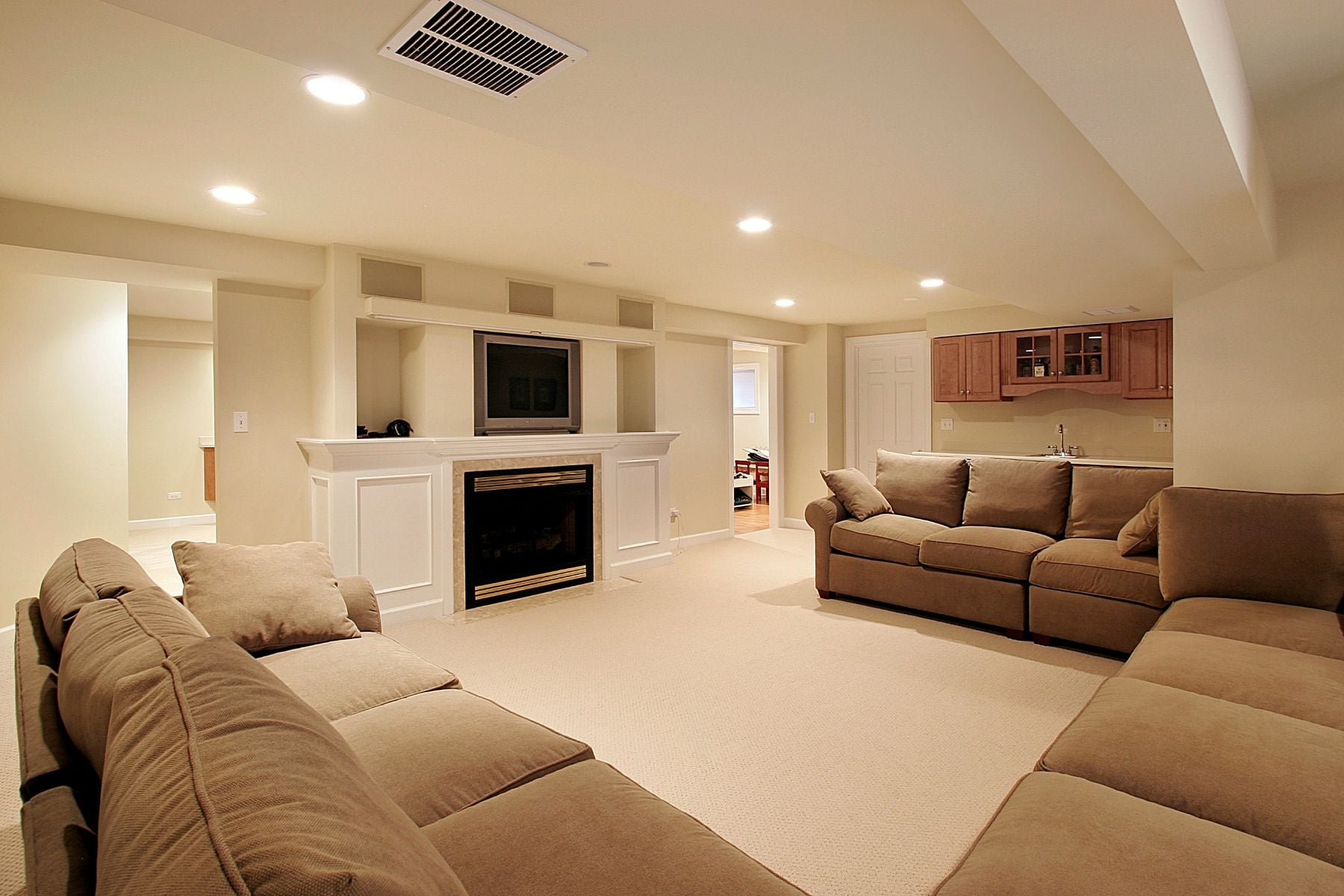
A well-finished basement in NW Metro Atlanta effectively adds a second living level to the home — one that functions as media room, home gym, guest suite, home office, playroom, or entertainment space depending on how the owners choose to configure it. The best finished basements feel like genuine living space: full ceiling height of at least eight feet (nine is better), natural light through egress or daylight windows, a bathroom, quality flooring, defined rooms, and independent climate control.
The value a finished basement adds is real but quality-dependent. Appraisers in Georgia typically value finished basement square footage at a discount to above-grade square footage — the ratio varies, but finished basement space commonly appraises at 50 to 75 percent of the per-square-foot value of above-grade space. Buyer perception, however, often assigns more value than the appraisal formula suggests — particularly when the basement offers a genuinely usable, comfortable space that expands the home's functional footprint in ways buyers can immediately visualize using.
Walkout access changes the equation further. A finished basement that opens directly to a patio, yard, or outdoor living area creates a seamless indoor-outdoor connection that adds utility and perceived value beyond what the square footage alone would suggest. In NW Atlanta's climate — where outdoor living is viable for the majority of the year — this connection between a finished lower level and outdoor space is a meaningful differentiator.
Unfinished Basement: The Potential Play
An unfinished basement is a different kind of asset — less immediately valuable, but potentially significant depending on what a buyer intends to do with it. Buyers who plan to finish the space themselves can often acquire the square footage at a meaningful discount compared to purchasing a home where that work is already done. The premium a seller receives for finished basement space typically exceeds the cost of finishing — which means buyers who finish their own basement after purchase often capture equity in the process.
The key variables that determine an unfinished basement's potential are ceiling height, egress options, plumbing stub-outs, natural light, and the existing condition of mechanicals. A basement with eight-foot ceilings, existing egress windows, plumbing roughed in for a future bathroom, and a walkout door is a significantly more valuable starting point than one with six-foot ceilings, no natural light, and no plumbing provisions. Buyers evaluating unfinished basements should assess these variables specifically rather than treating all unfinished basements as equivalent.
For sellers with unfinished basements, the decision of whether to finish before listing is worth careful analysis. In communities where finished basements are common and expected, an unfinished basement can be a competitive disadvantage that motivates buyers to negotiate aggressively or choose an alternative. In communities where unfinished basements are common across the price range, the disadvantage is less acute. A pre-listing consultation that accounts for your specific community's competitive landscape is the most reliable guide to this decision.
No Basement: When It's a Non-Issue and When It Hurts
Slab homes in NW Metro Atlanta exist where the lots support them — flat or minimally graded terrain where the topography doesn't call for a basement. In new construction communities, slab lots and basement lots are designated separately by the builder and are not interchangeable. A buyer who prefers a slab needs to shop slab lots; a buyer who wants a basement needs to find a community and lot where that option exists. Neither can be retrofitted after the fact. For buyers who don't need or want the additional space, a slab home can represent a price advantage: equivalent above-grade square footage at a lower total price than a comparable basement home.
Where the absence of a basement hurts most is in head-to-head competition with basement homes at the same price point. A buyer comparing two otherwise similar homes — same square footage, same finish level, same community — will typically choose the one with a finished basement when the price difference is modest. Sellers of non-basement homes competing against basement inventory need to be aware of this dynamic and price accordingly, or ensure their above-grade finishes and other features are strong enough to justify the comparison.
Storage is the practical gap that non-basement buyers feel most acutely over time. The basement absorbs seasonal items, holiday decorations, sporting equipment, tools, and overflow that would otherwise require a storage unit or create visual clutter in living spaces. Buyers who have lived in non-basement homes know this friction; buyers coming from basement homes often underestimate it until they've moved in.
The Finish Quality Factors That Actually Drive Value
Not all finished basements command equal premiums, and the variables that separate a high-value finish from a mediocre one are specific and consistent. Ceiling height is the most important: a basement that feels airy and open at nine feet commands a meaningfully different buyer response than one that feels compressed at seven. Natural light follows closely — a daylight or walkout basement with windows that bring in genuine exterior light feels fundamentally different from a below-grade space where artificial lighting is the only option.
Bathroom presence — even a half bath — substantially increases utility and therefore value. A basement without bathroom access requires any occupant to travel upstairs, which effectively limits how the space gets used. Flooring quality matters: luxury vinyl plank or hardwood-look materials that handle the slight moisture variability of below-grade environments read as finished living space; carpet that shows age or bare concrete that was never properly addressed reads as incomplete regardless of what else the basement contains.
The Bottom Line for Buyers and Sellers
For buyers: a finished basement in NW Metro Atlanta represents genuine additional living space that expands how a home can function across changing life circumstances — home office needs, guest accommodation, fitness, entertainment. Prioritize ceiling height, natural light, and bathroom access when evaluating finished basement quality. An unfinished basement with good bones is an opportunity; one with limitations is a project with a ceiling on its upside.
For sellers: understand what you have and what it's worth in your specific community context. A quality finished basement should be featured prominently in your marketing and priced to reflect its value. An unfinished basement in a market where buyers expect finished space may warrant investment before listing — or honest pricing that acknowledges the gap. The decision is community-specific and worth a direct conversation before you commit to either path.
If you'd like to talk through what a basement — finished, unfinished, or absent — means for your specific home's value and competitive position, I'm happy to have that conversation.
Marna Friedman · 678-920-3099 · [email protected]
finished basement value NW Atlantabasement vs no basement Atlantadoes a finished basement add value GeorgiaNW Metro Atlanta homes with basementsbasement homes Dallas GA
Check out this article next