55+ Active Adult · NW Metro Atlanta
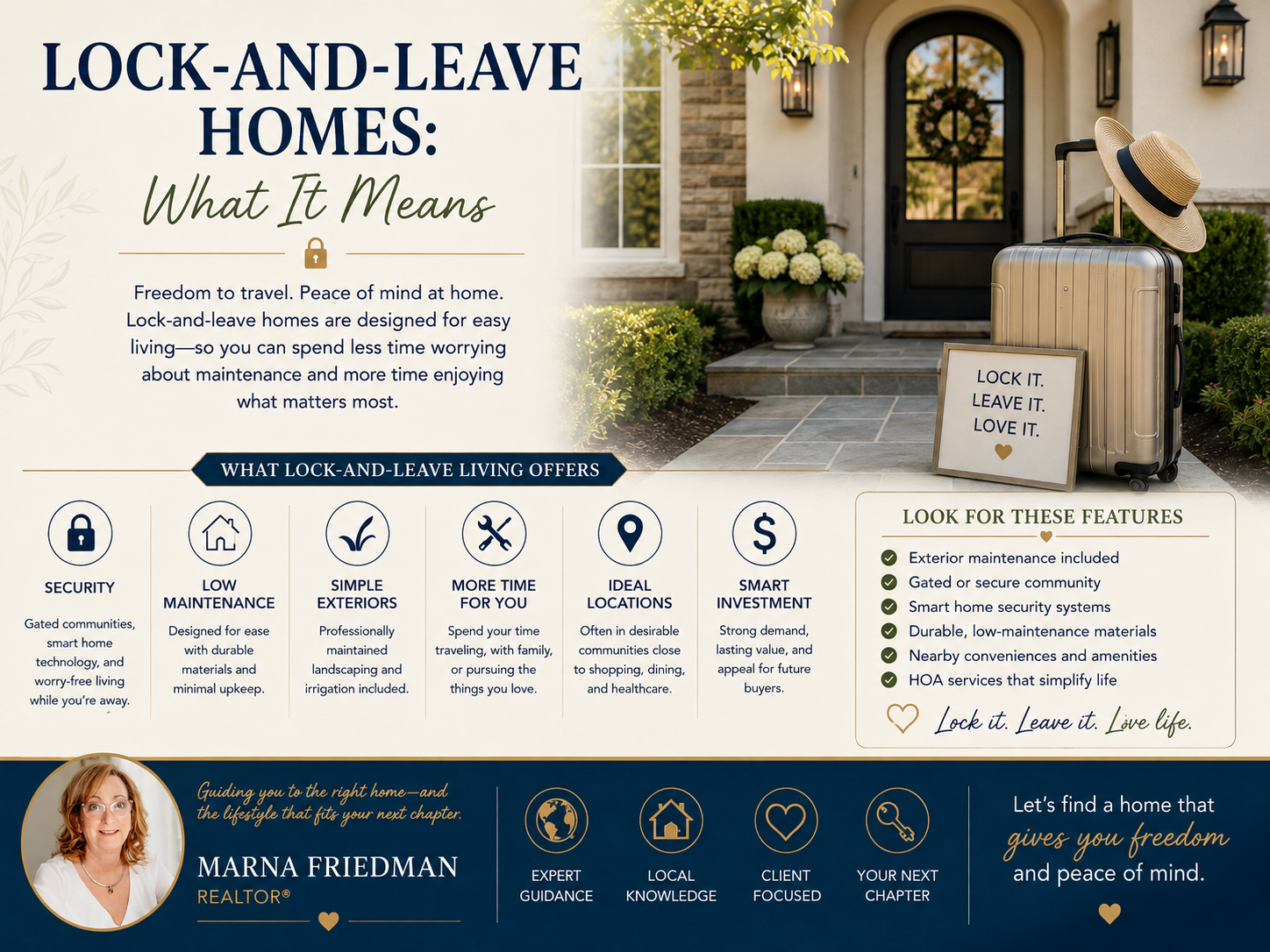
Lock-and-leave describes a home you can secure and walk away from for weeks at a time without arranging house care, because the combination of the home's features and the community's services removes the usual reasons to worry: the lawn is maintained for you, the exterior needs nothing seasonal, the systems can be monitored remotely, and the community's structure means the property is not sitting conspicuously unattended. It is a set of verifiable features, not a marketing mood, and you can shop for it item by item.
The phrase comes up constantly in my 55+ and low-maintenance conversations across NW Metro Atlanta, usually from people whose calendars finally belong to them: long trips, seasons spent elsewhere, months that should not revolve around a lawn. Here is what lock-and-leave actually consists of, the home types and communities that deliver it, and the checklist for confirming a listing really qualifies.
Key Takeaways
- Lock-and-leave is a checklist, not a vibe: exterior maintenance handled, lawn included, monitorable systems, and a community structure that watches the street.
- HOA scope is the heart of it; read exactly what dues cover before believing a listing's label.
- Townhomes, condominiums, and homes in maintenance-included communities deliver it most completely; some 55+ communities that legally qualify under HOPA build their entire model around it.
- Home features matter too: newer systems, smart monitoring, minimal high-touch landscaping, and low-upkeep exteriors.
- Ask the community how extended absences work in practice: package handling, gate or guest procedures, and what neighbors typically arrange.
"Lock-and-leave is really about what your time is for. My clients in 55+ communities around Canton and Woodstock describe the same change: the weekend stopped belonging to the yard."
Marna Friedman, REALTOR®, Atlanta Communities
What does lock-and-leave actually include?
Break the phrase into its working parts. Exterior maintenance handled by someone else is the foundation: lawn care, landscaping, and ideally exterior components like roofs and siding covered through the association, so no season's chore list waits for your return. A manageable envelope comes next, low-upkeep exterior materials, no aging systems on the edge of failure, and gutters, drainage, and irrigation that behave unsupervised. Then monitorability: smart thermostats, leak sensors, cameras, and remote locks that let you check the house from anywhere, features I detailed in smart home systems worth having, which apply at every price point.
Finally, and least tangibly, the setting: a community where an unoccupied home does not stand out, whether because a gate manages access, because homes are attached and neighbors are close, or because the community's rhythm includes plenty of people coming and going. No single feature makes a home lock-and-leave; the checklist does.
Which home types deliver it best?
Condominiums deliver the most complete version, since the association typically maintains everything outside your walls, followed closely by townhomes in maintenance-included communities, where exterior and lawn care commonly come with the dues. Detached homes can absolutely qualify, but only in communities whose HOA includes lawn and often exterior maintenance for detached homes, a model that has grown across NW Metro Atlanta precisely because of this demand. Ranch and other single-level plans pair naturally with the goal, for reasons my guide to single-level living features covers, though lock-and-leave is about maintenance scope, not floor count.
Many 55+ active adult communities that legally qualify under the Housing for Older Persons Act build their entire product around this model: included lawn care, low-maintenance exteriors, and amenity-centered life that assumes residents travel. Communities in our area such as Soleil Belmont Park and Crescent Pointe at Great Sky illustrate the category; confirm each community's current age-restriction status and exactly what its dues include, since coverage varies community to community. Lock-and-leave is not limited to 55+ communities, though: plenty of age-neutral townhome and maintenance-included communities deliver the same checklist.
How do the options compare?
| Option | What's typically covered | What's still yours | Watch for |
|---|---|---|---|
| Condominium | Exterior, roof, grounds, often water | Interior, HVAC, contents insurance | Association health, reserves, leasing caps |
| Townhome, maintenance-included | Lawn, landscaping, often exterior components | Systems, roof in some communities | Exactly which exterior items dues cover |
| Detached home, lawn-included HOA | Lawn and common landscaping | Full exterior and all systems | "Lawn included" is not "exterior included" |
| 55+ community home (HOPA-qualified) | Commonly lawn care; varies widely beyond | Per community documents | Confirm age-restriction status and dues scope |
| Standard detached home | Nothing by default | Everything | Achievable with hired services, at effort and cost |
How do you verify a listing's lock-and-leave claim?
Read the association documents, because the label lives or dies there. Confirm exactly what dues cover: lawn only, or landscaping beds too; exterior painting and roofs, or neither; irrigation and common-area trees; trash and gate operations. My breakdown of what 55+ HOA dues cover shows how widely the same monthly number can differ in scope. Then check the association's health, dues history, reserves, recent assessments, because a maintenance-included promise is only as good as the budget behind it.
Tour with the lifestyle in mind as well as the house. Visit the community midweek and again on a weekend, notice how many homes are clearly occupied versus resting between trips, and ask residents you meet how their own long absences have gone: what they arrange, what the association handles, and what surprised them the first time. Communities built around this model will have easy, specific answers.
Ask the practical absence questions, too: How do gates handle guests and deliveries while you are away? Is there a community practice for extended absences? What do covenants say about how long a home may sit unoccupied or whether it may be leased if plans change? And for 55+ communities specifically, verify the legal age-restriction status in writing, the distinction I explained in age-restricted vs. age-targeted, since occupancy rules matter to how flexibly the home can be used.
What should the home itself have before you buy?
- Systems with years left: a newer roof, water heater, and HVAC, or a plan and budget for the aging ones; unattended homes forgive nothing.
- Water defense: leak sensors at the water heater, laundry, and baths, a known and reachable main shutoff, and ideally a smart valve that closes it remotely.
- Remote eyes and controls: smart thermostat, doorbell and exterior cameras, remote locks, and lighting on schedules.
- A low-demand exterior: minimal high-touch plantings beyond what the association maintains, and gutters or gutter protection suited to the tree cover.
- Simple handoffs: a neighbor, community contact, or service that can check the home occasionally, because even the best checklist likes a human backstop.
New construction in maintenance-included communities often checks most of this list from day one, which is part of why the model dominates 55+ building; my guide to 55+ new construction covers how to shop it well.
One quiet detail deserves a call before your first long trip: your homeowner's insurance. Many policies treat extended vacancy differently from ordinary occupancy, and some include clauses that limit certain coverage when a home sits unoccupied past a stated number of days. Ask your insurer how your policy defines an extended absence, whether monitored leak detection or a checked-on-home arrangement changes anything, and what documentation they suggest. The answers vary by carrier, they are usually easy to satisfy once known, and knowing them in advance is exactly the kind of preparation lock-and-leave living is supposed to make routine.
Frequently Asked Questions
What does lock-and-leave mean in real estate?
A home whose features and community services let you leave for extended periods without arranging house care: maintenance handled through the association, a low-upkeep exterior, monitorable systems, and a setting where an unoccupied home is unremarkable.
Is lock-and-leave only found in 55+ communities?
No. Condominiums, townhomes, and maintenance-included communities of any kind deliver it. Many legally qualified 55+ communities build their model around it, but the checklist, not the age restriction, is what defines it.
Does lock-and-leave cost more?
The services live in the HOA dues, so monthly carrying costs typically run higher than a no-services neighborhood. Weigh the dues against what you would pay separately for lawn care, exterior upkeep, and house watching.
What is the difference between lawn-included and maintenance-included?
Scope. Lawn-included covers mowing and often basic landscaping; maintenance-included extends to exterior components, sometimes including roofs and painting. The association documents define exactly where each community draws the line.
What smart features matter most for extended absences?
Water protection first: leak sensors and a remotely controllable main shutoff. Then a smart thermostat, cameras and remote locks, and lighting schedules. Confirm the community's internet reliability while you are at it.
Can any house become lock-and-leave?
Functionally, with enough hired services and monitoring, yes. But buying the model built for it, where the association already handles the exterior, is simpler, and usually what people mean when they ask for it.
Lock-and-leave is one of the most livable promises in housing, provided you buy the checklist rather than the phrase. If travel-ready living is the goal, start with my 55+ active adult guide for the community landscape, then reach out. I will show you the homes in NW Metro Atlanta where leaving really is as simple as the lock.
Marna Friedman is a REALTOR® with Atlanta Communities serving NW Metro Atlanta. HOA coverage, dues, community rules, and age-restriction status vary and change; confirm current details in each community's documents before purchasing. Age-restricted communities operate under the Housing for Older Persons Act. Information is deemed reliable but not guaranteed. Equal Housing Opportunity.
Check out this article next