Real Estate Basics · NW Metro Atlanta
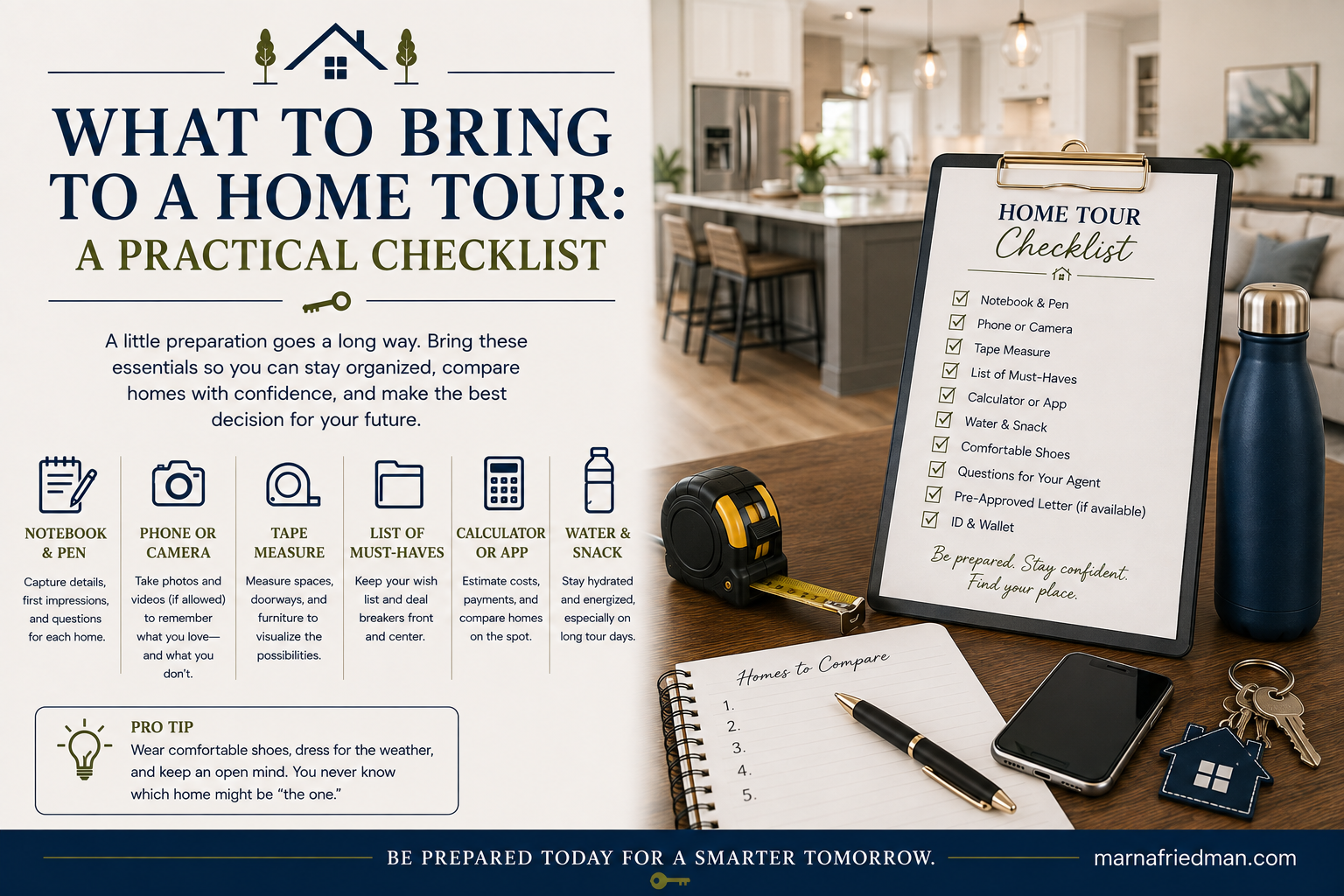
A well-prepared home tour turns a lot of walking through unfamiliar houses into a real evaluation. Bring a phone with a good camera, a way to take notes, a measuring tape, and a printed list of what matters to you. Wear layers and comfortable shoes. Beyond the essentials, have a clear framework for what you are evaluating: the neighborhood, the exterior, the layout, the systems, and the specific features that fit your lifestyle. Home tours are more useful when you know what to look for and less useful when you rely on memory alone. This checklist covers what to bring, what to look for, and how to compare homes you have toured.
Here is a practical checklist for touring homes across NW Metro Atlanta, from Marietta and Kennesaw to Woodstock and Canton.
Key Takeaways
- Bring a phone, measuring tape, notepad, and comfortable shoes.
- Print your must-haves and nice-to-haves so you evaluate consistently.
- Take photos and notes at every home; memory fades fast.
- Look at systems (HVAC, roof, windows) as well as aesthetics.
- Compare homes on the same criteria after touring, not during.
"Most buyers who tour more than three homes in a day forget which one had which feature. A quick photo and a one-sentence note per home is worth more than trying to remember it all later."
Marna Friedman, REALTOR®, Atlanta Communities
What should you actually bring to a home tour?
Keep the list short and practical. Everything on this list fits in a small tote or backpack:
- Smartphone with good camera: for photos, videos, and note-taking.
- Measuring tape: a 25-foot retractable tape is enough for most measurements.
- Notepad and pen: or a note-taking app; either works.
- Printed must-haves and nice-to-haves list: to reference as you walk.
- Comfortable, easy-off shoes: many homes require shoes off; slip-ons save time.
- Layers: vacant homes are often warm or cold depending on season.
- Water and snacks: especially if you are touring several homes in a day.
- A flashlight or phone flashlight: for basements, attics, and dark crawl spaces.
- Charged phone battery pack: photos and mapping drain phone quickly.
Everything on this list has one job: making the tour more useful, not more elaborate. Skip anything that adds weight or complexity without helping you evaluate the home.
What should you evaluate at each home?
A useful framework is to move from big to small: neighborhood context, then the exterior, then the layout, then the details. Walking the same order at each home makes comparison easier later.
Neighborhood context: what the drive up feels like, other homes on the street, sound levels (traffic, HVAC compressors), access to main roads. Cobb County corridors like I-75 and I-575 or Cherokee County's SR 92 shape daily commutes.
Exterior: roof condition, siding, windows, gutters, drainage, foundation, lot slope, mature trees. Georgia's red clay drains differently than many other soils; low spots hold water.
Layout and flow: how the rooms connect, natural light, ceiling heights, storage, primary bedroom location. Walk it as you would live in it (kitchen to garage, bedroom to laundry).
Systems and mechanicals: age of HVAC, water heater, roof; electrical panel; plumbing type. Ask when major systems were last replaced.
Specific features: what mattered to you on your list. A pool? A basement finish? A three-car garage? A yard for gardening? Check them off systematically.
My how home inspections work post covers what a professional inspector will look at later.
What to look for and what it tells you
The table maps what to notice to what it might signal.
| Notice | What it might indicate |
|---|---|
| Fresh paint in one room only | Possible cover for a repair or water stain; ask when and why |
| HVAC unit rust or dents | Older system; ask age and service records |
| Doors that stick or won't latch | Possible settling or humidity swings |
| Damp basement smell | Water intrusion history; investigate closely |
| Yard slopes toward the home | Drainage concern; check basement or crawl space |
| Very low water pressure | Plumbing or well issue depending on the property |
| Popcorn ceilings intact | Older finish; check age of home for possible asbestos concern |
None of these findings are dealbreakers on their own; they are signals worth asking about. Your inspector will confirm or clear them later.
How should you take notes without slowing down the tour?
Speed matters when you tour more than one home in a session. A workable system:
- Take a photo of the address or MLS number when you arrive: so you know where each set of photos starts.
- Take photos as you walk each room: one wide shot per room is enough.
- Photograph the electrical panel and HVAC label: the model and date are useful later.
- Note one strong impression per home in your notes app: "great flow but small primary" or "lot slopes badly."
- Do a 60-second voice memo when you leave: your first impression fades in an hour.
These techniques take 5 to 10 minutes per home total but make comparison later dramatically easier.
What questions should you ask the listing agent?
The listing agent works for the seller, but there are questions worth asking:
- How long has the home been on the market?
- Have there been price changes?
- Are there any known issues with the home?
- When were major systems last replaced (HVAC, water heater, roof)?
- What is the property tax history?
- What HOA dues, if any, and what do they cover?
- What is the seller's motivation and timeline?
- Are there other offers currently under review?
Your own buyer's agent should confirm the answers you get. Some questions have answers on the MLS or property record; others take direct conversation. Discussion is often more informative than paperwork alone.
How do you compare homes after touring?
The best comparison happens after the tour, not during. Set aside 20 minutes at home or a coffee shop and go through your photos and notes:
- Rate each home on your top 5 to 7 criteria: price, location, layout, condition, specific features, lot, systems.
- Note what you loved and what concerned you: one line each.
- Compare on the same criteria across homes: a simple spreadsheet works.
- Identify your top two or three: the ones worth a second visit.
- Sleep on it: impressions shift by morning; that shift is data.
Most buyers who tour multiple homes benefit from a structured comparison. Without it, the loudest impression from the last home tends to dominate.
What about a second tour?
A second tour of your top choice is one of the most useful hours in home buying. Different time of day, different weather, a slower walk, and the fresh eyes of a partner or trusted friend all reveal things a first tour did not. Second-tour focus items:
- Neighborhood at a different time: morning, evening, weekend, weekday.
- Storage space in detail: closets, garage, basement, attic.
- Systems and utilities: circuit breakers, water heater age, HVAC location.
- How you feel walking in: the second-tour test.
- Anything you noticed but did not process on the first tour.
A second tour is inexpensive and high-value. Use it before you commit to an offer.
What should you do between showings?
The 10 to 20 minutes between showings is often wasted time; used well, it makes the whole day more productive. Practical uses of that window:
- Review your notes from the last home: before it gets pushed out by the next one.
- Rank the last home against the ones you've seen: even a rough 1-to-10 gut score is useful.
- Discuss with your partner or agent: what stood out, what worried you, what you want to compare.
- Grab water and a quick snack: low blood sugar clouds evaluation.
- Look at the neighborhood you just drove out of: what's the pace, the traffic, the character?
Between-showing time is real thinking time. Use it, or the last-visited home overshadows every other home you saw that day.
Frequently Asked Questions
How many homes should I tour in one day?
Three to five is a workable maximum. Beyond that, memory blurs and evaluation quality drops. If you have a long list, break it across two days. Focus and thoroughness beat volume.
Should I bring my partner to every tour?
Bring the key decision-makers to any home you would seriously consider. First-pass tours can be solo or with your agent to save time; second tours benefit from a second set of eyes.
Can I take photos and video during a tour?
Usually yes, unless the seller has specifically requested no photography. Confirm with your agent at the start. Photos are for your own reference, not for sharing publicly.
What if I forget to check something?
Ask your agent or the listing agent afterwards. If you are seriously interested, you can request a second visit. Nothing in the tour process requires you to catch everything the first time.
How do I stay objective when a home feels perfect?
Wait 24 hours before making an offer if you can. Sleep, re-review your photos and notes, and confirm that the practical items (price, location, systems, layout) still add up. Emotion is real data, but so is arithmetic.
Ready to tour homes in NW Metro Atlanta?
A well-organized tour makes decision-making easier and reduces the chance of a surprise after closing. I help buyers organize their search, evaluate homes efficiently, and think clearly through the details that matter. Read my buyers page, my Perfect Home Finder, or reach out to plan your tours.
Marna Friedman is a licensed REALTOR® with Atlanta Communities Real Estate Brokerage serving NW Metro Atlanta. This article is general guidance, not professional inspection or financial advice; consult qualified professionals for your specific situation. Equal Housing Opportunity.
Check out this article next