Not all amenities are created equal. The features that photograph well in a community brochure are not always the ones that shape daily life after you move in. Here's what 55+ buyers consistently say matters most — and what to look past when you're evaluating communities in NW Metro Atlanta.
When buyers begin researching 55+ active adult communities in NW Metro Atlanta, the amenity list is almost always the first thing they evaluate. Clubhouse square footage. Number of pickleball courts. Whether the pool is heated. Whether there's a golf course, a dog park, a demonstration kitchen, a woodworking shop, a pottery studio. The list of available features across the region's active adult communities is extensive — and in a market with serious competition for this buyer, developers have invested heavily in making those lists as impressive as possible.
But buyers who have gone through the process — who toured extensively, made a choice, and lived with it — consistently report that the amenity list was not what determined their satisfaction. What mattered was whether those amenities were actually used, whether the community had genuine social energy, and whether daily life in the community matched the lifestyle they had imagined when they were standing in the sales center looking at a beautifully staged clubhouse.
This post is a buyer's honest guide to what matters most, what tends to be overrated, and how to evaluate the difference when you're touring communities in NW Metro Atlanta.
1The Clubhouse — And What's Actually Happening Inside It
Every 55+ community has a clubhouse. The meaningful question is not how large it is or how well it's appointed — it's whether it functions as the genuine social heart of the community or as an impressive space that mostly sits empty.
The clubhouse's value is entirely dependent on programming. A 10,000-square-foot clubhouse with a lackluster activity calendar delivers a fraction of the quality-of-life benefit of a 4,000-square-foot clubhouse with a full schedule of clubs, classes, events, and social gatherings that residents actually attend. Communities with strong HOA management and a dedicated lifestyle director consistently produce more social engagement than comparably appointed communities without that infrastructure.
When touring, ask to see the actual activity calendar from the past three months — not a sample or a prospective calendar, but the one that reflects what has actually been scheduled and attended. Look for variety: fitness classes, social events, educational programming, interest clubs, group outings. Ask how many residents typically attend a given event. A community where the pickleball courts are full every morning and the monthly social draws 80 residents has something that can't be built into a floor plan.
2Pickleball Courts — The Amenity That Changed the Category
No single amenity has transformed the 55+ community landscape over the past decade more than pickleball. What was a niche sport a decade ago is now the most consistently requested and highest-utilized sport amenity in active adult communities across the country — and NW Metro Atlanta communities are no exception.
The sport's appeal to active adults is straightforward: it is low-impact enough to be accessible with common joint limitations, intensely social by nature, competitive enough to sustain engagement, and scalable from casual drop-in play to organized leagues and tournaments. Unlike tennis — which requires a higher level of base athleticism and produces less frequent player interaction during a match — pickleball generates constant movement, communication, and socializing. Communities with dedicated courts frequently report that pickleball has become the primary social organizing force in the community, with players who met on the court becoming the community's most active social connectors.
When evaluating pickleball infrastructure, the number of courts matters — a single court creates wait times that frustrate the experience — but so does the surface quality, the lighting for morning and evening play, and whether the community has an active pickleball club that organizes leagues, clinics, and social play. Four well-maintained courts with an organized club program will deliver more satisfaction than six courts with no social structure around them.
3Fitness Center — Designed for Active Adults, Not Generic Members
A fitness center in a 55+ community should be evaluated differently than one in a general master-planned community. The relevant question is not whether it has the latest equipment — it's whether it has the right equipment for the population it serves and whether that population actually uses it.
Active adults prioritize different fitness goals than a 30-year-old gym user. Cardiovascular health, flexibility, balance, and functional strength matter more than maximum weight capacity on resistance machines. A well-designed 55+ fitness center includes a meaningful selection of low-impact cardio equipment (recumbent bikes, ellipticals, rowers), resistance equipment calibrated for strength maintenance rather than maximum load, and dedicated space for stretching, yoga, and balance work. Equipment that is intimidating in appearance or requires complex setup discourages use; equipment that is accessible and clearly oriented to the population it serves gets used.
Group fitness classes — yoga, tai chi, water aerobics, balance and mobility work — are the fitness amenity that generates the highest regular participation in most active adult communities. A fitness center without a group class schedule is a significantly less valuable amenity than one with a consistent, well-attended class program. Ask what classes are offered, how frequently, and what attendance typically looks like.
4Walking Trails and Outdoor Spaces — More Important Than Most Buyers Expect
Buyers who rank outdoor amenities lower than fitness centers and clubhouses during their search frequently reverse that ranking after they've moved in. Walking trails, nature paths, and thoughtfully designed outdoor common spaces become part of the daily rhythm of life in an active adult community in ways that scheduled amenities don't — they're accessible at any time, require no reservation, and provide both physical and psychological benefits that compound over time.
NW Metro Atlanta's terrain and natural environment make trail systems a particularly strong asset in this market. Communities with trails that move through wooded terrain, alongside natural water features, or through topographically varied landscape deliver a meaningfully different daily walking experience than communities with sidewalk loops around a flat residential grid. The quality and character of the trail matters, not just its presence on a feature list.
Dog-friendly trail access is also a consistent priority for a significant percentage of 55+ buyers who have companion animals. A community that welcomes dogs on its trail system and provides designated off-leash areas addresses a daily practical need that affects quality of life for a large segment of the buyer population.
5The Pool — Heated, Year-Round, and Actually Swimmable
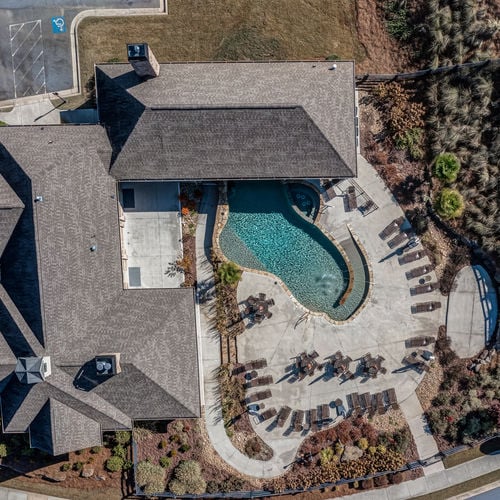
A resort-style pool is a standard feature in NW Metro Atlanta's active adult communities, and for buyers who use pools regularly, the relevant details go beyond the visual impression. Is the pool heated and seasonally extended — or is it only comfortable for four months of the year? Is there a lap lane for fitness swimming or is the pool configuration oriented entirely toward leisure? Is there an indoor pool option for year-round swimming regardless of weather? Is there aquatic fitness programming — water aerobics, aqua yoga — that uses the pool as more than a passive amenity?
For buyers who are not regular pool users, the pool's primary value is social: the pool deck and surrounding amenity space creates a gathering point during warm months that drives casual community connection. A well-designed pool area with comfortable seating, shade structures, and proximity to the clubhouse or an outdoor kitchen generates social activity that extends beyond the water. For these buyers, the atmosphere and design of the pool area matters more than its technical specifications.
6Low-Maintenance Living — The Amenity That Buyers Undervalue Until They Have It
When buyers are comparing amenity lists, low-maintenance living rarely generates the same enthusiasm as a new pickleball complex or a state-of-the-art fitness center. After moving in, it consistently ranks among the highest-satisfaction features of 55+ community life — sometimes the highest.
The HOA's maintenance scope varies significantly by community. Some 55+ communities include full exterior maintenance — lawn care, landscaping, exterior painting, roof and gutter maintenance — as part of the HOA fee structure, effectively eliminating the physical and logistical burden of home upkeep that many buyers have managed for decades. Others cover common area maintenance only, leaving individual homeowners responsible for their own lots and exterior. The distinction matters enormously for buyers whose motivation to move includes reducing the physical demands and time commitment of homeownership maintenance.
Before evaluating what an HOA fee costs, understand exactly what it covers. A $350 per month HOA fee that includes full exterior maintenance and lawn care may represent better value than a $175 fee that covers only common areas — particularly when the time, energy, and contractor cost of managing that maintenance independently is factored into the comparison.
7Location Relative to Healthcare, Errands, and Everyday Life
This is not an amenity in the traditional sense — it doesn't appear on a community feature list or in a sales brochure. But buyers who have lived in their 55+ community for several years consistently identify proximity to healthcare, grocery, dining, and everyday services as one of the most significant quality-of-life factors in their daily experience — and one they wish they had weighted more heavily during their search.
The practical question is whether the community's location allows residents to handle the full range of daily and weekly errands, medical appointments, and social outings without requiring extended highway driving. A community that is beautifully designed and amenity-rich but requires a 25-minute highway drive for a routine medical appointment or grocery run creates a friction in daily life that accumulates over time — particularly as residents age into their late 60s and 70s and driving becomes a more considered activity rather than an automatic one.
NW Metro Atlanta's healthcare infrastructure has expanded meaningfully in the Woodstock, Canton, and Acworth corridors over the past decade, with hospital campuses, specialist offices, and urgent care facilities that have reduced the drive-time burden for active adult residents in the region significantly. Communities within close proximity to this infrastructure — ideally accessible without highway driving — have a locational quality-of-life advantage that shows up in long-term resident satisfaction.
8Social Programming and Community Culture — What Can't Be Built Into a Floor Plan
The amenity that determines more about long-term satisfaction than any physical feature is the hardest to evaluate on a tour: the community's social culture. Two communities with identical amenity packages can deliver entirely different daily experiences depending on whether residents are genuinely engaged with each other and with the community's programming — or whether most people largely keep to themselves.
Community culture is built over time and is influenced by the HOA's investment in programming, the presence of social catalysts (residents who naturally organize and include others), and the community's design — whether it creates natural gathering opportunities or separates residents into isolated pockets. It is visible in small things: whether residents wave to each other on the trail, whether the clubhouse has a regular morning coffee crowd, whether there is a waiting list for interest clubs, whether new residents describe feeling welcomed within their first weeks.
The most useful thing a buyer can do to evaluate community culture is spend time in the community outside of a formal sales tour. Visit on a weekday morning and observe how the amenity spaces are being used. Ask to speak with current residents rather than the sales team. If the community hosts prospective buyer events, attend — the residents who volunteer to speak at those events are a reasonable proxy for the community's social core.
What Tends to Be Overrated
A few amenities that consistently appear on community feature lists but underdeliver relative to their prominence in marketing materials:
Golf courses. Unless golf is a genuine priority for both members of a household, a community's golf course is often an amenity that adds to HOA cost without proportional lifestyle benefit for non-golfers. Golf participation rates have been declining nationally for years, and the maintenance cost of a golf course is reflected in HOA fees regardless of whether residents use it. Buyers who are not golfers should evaluate whether a golf course community's fee structure makes sense for the lifestyle they're actually planning to live.
Demonstration kitchens and specialty hobby studios. These amenities photograph beautifully in marketing materials and suggest a rich, varied community life. In practice, utilization rates for specialty amenity spaces — pottery studios, woodworking shops, art rooms — vary significantly by community and are often concentrated among a small subset of residents. Before weighting these features heavily, ask how frequently the space is scheduled and what the typical participation looks like.
Putting greens and bocce courts. Pleasant to have, rarely a differentiating factor in daily satisfaction. These amenities tend to get heavy use in the first year after a community opens and lighter use as novelty wanes.
The Right Framework for the Decision
The most useful way to evaluate amenities in a 55+ community is to work backward from the life you intend to live — not the life that looks appealing in a brochure. If you walk every morning, the trail system matters more than the demonstration kitchen. If social connection is your primary motivation for moving, the activity calendar and community culture matter more than the number of pickleball courts. If eliminating maintenance burden is the goal, HOA coverage scope matters more than pool design.
The communities in NW Metro Atlanta that consistently produce the highest long-term resident satisfaction are not necessarily the ones with the most impressive amenity lists — they're the ones where the physical infrastructure and the social programming work together to support a genuinely active, connected, engaged daily life. Identifying which community delivers that combination for your specific priorities is exactly the kind of search I help 55+ buyers navigate every day.
Marna Friedman · 678-920-3099 · [email protected]
Check out this article next