
General Real Estate · NW Metro Atlanta
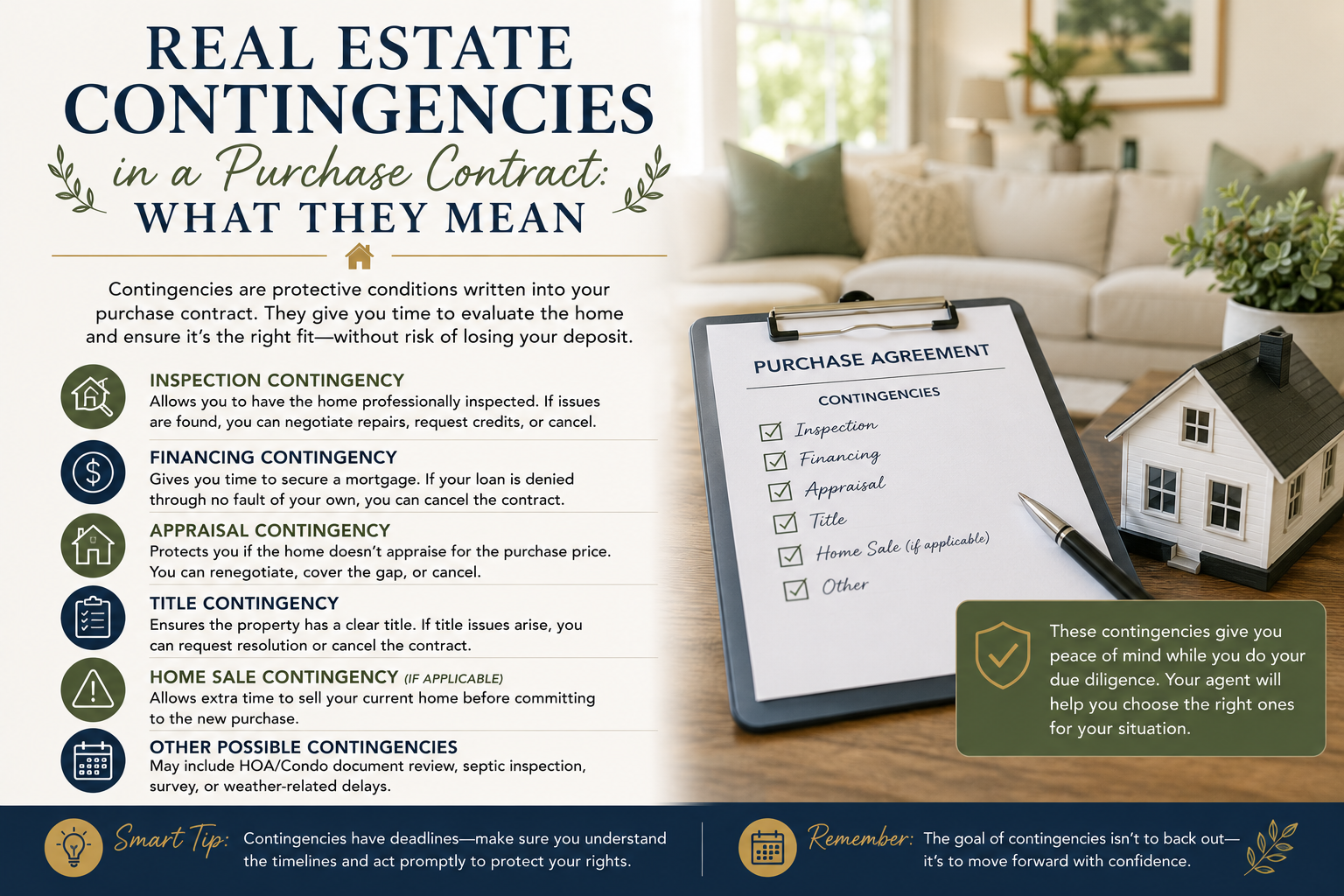
A contingency is a contract condition that must be satisfied for the sale to close, and it defines when a buyer can exit the deal with earnest money intact. In a Georgia purchase, the workhorses are the due diligence period, the financing contingency, the appraisal right, and, when needed, a home sale contingency, each with its own deadline, and each protecting against a specific way a purchase can go wrong.
Contingencies are where a purchase contract earns its keep, and where missed deadlines quietly cost buyers real money. Here is what each common contingency does, how Georgia handles them, and how to think about strengthening an offer without giving up the protection you actually need.
Key Takeaways
- Georgia's due diligence period is a negotiated window in which the buyer may terminate for essentially any reason and recover earnest money.
- A financing contingency protects you if the loan is denied despite good-faith effort; its deadline matters as much as its existence.
- The appraisal term decides what happens if value comes in under the contract price.
- Home sale contingencies link your purchase to your current home closing; useful, but a weaker offer in competition.
- Every contingency runs on dates. Calendar them the day you go binding, because missing one can convert protection into forfeiture.
"Georgia's contract framework rewards buyers who understand their windows. In competitive Cobb and Cherokee segments along the I-75 and I-575 corridors, knowing exactly what due diligence protects, and when it ends, is the difference between confidence and hope."
Marna Friedman, REALTOR®, Atlanta Communities
What does the due diligence period cover in Georgia?
Georgia's standard approach gives the buyer a negotiated due diligence period, commonly around one to two weeks, during which the buyer can terminate for nearly any reason and keep the earnest money. This window is when inspections happen, quotes get gathered, HOA documents get read, and the neighborhood gets driven at rush hour. It is intentionally broad: rather than itemizing permissible objections, Georgia's common structure simply gives you the days and lets you decide.
Two practical points. First, the period is negotiable in both length and existence; shortening it strengthens an offer, and waiving it removes your inspection safety net entirely, a trade to make knowingly or not at all. Second, requests for repairs or credits typically happen inside this window, through an amendment, because your leverage largely ends when it does. My guides to home inspections and earnest money cover the machinery underneath.
How does the financing contingency protect you?
A financing contingency makes the purchase conditional on obtaining the loan described in the contract, loan type, amount, and rate parameters, within a stated period. If you apply promptly, cooperate with underwriting, and the loan is still denied, the contingency lets you terminate and recover earnest money. It protects against the genuine risk that something changes between contract and closing: an employment surprise, an underwriting condition that cannot be met, a property issue the lender will not accept.
It does not protect a buyer who never applied, ignored document requests, or changed the loan mid-stream, which is why the details matter: apply within the contract's required days, respond to your lender fast, and change nothing about your finances until closing. A strong pre-approval before you shop makes this contingency a formality in most transactions rather than a drama.
What do the main contingencies protect against?
| Contingency | Protects against | Typical mechanics | If unmet |
|---|---|---|---|
| Due diligence period | Condition surprises, second thoughts, anything | Negotiated days; buyer may terminate for any reason | Buyer exits with earnest money |
| Financing | Loan denial despite good-faith effort | Stated loan terms and deadline; prompt application required | Buyer terminates per its terms, recovers earnest money |
| Appraisal | Value below contract price | Right to renegotiate or exit if value falls short | Renegotiate, buyer covers gap, or terminate |
| Home sale | Owning two homes at once | Purchase conditioned on buyer's current home closing | Contract unwinds per its terms |
| Title | Defects in ownership or liens | Seller must convey marketable title; attorney examines | Cure period, then buyer remedies |
How does the appraisal contingency actually work?
When a lender's appraisal values the home below the contract price, the appraisal term decides what happens: typically the buyer may ask the seller to reduce, negotiate a middle number, pay the difference in cash, or terminate if the contract grants that right and no agreement is reached. I walked through the resolution paths in the home appraisal process explained.
In competitive moments, buyers sometimes limit this protection, agreeing to cover a gap up to a stated amount, or waiving the right entirely. Partial gap coverage with a cap is often the sane middle: it strengthens the offer while defining your worst case in dollars you chose in advance. Full waiver means committing to the contract price regardless of value, which should only ever be done with cash reserves that make it survivable.
How should you handle contingency deadlines?
- Calendar every date the day you go binding: due diligence end, financing application and contingency deadlines, appraisal timing, and closing.
- Front-load the work. Book inspections for the first days of due diligence, not the last, so findings leave time to negotiate.
- Amend rather than assume. If a deadline needs to move, extend it in a signed amendment before it passes; verbal grace does not exist in a dispute.
- Terminate correctly if you terminate. Each contingency has a notice mechanism; earnest money follows the paperwork, not the intention.
- Read your specific contract. Georgia's commonly used forms evolve, and negotiated terms override every generalization in this article.
What other contingencies and conditions show up in Georgia contracts?
Beyond the headliners, several quieter provisions appear often enough to know on sight. Community association documents matter in HOA and condominium purchases: buyers commonly negotiate for delivery and review of covenants, budgets, and fees, so the rules you are marrying arrive before the commitment is final rather than after. Insurance deserves the same early attention, confirming during due diligence that the property is insurable at a premium you accept, since surprises there are far better discovered in week one than at the closing table.
Georgia transactions also traditionally involve a termite letter, an official wood-infestation report, most commonly handled around closing, and lenders may require one; who orders and pays is a contract detail worth settling at offer time. Surveys are optional but wise on acreage, older parcels, or anywhere boundaries and encroachments could surprise; when a survey matters to you, make it a due diligence task with the days to act on what it finds. Lease-back and possession terms, while not contingencies strictly, ride alongside them: if the seller stays past closing, the written terms, duration, payment, insurance, condition, deserve the same care as any protection clause.
The practical takeaway is not to stack every possible clause into every offer. It is to know the menu, choose the protections your situation genuinely needs, and write them with real deadlines you then keep, because in Georgia practice, the contingency you negotiated carefully and calendared faithfully is the one that actually protects you.
When in doubt about any clause, ask before signing rather than after; that ten-minute conversation with your agent or attorney is the cheapest protection in the entire transaction, and no reasonable professional on either side will ever begrudge you for having it.
Frequently Asked Questions
What is the most important contingency for a buyer?
In Georgia, the due diligence period, because it is the broadest: it covers inspection findings and nearly everything else during its window. Financing and appraisal terms carry the protection from there to closing.
Can a seller reject an offer because of contingencies?
Sellers weigh contingencies as risk. More contingencies and longer periods mean more ways the deal can die, so competitive offers often shorten or focus them. That is a strategy decision to make deliberately with your agent.
What happens to earnest money if a contingency fails?
If the buyer terminates properly under a valid contingency before its deadline, earnest money is returned. Terminate late or outside the contingency's terms, and the money is at risk.
Is a home sale contingency a bad idea?
It is a useful protection with a competitive cost. In multiple-offer situations it weakens you; in balanced conditions many sellers accept it. Alternatives include selling first or bridge financing.
Do new construction contracts have the same contingencies?
Builder contracts are builder-written and differ meaningfully from resale forms, especially on deposits and timelines. Review them with your own agent before signing; see my new construction resources for specifics.
Can contingencies be added after the contract is signed?
Only by written amendment that both parties sign. Practically, protections are negotiated at offer time; afterward you are asking the other side for a favor.
Contingencies are the difference between an offer and a well-built offer, and the right structure depends on the market you are competing in that week. If you are preparing to buy anywhere in NW Metro Atlanta, start with my buyer resources, then reach out and we will build your offer strategy together.
Marna Friedman is a REALTOR® with Atlanta Communities serving NW Metro Atlanta. Contract forms and terms vary and change; this article is general information, not legal advice. Consult a Georgia real estate attorney for advice on your contract. Equal Housing Opportunity.
Check out this article next