55+ Active Adult · NW Metro Atlanta
A move to a 55+ community is rarely just a transaction; it is usually two transactions, the sale of a longtime home and the purchase into a community with its own rules, wrapped around a life transition with financial, legal, and emotional layers. Serving that move well takes more than general sales skill: it takes specific education in how these transitions work, real experience inside the communities themselves, and the judgment to bring in the right professionals, attorneys, tax advisors, move specialists, at the right moments. This post is about what that expertise actually looks like, so you know what to ask of anyone you hire for this move, including me.
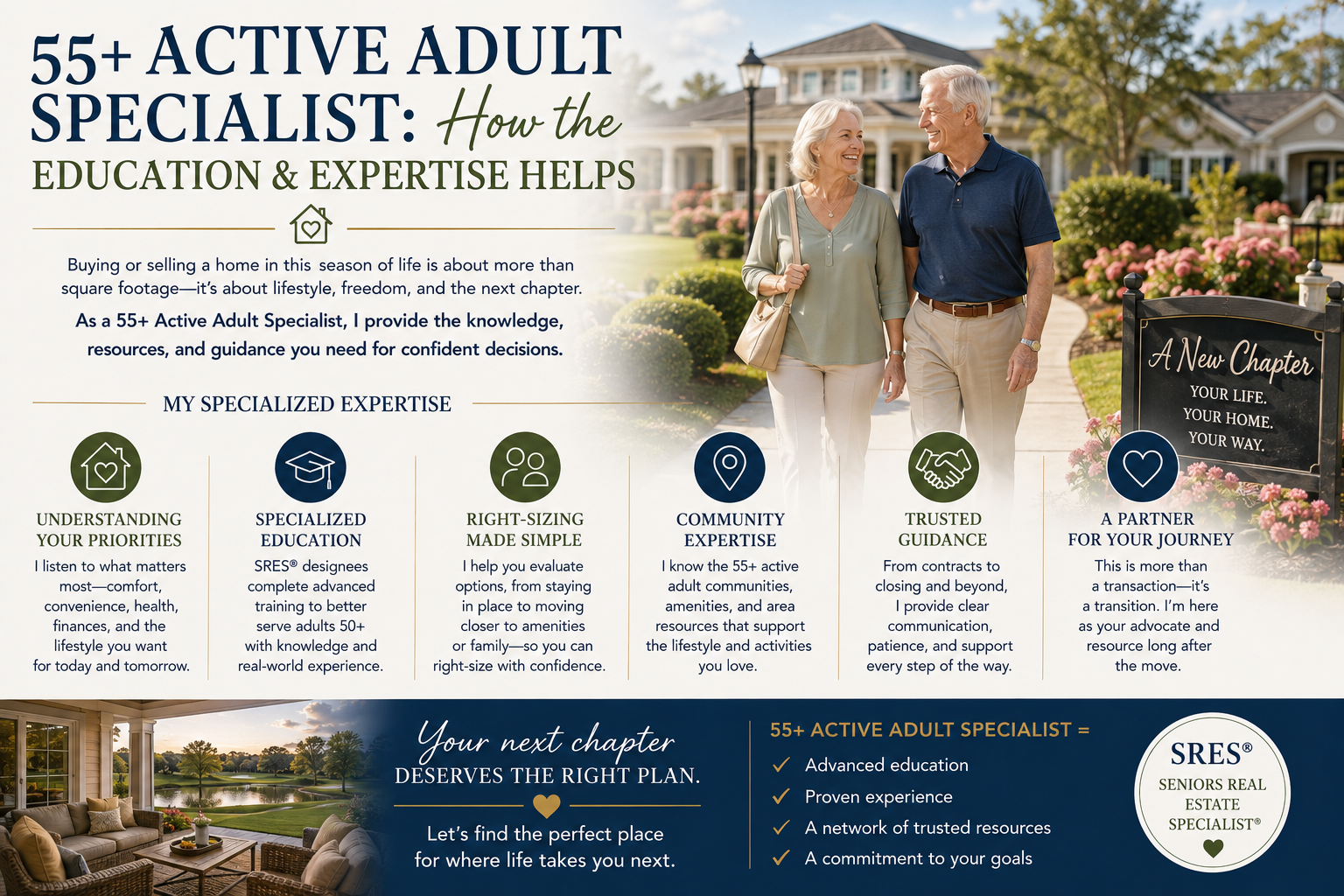
My own preparation for this work combines formal education and years of practice. I completed the Seniors Real Estate Specialist coursework, the national training program focused on later-life moves and the issues that surround them, and I have built on that foundation with continuing education and, more importantly, with the accumulated experience of guiding clients through these transitions across NW Metro Atlanta's 55+ communities. Here is what that training and experience cover, and why each piece matters to your move.
Key Takeaways
- Moves involving a longtime home and a 55+ community purchase carry layers a standard transaction does not: linked timing, decades of belongings, community rules, and coordination among everyone involved.
- Formal transition-focused education exists for agents, covering housing options, financing considerations, and the professional-team model these moves rely on.
- Community-specific knowledge, HOPA status, dues scope, governance health, matters as much as transaction skill.
- The professional-team approach is the hallmark: a well-prepared agent coordinates with your attorney, tax advisor, and move professionals rather than working around them.
- Whoever you hire, interview for this expertise specifically; the questions in this post show you how.
"The best compliment I get in this work is that nobody felt rushed. A move out of a longtime home near Kennesaw Mountain or downtown Woodstock deserves a timeline built around the person, not the transaction."
Marna Friedman, REALTOR®, Atlanta Communities
Why do these moves reward specialized preparation?
Count the moving parts. There is usually a longtime home to sell, often mortgage-free, often holding decades of belongings and memories, whose preparation and pricing carry both financial and emotional weight. There is a purchase into a community governed by recorded covenants, an association budget, and, in legally age-restricted communities, occupancy rules under the Housing for Older Persons Act that deserve verification in writing. There is timing: most of these moves link the sale and the purchase, and the sequencing decision, sell first, buy first, or bridge the two, shapes everything, the full analysis I laid out in selling your home to move to a 55+ community. And there are people: spouses aligning on the decision, adult loved ones helping from near or far, and advisors whose input genuinely matters.
A general transaction touches a few of those layers. This move touches all of them at once, which is why experience with the specific pattern, not just with buying and selling generally, changes the client's experience. An agent who has run this play many times anticipates the sequence, knows where the friction points live, and has answers ready before the questions get stressful.
What does transition-focused education cover?
The formal coursework in this specialty, the Seniors Real Estate Specialist program is the best-known national example, trains agents on the landscape of later-life housing decisions: the spectrum of options from staying put through 55+ communities to supportive settings, and how to help clients think through fit rather than pushing a transaction. It covers the financial dimension at the awareness level an agent should hold: how retirement-stage finances, pensions, and housing wealth interact with a move, what financing tools exist, and, critically, where the agent's role ends and the licensed advisor's begins. It covers HOPA and Fair Housing, the legal framework that makes age-restricted communities possible and defines how they must operate. And it teaches the professional-team model: these moves go best when the agent works alongside attorneys, tax professionals, financial advisors, and move-management specialists rather than improvising across their territory.
Education like that is a floor, not the finish. What builds on it is repetition: touring the same communities across years, reading dozens of association budgets, watching how different sequencing choices play out, and learning which local professionals actually deliver. When you interview any agent for this move, you are really interviewing for both layers, the training and the mileage.
What does that expertise look like in practice?
| Stage of the move | What specialized help adds |
|---|---|
| Deciding and planning | A no-pressure timeline built around your life, with the sequencing decision made deliberately |
| Choosing a community | Verified HOPA status, dues and budget analysis, governance health checks, honest comparisons across communities |
| Preparing the longtime home | A prioritized prep plan, vendor coordination, and pacing that respects what clearing a long-held home involves |
| The linked transactions | Contract terms that protect the timing, and steady management of two closings that depend on each other |
| The professional team | Introductions to attorneys, tax advisors, and move specialists at the right moments, with the agent coordinating, not substituting |
| Settling in | Community registration, local orientation, and a resource who still answers the phone after closing |
Two of those rows deserve emphasis. Community analysis is where local mileage shows most: knowing which NW Metro Atlanta communities are legally age-restricted versus age-targeted, what each association's dues actually cover, and where each community sits in its developer-transition arc, the subjects of my guides to what 55+ dues cover and comparing communities. And the team row is the philosophical one: an agent prepared for this work is eager to have your attorney and tax advisor involved, because the move goes better with them in it.
How should you interview an agent for this move?
- Ask about training and experience with this specific pattern. What education have they completed on later-life moves? How many linked sale-and-purchase transitions into 55+ communities have they handled recently, and in which communities?
- Test their community knowledge. Ask how they verify a community's age-restriction status, what they look for in an association budget, and how they would compare two communities you name. Specific answers reveal real familiarity; brochure language reveals its absence.
- Ask how they handle the timing problem. A prepared agent can walk you through sell-first, buy-first, and bridge approaches with the trade-offs of each for your situation, not a one-size answer.
- Ask who is on their professional bench. Attorneys, tax professionals, move managers, estate-sale and clearing services: the answer shows whether they actually run the team model.
- Notice the pace of the conversation. The right help for this move never rushes the deciding. If you feel pushed toward a listing agreement before your questions are answered, that is your answer.
These questions have a second purpose: they set the standard I hold myself to. My preparation for this work, the coursework, the continuing education, and years of these transitions across Cherokee, Cobb, and Paulding counties, exists so that my answers to every one of them are specific, current, and comfortable under scrutiny.
Where does the agent's role end?
An honest specialist is precise about boundaries, because these moves genuinely require licensed advice an agent must not give. Tax questions, capital gains treatment on a longtime home, exemptions, the interaction of a sale with retirement finances, belong to your tax professional. Legal questions, titling, trusts and estate considerations, powers of attorney, reviewing community covenants where stakes warrant it, belong to your attorney. Financial strategy belongs to your financial advisor. The agent's proper role is transaction expertise, community knowledge, and coordination: knowing when each professional should enter, making the introductions if you need them, and keeping the timeline organized so their work and the move's work mesh. The team model is not a disclaimer; it is the method, and it is what the best version of this help looks like.
It also extends to the people around you. Many of these moves involve adult loved ones helping from nearby or across the country, and good practice includes them at whatever level you choose, clear updates, video walkthroughs for the distant, and patience with those conversations, while never forgetting whose move it is. Your decisions drive everything; everyone else, including your agent, is support.
Frequently Asked Questions
Do I need a specialist agent for a move to a 55+ community?
You need an agent with real experience in these specific moves: linked transactions, community verification, and transition pacing. Formal training helps; demonstrated recent experience in the communities you are considering matters most.
What training exists for agents in this specialty?
National coursework such as the Seniors Real Estate Specialist program covers later-life housing options, financing awareness, HOPA and Fair Housing, and the professional-team approach. Ask any agent what education they have completed and how they have applied it.
What questions reveal whether an agent knows 55+ communities?
Ask how they verify age-restriction status, what they read in an association budget, and how two specific communities compare. Specific, current answers are the tell.
Can a real estate agent advise on taxes or legal issues in these moves?
No, and a well-prepared one is clear about it: those questions belong to your tax professional and attorney. The agent's role is coordinating the move so their advice and the transactions mesh.
How early should I involve an agent in a possible move?
Earlier than you might think, and without obligation: an early conversation shapes the timeline, the preparation plan for your current home, and the community research, even if the move is a year or more away.
What if my move involves helping from adult loved ones far away?
Good practice includes them at the level you choose: clear updates, video tours for the distant, and organized documents. The decisions remain yours; the communication keeps everyone confident in them.
The right help for this move combines education, local mileage, and a team approach, and you are entitled to interview for all three. If a 55+ community anywhere in NW Metro Atlanta is in your thinking, start with my 55+ active adult guide and touring questions, then reach out, and bring every question in this post with you.
Marna Friedman is a REALTOR® with Atlanta Communities serving NW Metro Atlanta. Real estate agents do not provide legal, tax, or financial advice; consult qualified professionals for those matters. Age-restricted communities operate under the Housing for Older Persons Act; verify each community's current status. Information is deemed reliable but not guaranteed. Equal Housing Opportunity.
Check out this article next