New Construction · NW Metro Atlanta
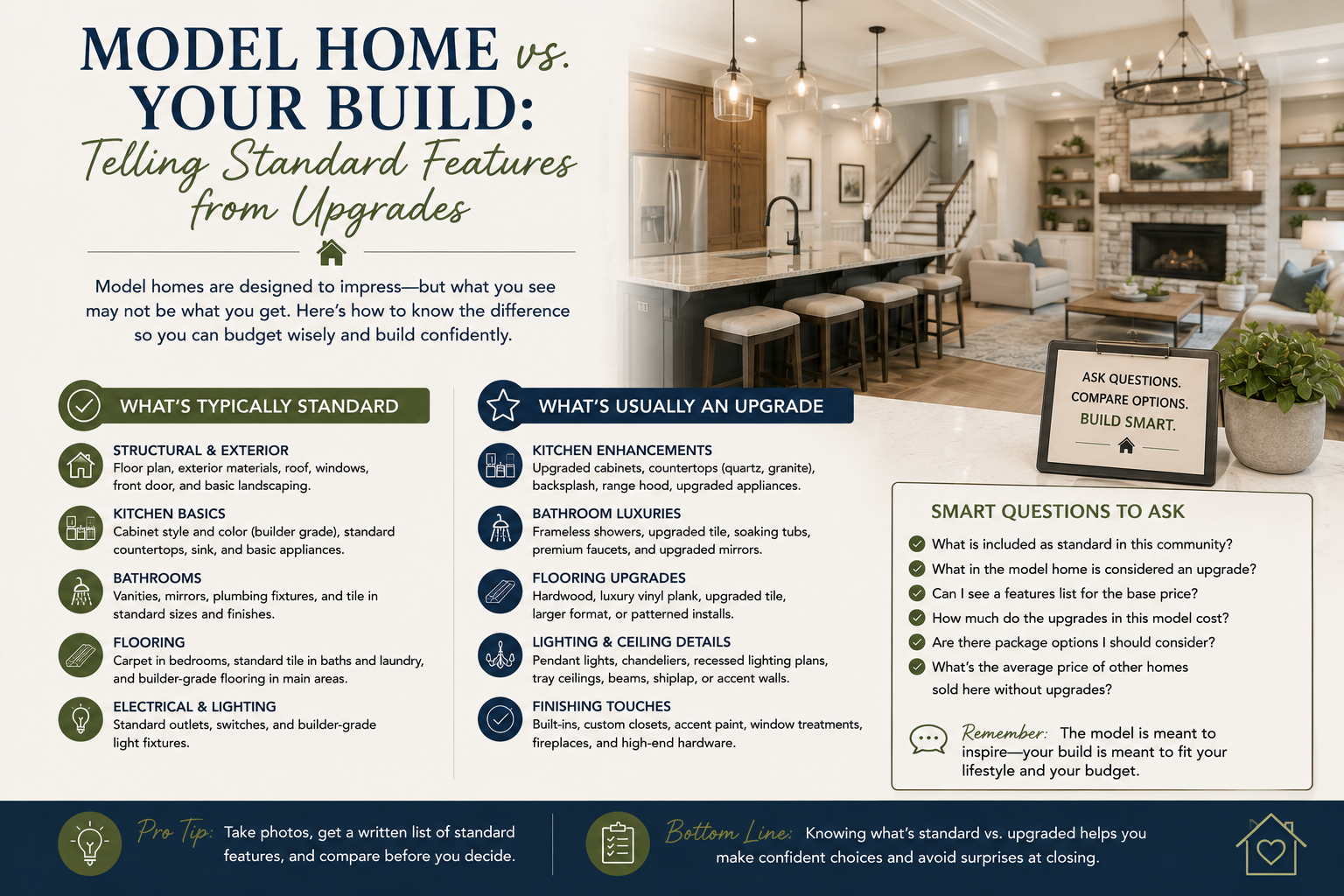
A model home is a marketing tool, and almost every model you tour blends the plan's standard features with optional upgrades, sometimes tens of thousands of dollars' worth, without labeling which is which. The way to protect your budget is simple and unglamorous: ask for the standard features list in writing, walk the model with it in hand, and price the gap between what you are seeing and what the advertised number actually buys.
I walk model homes with buyers across Cobb, Cherokee, and Paulding counties every month, and the single most common new construction surprise is not a construction issue at all. It is the moment a buyer learns that the kitchen they fell for in the model costs a five-figure sum beyond the price on the sign. Here is how to tour models with clear eyes, what to ask, and how to decide which upgrades belong in the contract and which can wait.
Key Takeaways
- Models are intentionally upgraded; the advertised base price rarely matches the home you are standing in.
- Request the written standard features list before touring, and walk the model against it item by item.
- Structural options (extra rooms, extended footprints, covered porches) can only happen at build time; finishes can often wait.
- Ask how upgrade pricing works at the design center and whether allowances or incentive credits apply.
- Bring your own agent from the first visit; comparing what is standard across builders is exactly the kind of work representation exists for.
"Model homes along the I-575 corridor and around Dallas are the best-dressed version of every plan. I walk clients through with the included-features sheet because the sheet, not the staging, is what you are buying."
Marna Friedman, REALTOR®, Atlanta Communities
Why do model homes show upgrades at all?
Because models sell the plan at its best, and builders are transparent about that when asked directly. The model's job is to help you imagine living there, so it typically carries upgraded cabinetry and countertops, higher-tier flooring, the optional trim package, designer lighting, the extended patio, and frequently structural options like a sunroom, a third-car garage, or the primary suite's optional layout. Professional decorating, furniture scaled to flatter the rooms, and landscaping beyond the standard package complete the effect.
None of this is deceptive by itself; it becomes a budget problem only when buyers assume the sign price buys the room they are standing in. Reputable sales teams will tell you what is upgraded when asked, and many communities now tag some upgraded features with small placards. Your job is to ask about everything else, and to get the answer in writing rather than in a walking conversation you cannot re-check later. The broader process context is in my guide to how buying new construction works.
How do you find out what actually comes standard?
Ask the sales office for the standard features sheet, sometimes called the included features list, for the specific plan and phase you are considering. This document exists at virtually every community, and it answers the question room by room: which countertop material is standard, which flooring goes where, what the standard appliance package includes, which fixtures, what the exterior includes, and what the lot's standard landscaping and irrigation cover.
Then walk the model with that sheet in hand and interrogate the differences. Useful questions, drawn from my longer list of questions to ask a builder, include: Is this kitchen layout standard or an option? Which of these cabinets, counters, and appliances match the standard sheet? Is this flooring the included product or an upgrade, and in which rooms? Is this trim, ceiling treatment, and lighting standard? Which structural options does this model include, and what does each cost on my lot? What did the total option load on this model cost over base?
That last question is the honest one, and good sales teams will answer it. Hearing that the model carries a substantial sum in options over base is not a reason to walk away. It is the number that turns the model from a promise into a menu.
Which upgrades must happen at build time, and which can wait?
| Category | Examples | Build now or later? |
|---|---|---|
| Structural | Additional bedroom or bath, extended footprint, covered porch, third-car garage, basement options, taller ceilings | Build time only; impossible or far costlier later |
| Behind the walls | Extra outlets and circuits, plumbing rough-ins, low-voltage wiring, insulation upgrades | Build time; cheap now, disruptive later |
| Hard finishes | Cabinets, countertops, tile, built-ins | Usually build time; replacing later means demolition |
| Soft finishes | Light fixtures, mirrors, hardware, paint colors | Easily done later, often for less |
| Outdoor living | Patios, decks, landscaping beyond standard, fencing | Later works; compare builder pricing against local contractors |
| Appliances | Range, refrigerator, washer and dryer tiers | Either; retail buying is often competitive |
The rule underneath the table: spend contract dollars on what only the builder can do, structure, systems, and anything inside the walls, and stay flexible on what any contractor or retailer can do after closing. A window seat framed at build time costs a fraction of adding one later; a light fixture costs the same either way and often less at retail.
How does the design center visit actually work?
Most builders separate the purchase into two events: the contract, which locks the plan, lot, and structural options, and the design center appointment, where finish selections happen, usually within a few weeks of signing. Three things to know going in. First, structural decisions typically must be final at or shortly after contract, because they drive the permit and the slab; the design center is mostly finishes. Second, design centers price line by line, and the session moves fast; arrive with your priority list already ranked, because decision fatigue after a hundred selections is real and expensive. Third, ask in advance for the option price book or at least the pricing of your likely selections, so the appointment confirms a budget rather than discovers one.
Ask, too, how incentives interact with options. Builders frequently offer credits toward design center spending or closing costs, and the structure matters: a credit usable only at the design center changes the later-versus-now math on finishes. My guide to builder financing and incentives covers how those packages tie together.
How do you keep the total budget honest?
Set the number before you tour, not after. Decide the total you will spend, base price plus options plus the lot premium many communities charge for specific homesites, and hold structural options against that ceiling first, because they are the ones you cannot add later. A practical sequence: rank every want as structural, behind-the-walls, or finish; price the structural list at contract; protect a reserve for the design center; and let soft finishes fall to after closing whenever the budget tightens. Buyers who follow that order almost never regret the outcome; buyers who select in the order the tour presents things frequently do.
And bring your own representation from the first model visit. The on-site agent works for the builder, knowledgeably and often helpfully, but their job is not to compare this builder's standard sheet against the community down the road, or to tell you which options resell well in this market and which are personal taste. That is my job, at no cost disadvantage to you, as I explain in the value of your own agent in new construction.
Frequently Asked Questions
Is the model home's price the same as the advertised base price?
Almost never. The advertised number is typically the plan's base price, while the model includes structural options, upgraded finishes, and decorating. Ask what the model's total option load adds over base.
Can you buy the model home itself?
Often yes, near community close-out, sometimes with a leaseback while the builder finishes selling. Model sales include the upgrades but come with heavy foot-traffic wear; negotiate and inspect accordingly.
What upgrades hold value best at resale?
Structural space and layout options, kitchen and bath quality, and anything buyers expect to see at the home's price tier. Highly personal finishes return less; neutral, durable selections travel best across tastes.
Do I have to use the builder's design center?
For selections built into the home, yes; the builder installs what its program offers. Items like window treatments, closet systems, and light fixtures can usually be handled after closing by anyone you choose.
Are design center prices negotiable?
Line-item pricing is usually fixed, but the total picture is negotiable: builders often offer design center credits as incentives, especially on inventory homes or at phase milestones. Negotiate the credit, then spend it deliberately.
How do I compare builders fairly?
Compare standard features lists side by side, not model against model. Two similar base prices can hide very different included packages, and the sheet, not the tour, is where the difference shows.
A model home is a wonderful thing to tour and a risky thing to assume. Bring the standard sheet, ask the option-load question, and the model becomes exactly what it should be: a well-lit menu. If you are shopping new construction anywhere in NW Metro Atlanta, start with my new construction page, then reach out and I will walk the models with you, list in hand.
Marna Friedman is a REALTOR® with Atlanta Communities serving NW Metro Atlanta. Standard features, option pricing, incentives, and availability vary by builder, community, and phase and change without notice; confirm current details in writing with the builder. Information is deemed reliable but not guaranteed. Equal Housing Opportunity.
Check out this article next