New Construction · NW Metro Atlanta
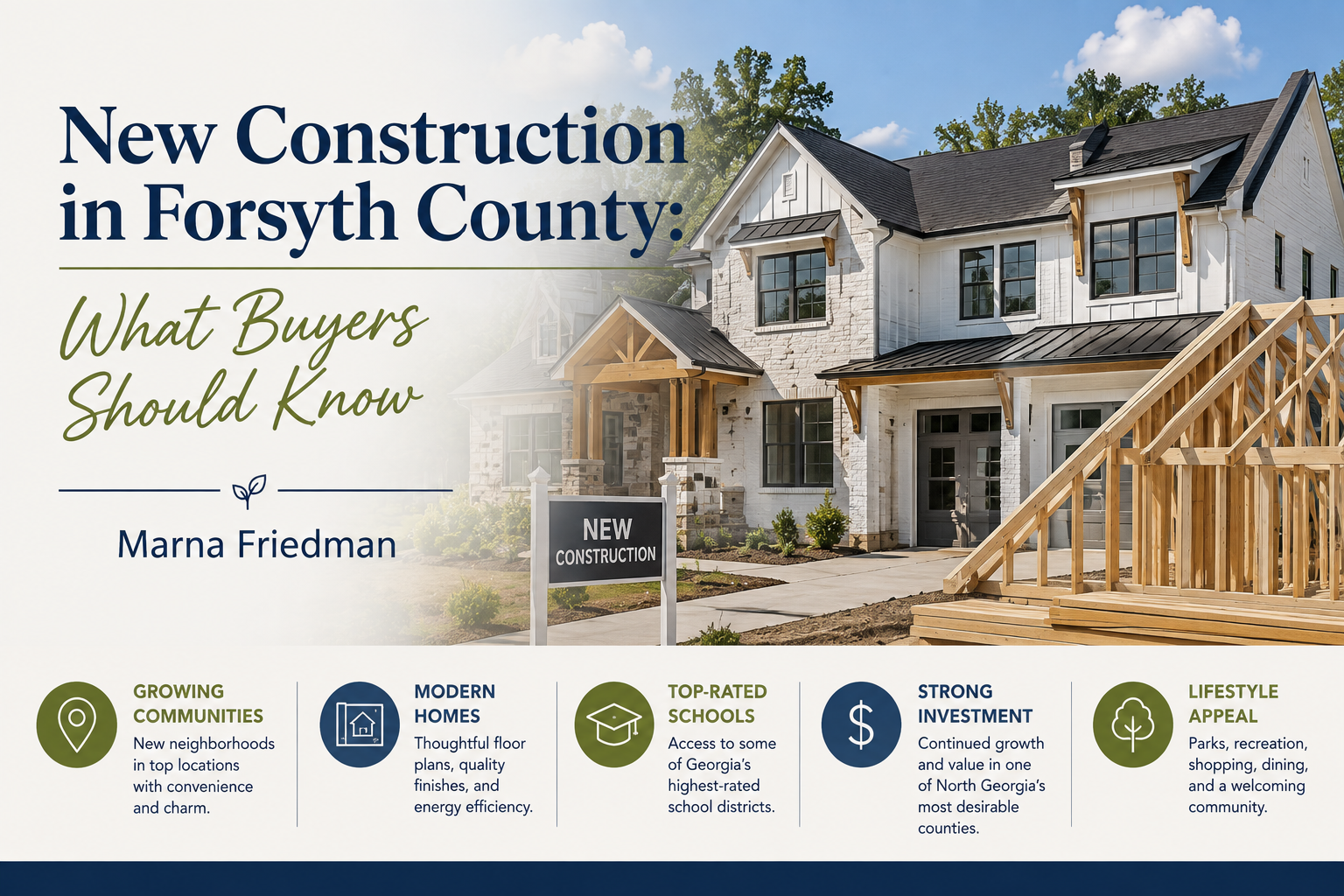
New construction in Forsyth County follows the GA-400 corridor and the roads feeding into Cumming, and it runs the full range from production subdivisions to smaller custom-oriented enclaves. Two decisions shape everything else for a buyer here: whether you purchase a to-be-built home or a quick move-in, and whether you bring your own representation to the builder's sales office. Forsyth sits at the eastern edge of the area I work across Cobb, Cherokee, Forsyth, and North Fulton counties, and while the mechanics match what you would see in Canton or Kennesaw, the inventory mix and the pace are their own.
What follows is a practical look at how buying new works in Forsyth: the product types, the contract questions, the timeline, and where buyers most often get caught off guard.
Key Takeaways
- Most Forsyth new construction sits along GA-400 and the corridors running west and north out of Cumming.
- To-be-built gives you selections and a longer wait; quick move-in gives you a date and fewer choices.
- Builder contracts are written by the builder's attorneys and differ substantially from the standard resale contract.
- Register your own agent on your first visit to a sales office, before you tour or sign anything.
- Order an independent inspection even on a brand-new home, and do it before the final walkthrough.
"A builder's sales agent is good at their job, and their job is representing the builder. Registering your and attending with your own agent on that first visit is the simplest protection a new construction buyer has, and it has to happen before you walk the model, not after."
Marna Friedman, REALTOR®, Atlanta Communities
Where is new construction happening in Forsyth County?
Building activity in Forsyth clusters around access. GA-400 is the spine, and the communities that fill fastest tend to sit within a reasonable drive of an interchange, because commuting patterns here run south toward North Fulton and the Perimeter. Around Cumming, you will find newer subdivisions off GA-20, GA-9, GA-141, Bethelview Road, and Post Road, with the western side of the county pushing toward the Cherokee County line.
The county has been steadily adding the things that make a location hold interest over time: the Big Creek Greenway extension through Forsyth, the trail network at Sawnee Mountain Preserve, the Cumming City Center district, and the shopping and dining along GA-400. Lake Lanier sits along the county's eastern and northern edges. Those are durable anchors, and they matter more for long-term value than any single builder's amenity package.
Product varies widely by pocket. Some communities are large-scale production neighborhoods with a handful of floor plans repeated across hundreds of homesites. Others are small infill projects with a dozen homes. A few build on larger acreage with more custom latitude. If you are comparing across counties, my new construction guide covers how the process works generally, and my area pages give the geographic context for each market I serve.
To-be-built or quick move-in: which fits your situation?
This is the first real fork in the road, and it usually comes down to how much control you want versus how firm a move date you need. Neither is better; they solve different problems.
| Factor | To-be-built | Quick move-in |
|---|---|---|
| Timeline | Several months to over a year | Weeks to a few months |
| Selections | Full design center process | Already chosen by the builder |
| Homesite choice | Wider selection early in a phase | Limited to what is standing |
| Price certainty | Upgrades can move the number | Priced as it stands |
| Incentives | Often tied to the design center | Often tied to closing timing |
| Best when | Your timing is flexible | You have a lease or closing date |
Buyers with a home to sell often lean toward quick move-in inventory for the date certainty, then find the finishes were selected for broad appeal rather than personal taste. Buyers who go to-be-built get the selections they want and then live through a moving target on completion. Knowing which trade-off you can tolerate saves a lot of second-guessing.
What should you ask before you sign a builder contract?
The builder's purchase agreement is not the standard Georgia resale contract you may have used before. It was drafted by the builder's counsel, it favors the builder, and many of its terms are presented as fixed. Some genuinely are. Others are worth a conversation. Ask these before you sign:
- What is the completion language? Look for how the estimated completion date is described, what happens if it slips, and whether you have any remedy.
- How is earnest money handled? Builder deposits are frequently larger than resale deposits and the conditions for return are narrower.
- Are design center selections refundable? Upgrade money is often non-refundable once ordered, even if the contract terminates.
- What is included at base price? Get the standard features sheet in writing and compare it against what you saw in the model.
- Can I use my own lender? You usually can, though incentives may be tied to the builder's affiliated lender.
- What are the inspection rights? Confirm you may bring your own inspector and at which stages.
- What does the warranty actually cover? Ask for the warranty document itself, not a summary.
My list of questions to ask a builder goes deeper on each of these, and common builder blunders covers the mistakes I see repeat.
Why does representation matter on a builder's sales floor?
The person at the desk in the model home works for the builder. That is not a criticism; it is the arrangement, and good sales agents are transparent about it. The consequence is that no one in that room is reviewing the contract from your side, tracking your contingencies, or telling you which upgrades tend to disappoint at resale.
The mechanical part matters most: most builders require your agent to be present or registered at your first visit for representation to apply. Walk in alone, tour, and give your information, and you may have limited your options before you understood the process. That single step is the difference between having an advocate through construction and handling it yourself.
Beyond the paperwork, an agent who works new construction regularly knows which questions produce useful answers, how to read a standard features sheet against a decorated model, and when to push on a punch list. My page on the value of an agent on a new construction purchase lays out where that shows up in practice.
What should you evaluate about the community itself?
A model home is designed to sell. The community around it is what you actually live in, and it deserves the harder look:
- Build-out stage: ask how many phases remain. Living beside active construction for two more years is a real condition, not a detail.
- Homesite specifics: grade, drainage, tree buffer, what backs to the rear line, and what is platted for the lot behind you.
- HOA structure: who controls the board during build-out, what dues cover, and when control transfers to residents.
- Amenity delivery: confirm in writing when planned amenities are scheduled to be built, not just that they are planned.
- Access and commute: drive the route to work at the hour you would actually drive it, in both directions.
- Resale mix: a community of nearly identical plans competes with itself when several owners list at once.
Georgia's red clay makes drainage worth specific attention on a sloped homesite. Ask how the lot was graded, where water is directed, and what the builder's grading warranty says. It is a common source of after-closing frustration.
How does the build timeline usually run?
Timelines vary by builder, plan, and permitting load, so treat any date as an estimate until the home is framed and inspected. The sequence, though, is consistent: contract and deposit, design center selections, permitting, site work and foundation, framing, mechanical rough-in, insulation and drywall, interior finishes, exterior and landscaping, municipal inspections, builder quality walk, your independent inspection, pre-closing walkthrough, then closing.
Two points inside that sequence deserve your attention. The pre-drywall walk is your one chance to see the structure, framing, and mechanical runs before they disappear behind sheetrock; bring your inspector. The final walkthrough is where the punch list gets built, and anything you accept verbally without writing down tends to evaporate. My new construction punch list gives you a working checklist for that walk, and how buying new construction works maps the full sequence.
Frequently Asked Questions
Is the price of a new construction home negotiable in Forsyth County?
Base price is usually the least flexible number, because builders protect the comparable sales they report on future homes. Incentives are where movement typically happens: closing cost contributions, design center allowances, or included upgrades. What is available changes by community and by the builder's inventory position at that moment.
Do I still need a home inspection on a brand-new home?
Yes. Municipal inspections confirm code compliance; they are not a quality review on your behalf. An independent inspector working for you will find items that code inspections do not cover. Schedule one at pre-drywall and again before closing.
Do new construction homes in Georgia come with a warranty?
Most production builders provide a written limited warranty, commonly layered with shorter coverage for workmanship and finishes, longer coverage for major systems, and the longest term for structural items. Terms differ significantly between builders. Read the actual warranty document before you sign the contract, not after closing.
Can I use my own lender instead of the builder's?
In most cases yes, though builder incentives are frequently tied to using their affiliated lender. Run both options side by side on total cost rather than on the incentive alone. My guide to builder lender versus your own lender walks through the comparison.
What happens if the home is not finished on time?
That depends entirely on your contract language, which is why it is worth reading closely before signing. Many builder agreements give the builder wide latitude on completion dates with limited remedies for the buyer. Build flexibility into your own plans, and avoid scheduling a lease end or a closing on a home you are selling too tightly against an estimated completion date.
Thinking about a new build in Forsyth County?
Forsyth has real depth in new construction, and the difference between a smooth purchase and a frustrating one usually traces back to the first visit and the contract review. I represent buyers through the whole build. Start with my new construction guide, browse current listings, or reach out before you tour your first model.
Marna Friedman is a licensed REALTOR® with Atlanta Communities Real Estate Brokerage serving NW Metro Atlanta. Builder terms, incentives, warranties, and community plans change; verify current details directly with each builder. This article is general guidance, not legal advice; consult a qualified attorney regarding your contract. Information is deemed reliable but not guaranteed. Equal Housing Opportunity.
Check out this article next