New Construction · NW Metro Atlanta
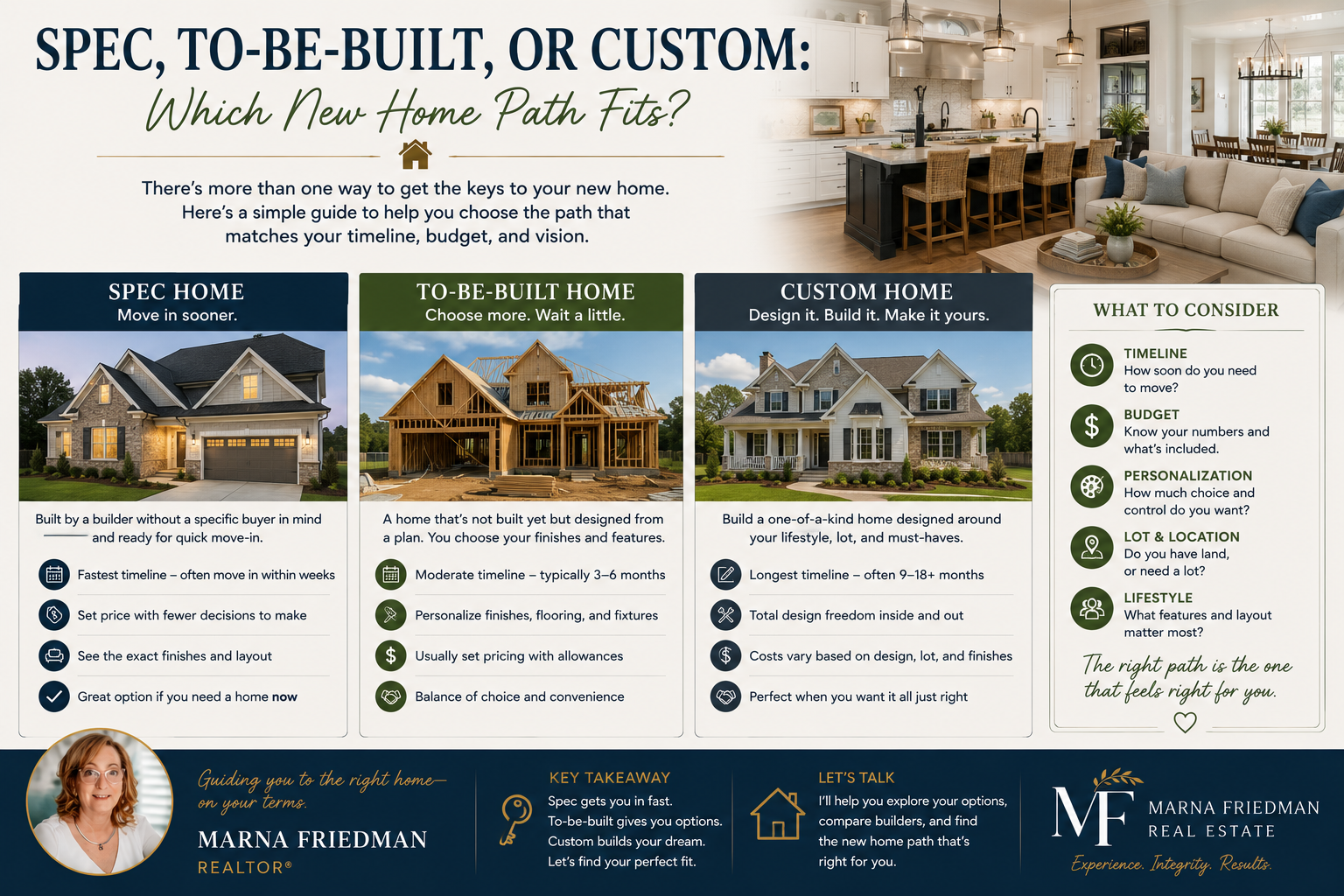
New construction comes in three forms. A spec home, also called an inventory or move-in-ready home, is one the builder started without a buyer; it closes in weeks and you take its selections as built. A to-be-built home is a builder's plan you contract before construction, choosing the homesite and finishes and waiting several months to around a year. A custom home is designed for you, on your lot or one you acquire, with the widest choices and the longest, least predictable timeline. Which path fits comes down to three questions: how soon you need to move, how much you want to choose, and how much process you are willing to manage.
All three paths are active across NW Metro Atlanta's new construction market, often inside the same community, where a builder sells to-be-built homesites while finishing a handful of spec homes on the same street. Here is how the paths really differ, where each one shines, and the questions that sort them for your situation.
Key Takeaways
- Spec homes trade choice for speed and certainty: a firm price, a real house you can walk, and a closing measured in weeks.
- To-be-built homes are the middle path most community buyers take: your homesite, your selections within the builder's program, and a wait of several months or more.
- Custom homes offer the fullest control and ask the most in return: land, design time, a construction loan in many cases, and active decision-making throughout.
- Incentives often run richest on spec homes a builder wants off the books, especially near quarter and year end.
- Every path deserves your own representation and an independent inspection; new never means skip the diligence.
"In Cherokee communities along I-575 and out to Dallas, I regularly show a finished spec, a to-be-built homesite, and a plan book in the same afternoon. The right path usually names itself once the calendar and the appetite for decisions are honest."
Marna Friedman, REALTOR®, Atlanta Communities
When is a spec home the right call?
When the calendar leads. A spec home exists because builders keep inventory moving: homes started on attractive homesites with broadly appealing selections, finished or nearly finished by the time you tour. The advantages are concrete. You walk the actual house, not a rendering, and see the real light, the real lot, the real finishes. The price is a firm number for a finished product, with no selection sheet drifting upward behind it. And the closing timeline matches a resale purchase, which matters enormously when a lease is ending, a relocation clock is running, or a sold home has you counting weeks.
The trade is choice. The selections are the builder's, and while late-stage specs sometimes allow minor finishing decisions, the house is substantially what it is. Negotiability often tilts in your favor, though: a standing finished home carries costs the builder feels every month, so incentives, closing cost help, rate buydowns through affiliated lenders, or price flexibility, tend to run richest on inventory, particularly toward quarter and year end. Walk it with the same care as any purchase: an independent inspection, a close look at the punch list items, and the warranty terms in writing.
What does the to-be-built path involve?
To-be-built is the standard community path: the builder offers a set of floor plans across available homesites, and you contract before construction begins, choosing the plan, the lot, the structural options, and then the finishes at the design center. It is the path with the best balance of personalization and predictability, you get a home configured to your choices, inside a program the builder has priced and built many times, on a timeline that commonly runs several months to around a year depending on the plan, the community's pace, and conditions.
The disciplines that make it go well are the ones I cover across my new construction series: understand what is standard versus upgraded before you fall for a model, the whole subject of telling standard features from upgrades; hold structural options against your budget first, since they cannot be added later; walk the specific homesite before contracting; and read the builder contract, deposit structure, and timeline language with your own agent, because builder contracts are builder-written. Financing has its own decision on this path, the builder's affiliated lender and its incentives versus your own lender, which I compared in builder's lender or your own.
How do the three paths compare side by side?
| Factor | Spec / inventory | To-be-built | Custom |
|---|---|---|---|
| Timeline | Weeks to close | Several months to a year | A year or more, design included |
| Choice | As built, minor late selections at most | Plan, homesite, options, finishes within the program | Essentially everything |
| Price certainty | Firm finished price | Base plus options; strong once selections lock | Budget requires active management |
| Financing | Standard purchase loan | Standard loan timed to completion | Often construction-to-permanent lending |
| Incentives | Often richest here | Common, tied to lender or design credits | Negotiated per project |
| Your effort | Lowest | Moderate, concentrated at selections | Highest and ongoing |
What does going custom really ask of you?
Custom building is the full version of the idea and the full version of the project. It starts with land, a lot you own or acquire, with all the diligence raw land deserves: utilities or well and septic feasibility, topography and drainage, access, and any covenants. Then design, with an architect or a design-build firm, which takes months and is where the budget is truly written; then builder selection if design and construction are separate; then financing, which for most custom projects means construction-to-permanent lending with draws and inspections along the way; then a construction period in which you are a standing decision-maker, not a spectator.
The reward is a home that exists nowhere else, shaped to your land and your life. The honest prerequisites are time measured in a year or more, tolerance for decisions arriving weekly, contingency room in the budget, and a team you trust, builder, designer, lender, and your own representation, assembled before the first line is drawn. Custom is a wonderful path for the buyer who wants the process as well as the product; it is a frustrating one for the buyer who only wants the product. Knowing which buyer you are is most of the decision.
How do you choose between them in practice?
Run your situation through three filters, in order. Timeline first: if you need keys inside three or four months, spec is the honest answer, and the good news is that inventory in our market is real and often well-incentivized. Choice second: if the thought of living with someone else's selections genuinely bothers you, to-be-built earns its wait, and if the plan book itself feels confining, you are a custom conversation. Process third, and be truthful: selections and walkthroughs are the extent of to-be-built's demands, while custom is a part-time project for a year. Budget rides along all three, remembering that each path spends differently, spec in the negotiation, to-be-built at the design center, custom throughout.
And on every path, the same two protections apply. Bring your own agent from the first visit, whether the first visit is a finished spec, a model home, or a piece of land, for all the reasons in the value of your own agent. And inspect independently regardless of the home's age, because new construction is built by people, and the punch list exists for a reason. The broader map of the whole journey lives in how buying new construction works.
Frequently Asked Questions
What is a spec home?
A home a builder starts without a specific buyer, also called an inventory or move-in-ready home. It sells finished or nearly finished, with the builder's selections, and closes on a resale-like timeline.
Are spec homes cheaper than to-be-built homes?
Not automatically, but they often carry the richest incentives, since a standing finished home costs the builder monthly. Compare the whole package, price, incentives, and included features, rather than price alone.
How long does a to-be-built home take?
Commonly several months to around a year from contract to closing, depending on the plan, the community's construction pace, permitting, and conditions. Get the builder's current timeline in writing and ask how delays are handled.
Do I need a construction loan for new construction?
Usually not in a builder community: for spec and to-be-built homes the builder finances construction and you close with a standard loan. Custom builds on your own land typically involve construction-to-permanent financing.
Can I make changes to a spec home before closing?
Sometimes, at the margins: homes early in construction may allow limited selections, while finished homes sell as built. Ask what is still open on the specific home, and get any agreed changes in writing.
Should I still get an inspection on a brand-new home?
Yes, on every path. An independent inspection plus a thorough final walkthrough catches items while the builder's crews are on site, and warranty coverage works best from a documented starting point.
Three paths, one decision framework: calendar, choice, and appetite for process. Answer those honestly and the right path usually names itself. If a new home is in your plans anywhere in NW Metro Atlanta, start at my new construction page, then reach out, and we will find the version, spec, to-be-built, or custom, that fits the way you actually want to get there.
Marna Friedman is a REALTOR® with Atlanta Communities serving NW Metro Atlanta. Timelines, pricing, incentives, and availability vary by builder, community, and market conditions and change without notice; confirm current details in writing. Information is deemed reliable but not guaranteed. Equal Housing Opportunity.
Check out this article next