55+ Active Adult · NW Metro Atlanta
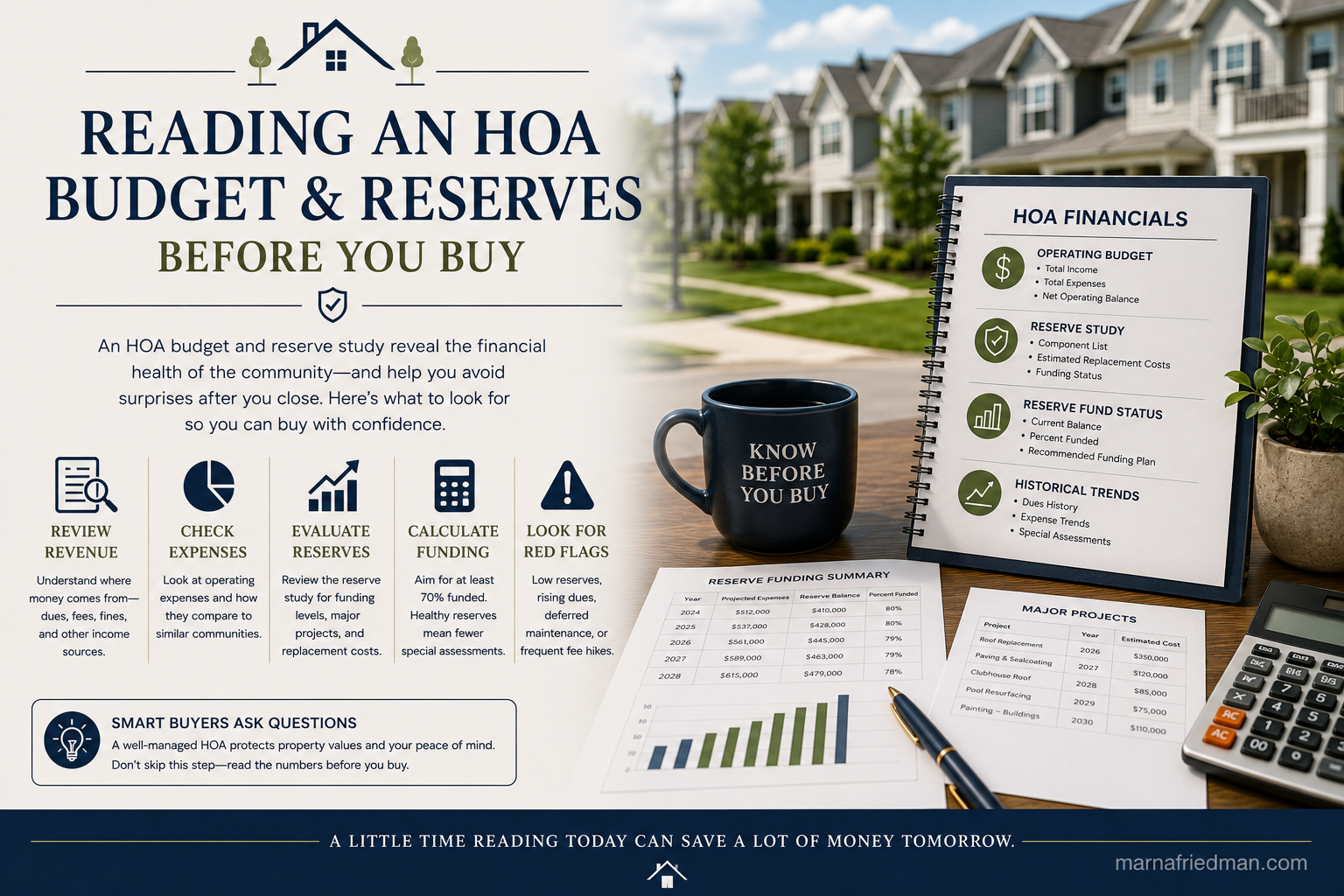
An HOA's financial health is readable before you buy, and reading it takes three documents: the current budget, which shows whether routine dues cover routine life; the reserve information, ideally a professional reserve study, which shows whether the community is saving realistically for the roofs, roads, and amenity systems that wear out on schedules; and the assessment history, which shows how past boards handled the gap when one appeared. Healthy communities look boringly similar across all three, and troubled ones announce themselves in the same documents, if a buyer actually reads them.
In 55+ communities, where the association often runs lawn care, amenities, and a share of daily life, this reading matters doubly: the dues are larger, the common assets are richer, and the community's finances are effectively part of your housing cost forever. I read these documents alongside clients in communities across Cherokee, Cobb, and Paulding, and this guide is the method, extending the what-dues-cover basics from what 55+ HOA dues cover into the deeper financial read.
Key Takeaways
- Three documents tell the story: the operating budget, the reserve study or reserve balances, and the assessment and dues history.
- Reserves are the heart of the read: communities age on schedules, and underfunded reserves are tomorrow's special assessments wearing today's low dues.
- Steady, explained dues increases are a health signal, not a warning; flat dues for a decade often are the warning.
- Request the documents during due diligence, and read board minutes alongside them; minutes show how the numbers get made.
- Route judgment calls to professionals: your agent for patterns, an attorney for document questions, and the reserve study's own professionals for the engineering.
"An HOA budget tells you a community's honest story faster than any tour. In communities from Canton to Lake Allatoona's Acworth side, read the reserves before you fall for the clubhouse."
Marna Friedman, REALTOR®, Atlanta Communities
What does the operating budget actually tell you?
The operating budget is the association's year at a glance: dues income on one side, and on the other the recurring costs of running the community, landscaping and grounds contracts, amenity operations and utilities, insurance, management fees, administration, and a contribution to reserves. Read it for balance and realism. Income should cover expenses without heroics; line items should look plausible against the community you toured (a large amenity campus with a small utilities line invites a question); insurance should be present and substantial, since association insurance costs have been a real force in budgets; and the reserve contribution should exist as a meaningful line rather than a token.
Then read it for direction by asking for two or three prior years alongside the current one. Costs in the categories associations buy, labor, insurance, utilities, rise over time, so a budget whose expenses climb while dues never move is being balanced somewhere invisible, usually the reserve line. This is also where a community's stage matters: in developer-controlled communities, ask explicitly how the budget maps to build-out and what happens when any developer support ends, the transition dynamics covered in when the builder hands over the HOA.
Why are reserves the heart of the financial read?
Because communities age on physical schedules that do not negotiate. Private roads need resurfacing, clubhouse roofs and HVAC systems wear out, pools need resurfacing and equipment, gates and fencing and retention infrastructure all carry replacement dates, and in a 55+ community the amenity list is usually the longest version of this inventory. Reserves are the savings account for those dates, and a professional reserve study is the document that does the math: it inventories the components, estimates remaining life and replacement cost, and calculates whether current savings and contributions meet the schedule, often expressed as a percent-funded figure. Well-run communities order these studies periodically and follow them; the study's existence, recency, and the board's adherence to it are each independently informative.
The buyer's translation is simple: strong reserves mean the community's future repairs are being paid a little at a time by everyone who enjoys the assets, while weak reserves mean those same repairs are waiting to arrive as special assessments, one-time charges to whoever owns a home when the roof finally goes. Low dues attached to thin reserves are not a bargain; they are deferred billing. When the reserve picture is unclear from the documents provided, that is not a shrug moment; it is a written-question moment during due diligence, and the answer's clarity is itself a governance signal.
What health signals should you check across the documents?
| Signal | Healthy pattern | Warrants questions |
|---|---|---|
| Dues history | Steady, modest, explained increases | Flat for many years, or sudden large jumps |
| Reserve funding | Recent study, meaningful funding level, contributions per plan | No study, thin balances, contributions skipped in lean years |
| Special assessments | Rare, specific, well-documented | Repeated assessments covering routine aging |
| Delinquencies | Small share of owners behind | Meaningful delinquency rates straining income |
| Common-area condition | Matches the financial story you read | Visible deferred maintenance beside "healthy" numbers |
| Minutes and communication | Clear discussion of finances and plans | Silence on money, or recurring unresolved disputes |
The last row is the underrated one: a year of board minutes reads like the community's diary, showing whether finances are discussed candidly, how projects get planned, and what the recurring arguments are. Pair the paper with your eyes, walk the amenities and streets with the reserve component list in mind, and the two should agree. When the pool furniture, pavement, and roofs all look tired next to reassuring documents, believe the assets.
How do you actually get and use these documents?
Request them as part of due diligence, association documents customarily flow to buyers in community purchases, and ask specifically for the current budget, prior-year budgets, the most recent reserve study or reserve balance statements, the assessment history, and recent minutes. Georgia's closing structure gives you an attorney in the transaction already; document questions with legal weight, what the covenants permit, how assessments work, what disclosure the association owes, belong there, while your agent supplies the pattern recognition across communities. Build the questions into your tour-and-compare process too: the checklists in comparing 55+ communities and questions for a community tour both gain teeth when the financial documents arrive to answer them.
Then use what you learn proportionately. Perfect documents do not exist, and a single blemish, one explained assessment years ago, one lean-year reserve contribution, is history, not disqualification. You are reading for pattern: does this community face its numbers, plan its future, and tell its members the truth? Communities that do are everywhere in this area, including among its best-known 55+ addresses, and the reading simply sorts them from the rest.
What does this mean for your ownership afterward?
The skills transfer the day you close. As an owner you will receive budgets annually, vote in elections that decide who stewards these numbers, and, in a resident-governed community, perhaps eventually help make them; the financial literacy that vetted the community becomes the literacy of a good member. Watch the same signals you bought on, steady funding, honest communication, assets maintained on schedule, and participate at whatever level suits you, because well-attended annual meetings are themselves a health indicator. And when your own eventual resale comes, the community's documented financial health becomes part of your home's story to the next reader of these same documents; buying into a well-run association is also, quietly, a resale strategy. The whole subject rewards exactly the temperament 55+ buyers tend to bring: patience, diligence, and a preference for boring numbers over exciting ones.
Frequently Asked Questions
What documents show an HOA's financial health?
The current and prior operating budgets, the reserve study or reserve balances, the dues and special assessment history, and recent board minutes. Together they show whether routine life is funded and future repairs are being saved for.
What is a reserve study?
A professional analysis that inventories the community's major components, estimates remaining life and replacement costs, and calculates whether savings and contributions meet the schedule. Its existence, recency, and the board's adherence to it are all health signals.
Are rising HOA dues a bad sign?
Usually the opposite: steady, explained increases track the real costs associations buy. Dues flat for many years alongside aging assets more often signal underfunding that surfaces later as special assessments.
What is a special assessment?
A one-time charge to owners for costs beyond the budget and reserves, often a major repair. Rare and well-documented ones happen; repeated assessments covering predictable aging suggest chronic underfunding.
How do I get HOA documents before buying?
Request them during due diligence through your agent; association documents customarily flow to buyers in community purchases. Put specific financial questions in writing, and involve your closing attorney on document and covenant questions.
Do these checks matter more in 55+ communities?
They matter everywhere and weigh more here: 55+ associations typically run more of daily life, hold richer amenities, and charge accordingly, so their financial health is effectively part of your housing cost.
The clubhouse gets the tour, but the budget gets the truth, and thirty minutes with three documents protects a decision measured in years. When communities are on your shortlist anywhere in NW Metro Atlanta, reach out, and we will read their numbers together; my 55+ active adult guide maps the communities worth the reading.
Marna Friedman is a REALTOR® with Atlanta Communities serving NW Metro Atlanta. Association finances, document practices, and governance vary by community and are governed by each community's recorded documents and applicable law; review them with appropriate professionals. This article is general information, not legal or financial advice. Age-restricted communities operate under the Housing for Older Persons Act. Equal Housing Opportunity.
Check out this article next