55+ Active Adult · NW Metro Atlanta
Sport amenities have become one of the most-scrutinized parts of a 55+ active adult community tour. Pickleball has exploded across NW Metro Atlanta communities over the past five years, tennis remains a core amenity in most established communities, and well-equipped fitness centers with cardio, strength, and group class space are now standard at the price tier. What varies meaningfully is scale, condition, programming, and how the amenity package holds up in the years after a community's grand opening. A serious pickleball program with dedicated courts is a different asset than one shared pickleball line taped over an aging tennis court. Understanding what to look for helps you evaluate whether a community's sport package actually matches your daily use.
Here is a practical guide to pickleball, tennis, and fitness amenities at 55+ active adult communities in NW Metro Atlanta, and what to look for on your tour.
Key Takeaways
- Pickleball has become a core amenity in most 55+ communities.
- Court count, condition, and programming vary widely.
- Tennis is still standard; some communities have converted courts to pickleball.
- Fitness centers range from basic to well-equipped with group class space.
- Walking trails and outdoor recreation round out the sport package.
"Five years ago buyers asked me about tennis courts and the pool. Now the first question at almost every 55+ community I show across Cherokee and Paulding counties is 'how many pickleball courts and what does the ladder look like.' The amenity package has genuinely shifted."
Marna Friedman, REALTOR®, Atlanta Communities
Why do sport amenities matter more in a 55+ community?
In an age-restricted community, sport amenities carry a bigger share of the lifestyle offering than they do in a general-market neighborhood. Practical reasons:
- Daily use: residents in these communities use amenities more frequently than in general-market subdivisions, in part because the community is designed around them.
- Social gateway: pickleball ladders, tennis leagues, and fitness class schedules are how many new residents build their social connections in the community.
- HOA dues justification: a meaningful portion of dues supports these facilities; underused or poorly-maintained amenities feel like wasted money.
- Property values: communities with strong, well-maintained sport programming hold value better than those with faded amenities.
The amenity package is not just a feature list; it is much of what makes daily life in the community feel like the lifestyle that attracted you. See my what amenities matter most in a 55+ community post for broader context.
What does a serious pickleball program look like?
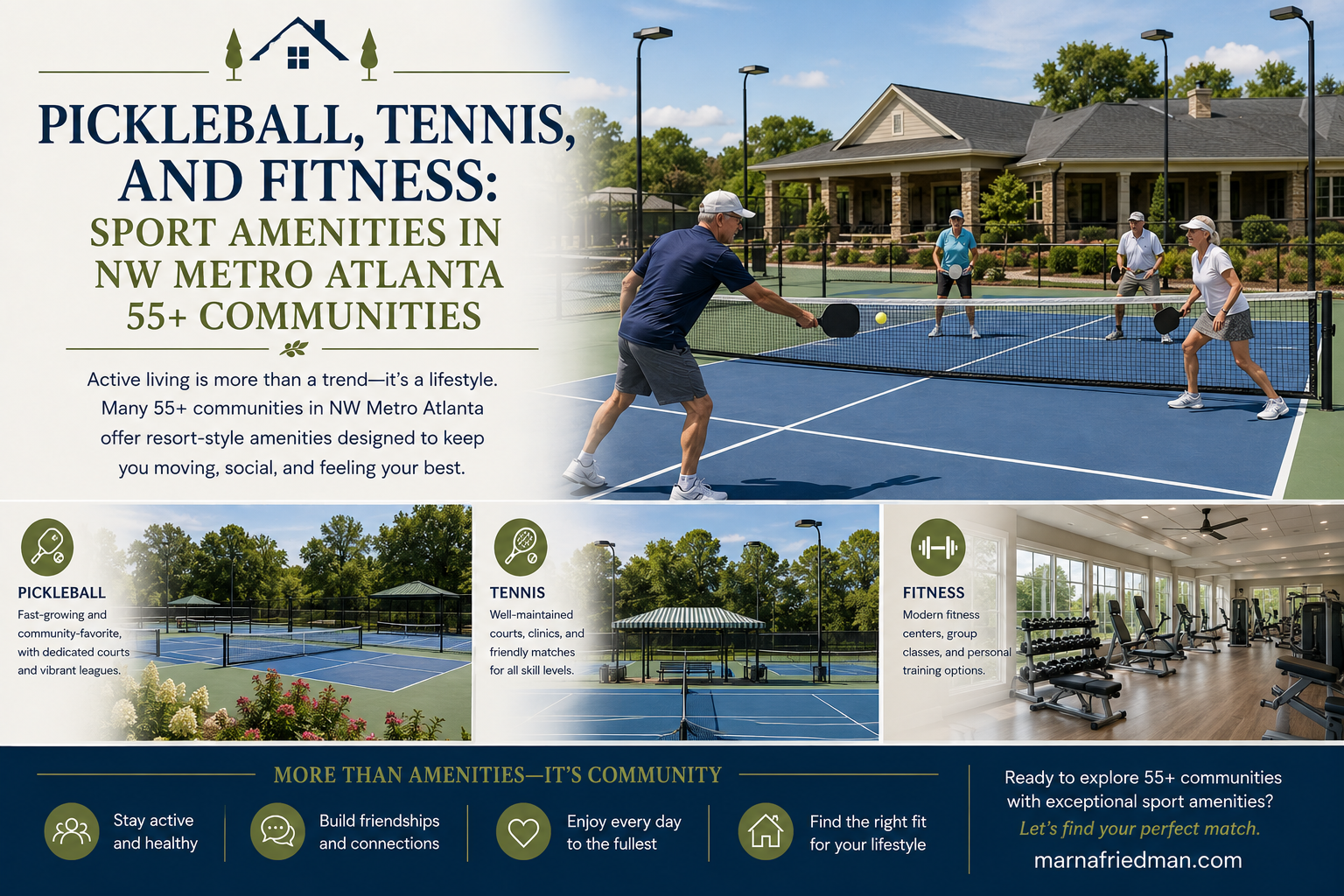
Pickleball has moved from a novelty to a core amenity in NW Metro Atlanta 55+ communities. What separates a serious program from a token offering:
- Dedicated courts (not shared or taped over tennis): purpose-built pickleball courts with proper surfacing and nets.
- Multiple courts: four to eight or more, so leagues and ladders can run without long waits.
- Court lighting for evening play: extends usable hours meaningfully.
- Windscreens and covered pavilions: for weather and shade.
- Active ladder or round-robin structure: organized play that welcomes newcomers.
- Clinics and lessons: especially for players new to the sport.
- Court reservation system: online booking or a well-run posted system.
Ask about court hours, whether courts are busy at your preferred play times, and how newcomers are welcomed into the ladder or round-robin. If pickleball matters to you, this is one area where the specifics really are the amenity.
Sport amenity comparison at a glance
The table shows what to look for and how to evaluate each amenity category.
| Amenity | Baseline | Strong offering |
|---|---|---|
| Pickleball | 2 courts, shared surface | 4-8+ dedicated courts, lighting, active ladder |
| Tennis | 2 hard courts | 4+ courts, mix of surfaces, USTA leagues |
| Fitness center | Small room, basic cardio and weights | Full cardio, strength, group class studio, personal training |
| Group classes | Occasional yoga or aerobics | Full weekly schedule, multiple instructors, variety |
| Walking trails | Sidewalk loops | Dedicated trails, scenic routes, connectivity |
| Pool for exercise | Leisure pool only | Lap lanes, water aerobics classes, indoor and outdoor |
| Bocce or shuffleboard | Not present | Dedicated courts with active leagues |
| Golf | Not present or nearby public | On-site course or included membership |
A well-rounded 55+ community will offer several of these at the strong-offering level. No single community will hit every category at the top tier, so priorities matter.
What about tennis in 55+ communities?
Tennis remains a standard amenity, though the picture has shifted with the rise of pickleball. Common patterns across NW Metro Atlanta communities:
- Established communities: often have four or more tennis courts built during the initial construction.
- Court conversions: some communities have converted underused tennis courts to pickleball; ask what the current split is.
- Surface types: hard courts are most common; some communities have Har-Tru clay courts, which are easier on joints but require more maintenance.
- League participation: USTA leagues, community-run round robins, and doubles ladders all common.
- Lessons and pros: some communities have a resident tennis pro or partner with a local club.
If tennis is central to your daily routine, ask about court availability at your preferred play times, league opportunities, and whether the community has recently converted or plans to convert tennis courts to pickleball.
What separates a good fitness center from a basic one?
Fitness centers in 55+ communities range from a small room with a few treadmills to a full commercial-grade facility. Elements of a well-equipped fitness offering:
- Cardio variety: treadmills, ellipticals, bikes, rowers, some low-impact options.
- Strength equipment: a mix of selectorized machines and free weights.
- Group class studio: a dedicated space with wood flooring, mirrors, and sound system.
- Class schedule: yoga, Pilates, low-impact aerobics, water aerobics, strength training, all on a regular weekly rotation.
- Personal training availability: in-house or referral options.
- Locker rooms and showers: full-service facilities, not just a bathroom.
- Hours of access: extended hours or 24-hour keycard access at some communities.
Ask about equipment age and maintenance schedule; a fitness center is only as good as its condition. Also ask about class attendance, because a full weekly schedule with three attendees per class tells a different story than one with 15.
Are walking trails and outdoor recreation part of the package?
Beyond the courts and gym, the outdoor amenity network shapes daily use. NW Metro Atlanta communities across Cobb, Cherokee, and Paulding counties often integrate:
- Dedicated walking or running trails: loops or connecting paths through the community.
- Nature preserves or greenspace: on-site conservation land or pond areas.
- Community gardens: raised beds available to residents.
- Outdoor pools: separate from indoor lap pools; often the social hub in warm months.
- Fire pits and outdoor gathering spaces: for social use in evenings.
- Dog parks: increasingly common as a distinct amenity.
Communities like Soleil Belmont Park in Canton and Crescent Pointe at Great Sky have distinct outdoor amenity approaches; each community's package is worth walking in person. See my complete 2026 guide to 55+ communities for community-by-community context.
What questions should you ask on your tour?
Practical questions worth asking about sport amenities:
- How many pickleball courts, tennis courts, and other facilities?
- Are courts dedicated or shared, and what surface?
- How busy are courts at typical play times?
- What ladders, leagues, or round robins are active?
- How does a new resident join organized play?
- What is the fitness center equipment inventory?
- What is the weekly class schedule?
- What are the amenity hours and any access restrictions?
- What is the maintenance schedule and recent facility investment history?
- Are amenities included in HOA dues or do some require separate fees?
Getting concrete answers, not just general assurances, is worth the effort. My questions to ask touring a 55+ community post covers the broader interview.
How do NW Metro Atlanta communities compare?
Communities I work with regularly across Cobb, Cherokee, and Paulding counties differ meaningfully on sport amenities. Some have exceptional pickleball programs with dedicated 8-court complexes; some have strong tennis traditions with active USTA participation; some are strongest on fitness with commercial-grade centers and full class schedules. Others emphasize walking trails, on-site golf, or specialty amenities like bocce or outdoor cooking spaces. The right community depends on which combination fits your routine. Communities including Soleil Belmont Park, Crescent Pointe at Great Sky, and various Del Webb Georgia communities each have distinct amenity profiles; touring in person is the only way to see how each feels day-to-day.
Frequently Asked Questions
How many pickleball courts is enough?
Four dedicated courts is a workable baseline for a community of a few hundred residents. Larger or more pickleball-focused communities have six to eight or more. Ask about wait times at typical play hours as the real test.
Are tennis courts being converted to pickleball?
In some communities, yes. Some have added pickleball on separate courts; others have converted underused tennis courts. Ask each community about their specific approach, especially if tennis is important to you.
What if I don't play pickleball or tennis?
The fitness center, walking trails, pool, and group classes are typically the more universally-used amenities. Court sports are important to many residents but not all. Evaluate the whole package, not just the courts.
Do amenities require separate fees?
Most amenities are included in HOA dues. Some specialty items like personal training, golf memberships in golf communities, or private lessons may carry additional cost. Confirm what is included at each community you tour.
How do I know if an amenity is well-maintained?
Look at court surface condition, equipment age in the fitness center, cleanliness of common areas, and landscaping around outdoor facilities. Ask about the recent capital improvement history and the current reserve funding for facility maintenance.
Considering a 55+ community in NW Metro Atlanta?
The right amenity mix depends on your priorities and how you actually plan to use them day-to-day. I help buyers evaluate 55+ communities across NW Metro Atlanta and match the amenity package to the way you want to live. Read my 55+ Active Adult Guide, my community comparison checklist, or reach out to plan community tours.
Marna Friedman is a licensed REALTOR® with Atlanta Communities Real Estate Brokerage serving NW Metro Atlanta. Amenity offerings, programming, and facilities change over time; verify current details with each community. Information is deemed reliable but not guaranteed. Equal Housing Opportunity.
Check out this article next