Home Maintenance · NW Metro Atlanta
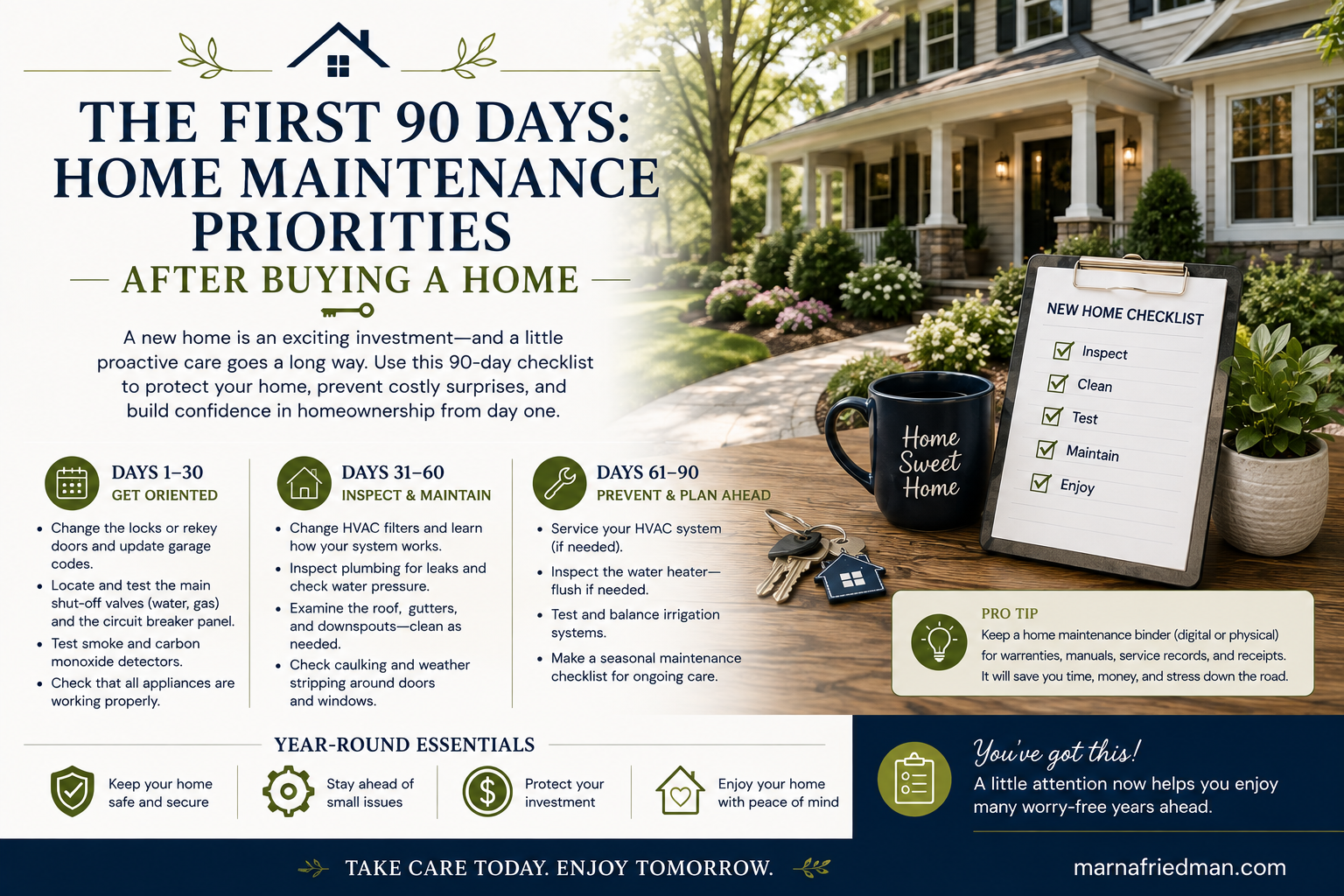
The first 90 days after buying a home are the highest-leverage window for home maintenance. This is when you make the home yours, address issues found at inspection, set up systems and services, verify safety features, and establish the maintenance rhythm you will follow for years. Doing this well now saves substantial time, cost, and hassle later. Doing it poorly, or not at all, means you spend the next several years playing catch-up. A useful framing: the first 30 days are about safety and access; the next 30 are about systems and setup; the final 30 are about establishing a rhythm you can actually keep. Whether the home is a new build in Paulding or a resale in Cobb, the pattern is the same.
Here is a practical framework for what to do in the first 90 days after closing on a home in NW Metro Atlanta.
Key Takeaways
- The first 90 days set the maintenance rhythm for years to come.
- Days 1-30: safety, access, and immediate items.
- Days 31-60: systems, service providers, and setup.
- Days 61-90: maintenance rhythm and long-term planning.
- A simple maintenance calendar is worth an hour to set up.
"The homes I sell in NW Metro Atlanta that hold value best are almost always the ones where the owner set up a maintenance rhythm from day one. It doesn't take much; it just takes doing it."
Marna Friedman, REALTOR®, Atlanta Communities
What should you do in the first 30 days?
Focus on safety, access, and immediate items. This is the phase where you deal with anything that shouldn't wait:
- Change or rekey all exterior locks: you don't know who has a key from prior owners.
- Update or install a security system: if the home has one, transfer the account; if not, decide what you want.
- Change garage door codes: for keypad and any car remotes.
- Test smoke and carbon monoxide detectors: replace batteries; add units if needed. Georgia code requires CO detectors near sleeping areas in homes with combustion appliances or attached garages.
- Locate main water shutoff, gas shutoff, and electrical panel: know how to operate each in an emergency.
- Confirm homeowner's insurance is active: verify the policy is in place effective closing day.
- Address inspection-report items: that need immediate attention.
- Change HVAC filters: whatever was in them at closing.
- Introduce yourself to neighbors: useful for future information and community.
These are one-time tasks that establish safety and control. Working through this list in the first week or two is realistic.
What should you do in days 31-60?
Focus on systems and service providers. Now you know the home better and can set up the ongoing infrastructure:
- Schedule HVAC service: a full checkup by a licensed technician; establish a service relationship.
- Get to know your utilities: read the meters, understand the billing cycles, sign up for online access.
- Set up a landscape service: if you need one; establish scope and schedule.
- Find a plumber and electrician: get referrals from neighbors or your agent; you want a relationship before you need one.
- Test appliances: run each through a full cycle; note anything that doesn't work right.
- Understand your septic or sewer: if septic, schedule pump-out timing; if sewer, know where the cleanout is.
- Register warranties: for major appliances and, if new construction, the builder's warranty.
- Set up mail forwarding and update addresses: driver's license, bank accounts, tax filings.
- Meet nearby police and fire non-emergency lines: save contacts.
- Explore your neighborhood: walking or driving; understand routes, amenities, and quirks.
This phase turns the property into a functioning home. Many of these tasks connect you to service providers and community resources you'll rely on for years.
What about days 61-90?
Focus on establishing the maintenance rhythm. Now that immediate items are done and systems are set up, you can plan the ongoing pattern:
- Set up a maintenance calendar: monthly, quarterly, semi-annual, annual tasks. See below.
- Compile a home documents binder or digital folder: warranties, service records, receipts, appliance manuals.
- Photograph everything: for insurance records and future reference.
- Address any remaining inspection items: that can wait but should not be forgotten.
- Plan first-year larger investments: paint, landscape improvements, minor renovations.
- Review your homeowner's insurance: after you know the home; confirm coverage matches the property and contents.
- Set up a home improvement wishlist and priority order: to guide future decisions.
- Consider a home warranty: for older homes with older systems; not always worthwhile but worth evaluating.
By day 90, you should have a clear picture of what the home needs and a workable rhythm for maintaining it.
The 90-day plan at a glance
The table summarizes the framework.
| Phase | Focus | Key items |
|---|---|---|
| Days 1-30 | Safety and access | Locks, detectors, shutoffs, insurance, urgent items |
| Days 31-60 | Systems and service providers | HVAC service, utilities, plumber, electrician, warranties |
| Days 61-90 | Rhythm and planning | Maintenance calendar, documents, insurance review, plans |
Working through this framework across 90 days is manageable at a normal pace, without turning the move-in into a full-time project.
What should be on a maintenance calendar?
A simple maintenance calendar for a Georgia home:
Monthly: change or check HVAC filters, test smoke and CO detectors, inspect for pests, check for water damage or leaks.
Quarterly: flush water heater sediment (annually for tankless), clean garbage disposal, inspect grout and caulking in wet areas, check attic and crawl space for issues.
Semi-annually: HVAC service (spring and fall), gutter cleaning (spring and fall), fire extinguisher check, dryer vent cleaning.
Annually: roof inspection, chimney service if applicable, deep landscape work, septic pump if on schedule, home security review, insurance policy review, tax record review.
A calendar reminder app works fine; a printed calendar on a fridge works too. What matters is having something you actually see and follow. My fall maintenance checklist and year-round maintenance calendar have more detail.
What is different for new construction homes?
New construction adds a few first-year items:
- Builder warranty: know what is covered and how to submit warranty items; typically strongest in year one.
- 11-month warranty walkthrough: most builders schedule this; use it fully to identify anything for warranty repair before the year-one warranty expires.
- Nail pops and settling cracks: normal in the first year; typically covered by warranty.
- Landscape establishment: new landscape needs regular water and attention through the first two growing seasons.
- Grading and drainage: watch for settling around the foundation; document any issues for warranty.
- HVAC calibration: new systems sometimes need adjustment as the home settles into use.
If you're in a new home in Cherokee, Cobb, or Paulding County, my punch list post covers the walkthrough side; my how buying new construction works covers broader new-build items.
What is different for older resale homes?
Older homes need attention to different items:
- Age-of-systems audit: HVAC, water heater, roof, electrical panel, plumbing. Know what may need replacement in years 1 to 10.
- Existing repairs: understand any prior repairs; get records if possible.
- Older wiring or plumbing: homes with knob-and-tube, galvanized pipes, or aluminum wiring have specific considerations.
- Insulation and efficiency: older homes often have thin insulation; upgrading pays back in comfort and utility costs.
- Historic considerations: if the home has historic status or is in a district, understand any renovation restrictions.
- Radon and other environmental items: testing at first-year is worthwhile for older homes in some areas.
Older homes usually need more first-year attention than new construction, but the investment tends to pay back well.
Frequently Asked Questions
Do I really need to rekey the locks?
Yes. Previous owners, contractors, cleaners, real estate professionals, and others may have keys. Rekeying is inexpensive and provides real peace of mind. Handle it in the first week.
What's the most important service relationship to establish first?
HVAC. It is the highest-cost mechanical system, uses the most energy, and its condition affects daily comfort. Get to know a good HVAC technician and get on a service plan.
Should I get a home warranty?
It depends. For older homes with older systems, a warranty can offset repair costs. For newer homes or homes with recently-replaced systems, warranties may not pay back. Evaluate case-by-case; read the fine print carefully.
How much should I budget for first-year maintenance?
Depends on the home. A useful rule of thumb is 1% to 3% of home value per year for maintenance; the first year is often on the higher end due to setup, inspection follow-ups, and improvements.
What if I miss the 11-month warranty walkthrough on a new construction home?
You may lose the opportunity to have items addressed at no cost. Some builders extend a grace period; some do not. Schedule proactively at month 10 or 11; do not wait.
Considering buying in NW Metro Atlanta?
The first 90 days set a lot in motion. I help buyers plan for the transition and think through what to prioritize once the keys are in hand. Read my buyers page, my helpful guides, or reach out to talk through your purchase and beyond.
Marna Friedman is a licensed REALTOR® with Atlanta Communities Real Estate Brokerage serving NW Metro Atlanta. This article is general guidance, not professional home-inspection, electrical, plumbing, or insurance advice; consult qualified professionals for your specific situation. Equal Housing Opportunity.
Check out this article next