Luxury · NW Metro Atlanta
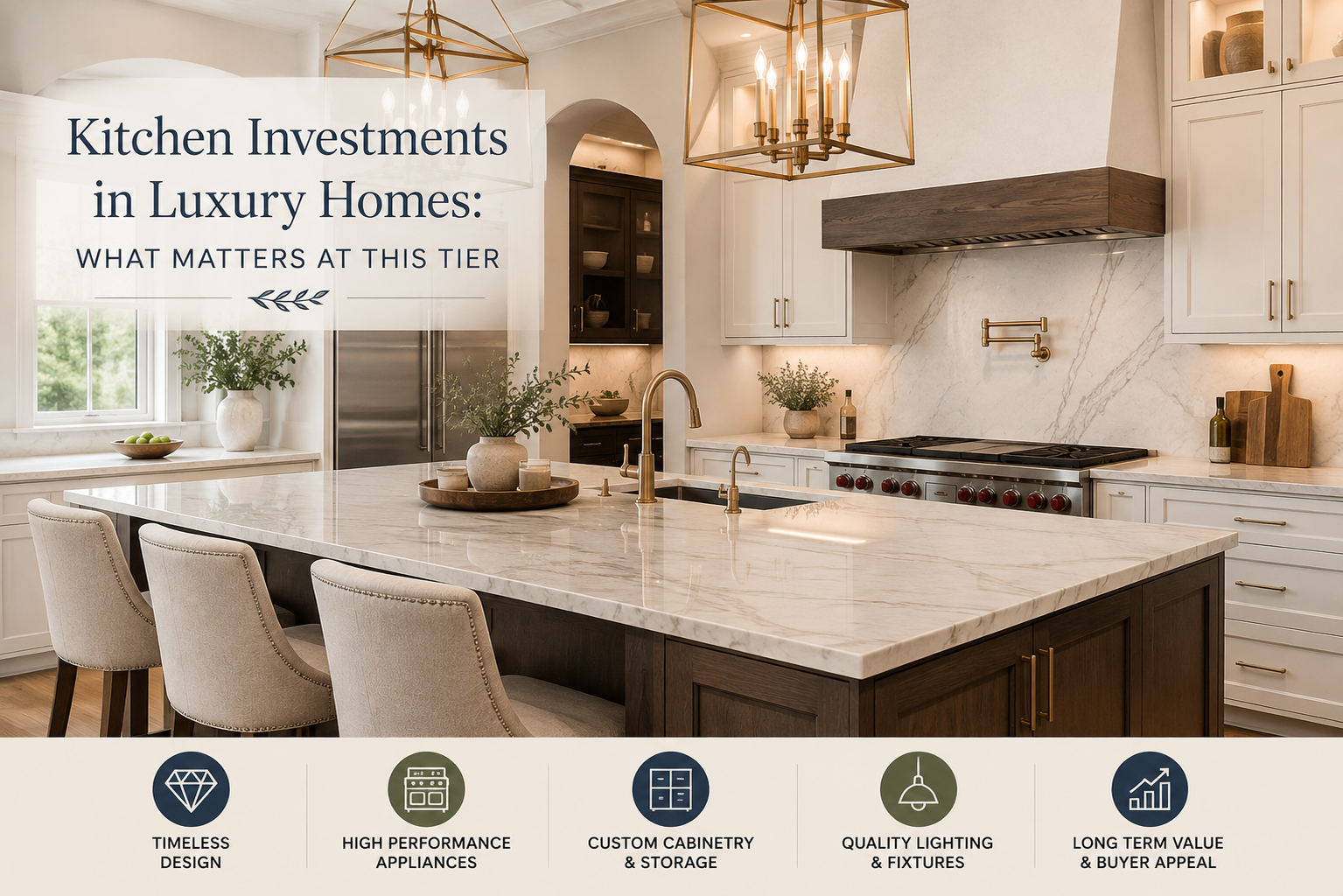
The kitchen is often the most-scrutinized room in a luxury home, and the one where the gap between good and genuinely high-end is widest. At the estate tier, kitchen investment is not just about premium appliance brands; it's about the layout, materials, integration with the rest of the home, and the practical usability of a space designed for both daily use and entertaining. In NW Metro Atlanta's luxury markets across Cobb, Cherokee, and North Fulton counties, well-designed kitchens carry meaningful weight in both use and resale. Here's a look at what actually distinguishes a luxury kitchen from a higher-end standard kitchen, and where the investment tends to hold value.
A practical look at kitchen investments in luxury homes: what matters, what holds value, and where the differences show up.
Key Takeaways
- Layout and flow matter more than brand names.
- Appliances at this tier are integrated, not just premium-branded.
- Real materials (stone, wood, metal) outperform veneers.
- Prep, cook, and clean-up zones need real separation.
- A butler's pantry or scullery is common at the estate tier.
"The luxury kitchens I show clients across Cherokee and North Fulton that hold value best are almost never the ones with the biggest island or the most appliance logos. They're the ones designed by someone who cooks."
Marna Friedman, REALTOR®, Atlanta Communities
What separates a luxury kitchen from a high-end kitchen?
The differences are meaningful but often subtle:
- Layout designed for real cooking: not just for display; work triangle, prep zones, cleanup zones all considered.
- Integrated appliances: panel-front refrigerator, hidden dishwasher; the appliances disappear into the cabinetry.
- Multiple work surfaces: primary counter, secondary prep, and often a dedicated baking station.
- Real materials throughout: stone counters (not stone-look), wood cabinets (not thermofoil), metal hardware (not plastic).
- Custom cabinetry: built to fit the space specifically, not stock cabinets modified.
- Lighting design: multiple layers (task, ambient, accent), controllable independently.
- Storage that works: pull-outs, dedicated pantry, appliance garage, wine storage, spice rack, all designed rather than assembled.
- Support spaces: a butler's pantry, scullery, or prep kitchen supporting the main kitchen.
None of these individually make a luxury kitchen; the integration of all of them does. See my luxury homes guide for broader context on the NW Metro Atlanta market.
What are the appliance-tier considerations?
At the luxury tier, appliance choice matters but the brand alone isn't the point. What matters:
- Cooking capacity and configuration: range vs. cooktop + wall ovens; single vs. double oven; steam vs. speed oven; induction vs. gas vs. dual-fuel.
- Refrigeration: full-size fridge and freezer as separate units; under-counter drawers for specific uses; wine refrigeration.
- Ventilation: commercial-scale hood, real CFM appropriate to cooking surface, quiet operation.
- Dishwashing: primary dishwasher plus a secondary (drawer style) for glassware or entertaining.
- Warming drawer or built-in coffee: often included at the tier.
- Integration: appliances that either disappear (panel-fronted) or make a design statement, not appearing as afterthought additions.
The specific brand mix depends on preference and design; Sub-Zero, Wolf, Miele, Thermador, Gaggenau, and others all fit the tier. What matters is the integration and how the appliances support how you actually cook.
Kitchen investment comparison
The table summarizes where investment typically shows up.
| Element | Standard high-end | Luxury tier |
|---|---|---|
| Cabinets | Semi-custom, painted or stained | Custom-built, real wood, custom finish |
| Countertops | Quartz or granite | Book-matched marble, quartzite, or specialty stone |
| Range/cooktop | 36-inch gas or dual-fuel | 48-inch or 60-inch professional-grade with griddle or grill |
| Refrigeration | French-door standalone | Panel-fronted column fridge and freezer, plus drawers |
| Ventilation | Standard hood | Commercial-scale, ducted, high-CFM with quiet operation |
| Island | Single with seating | Multiple work surfaces, integrated prep sink |
| Pantry | Walk-in closet | Butler's pantry or scullery with second sink and prep space |
| Lighting | Recessed with island pendants | Layered task, ambient, accent; dimmer control |
| Hardware | Quality metal | Solid brass, hand-finished, custom |
Individual differences are subtle; integrated together they're meaningful.
Why is a butler's pantry or scullery valuable?
At the estate tier, a support kitchen behind the main kitchen is increasingly common. Reasons:
- Keeps the main kitchen showpiece clean: prep work, dishes, and mess happen in the secondary space.
- Real entertaining support: hosting six people is different from hosting twenty; a scullery makes larger entertaining functional.
- Second refrigerator and sink: extra capacity for holidays, parties, or extended household use.
- Wine storage and bar: often integrated into the butler's pantry.
- Staging area: catering, party prep, and heavy cooking use the second space.
A well-designed butler's pantry is one of the features that most reliably separates estate-tier kitchens from high-end suburban ones. It's not showy from the front, but it changes daily use meaningfully. My luxury lifestyle page has more on estate-tier design.
What about the primary kitchen island?
The kitchen island is often the visual anchor of a luxury kitchen. Design considerations:
- Scale to the room: larger isn't always better; the island should be proportional.
- Work surface vs. seating: both integrated but not one at the expense of the other.
- Integrated prep sink: supports the work triangle without crowding the main sink.
- Storage on both sides: not just cabinet doors on the seating side and open drawers on the work side.
- Lighting overhead: pendants or a specific fixture treatment.
- Height variation: some luxury islands feature counter-height work and bar-height seating in one design.
- Waterfall edges: stone continuing down the sides of the island; a common luxury detail.
A well-designed island supports how the kitchen actually gets used. An oversized island that eats floor space without adding function is a design mistake even in an expensive kitchen.
What holds value long-term?
Some kitchen investments hold value better than others:
- Timeless finishes: classic materials in restrained colors age better than trendy statements.
- Real materials: stone, wood, metal outlast their look-alike substitutes.
- Layout quality: a well-designed kitchen holds value even if finishes eventually get updated.
- Commercial-grade cooking: professional ranges and hoods are durable and recognized.
- Storage integration: built-in storage solutions add value; freestanding pieces don't as reliably.
- Quiet operation: quality ventilation and dishwashing that doesn't overwhelm the room.
Trendy elements (very bold cabinet colors, specific tile patterns, statement wallpaper) can date quickly. What holds up is craft and material quality. See my luxury home inspections for related buyer-side context.
What should buyers watch for on a tour?
Direct evaluations during a luxury home tour:
- Open every drawer and door: quality of hardware, hinges, and interior fit.
- Look inside appliances: capacity, condition, model year.
- Check the ventilation: real CFM, proper ducting, quiet operation.
- Notice the layout flow: where would you actually work when cooking?
- Look at the support spaces: pantry, butler's pantry, scullery.
- Test lighting scenarios: task, dining, entertainment modes.
- Ask about the designer or builder: was this a custom kitchen or a builder standard?
Luxury kitchens reward close inspection. Surface impressions and photos can hide real quality issues; hands-on evaluation reveals them.
How does the kitchen tie to the rest of the home?
In a luxury home the kitchen isn't a standalone feature; its relationship to adjacent spaces matters:
- Great room integration: most luxury kitchens open to a great room or gathering space; the transition, sightlines, and material continuity matter.
- Dining connection: both formal dining and informal breakfast areas relate to the kitchen; direct access for both use cases.
- Outdoor kitchen and covered patio: extending cooking and dining outside is common at the estate tier; the connection to the interior kitchen matters for real usability.
- Mudroom and back entry: most luxury kitchens have a supporting mudroom for daily entry; groceries flow through this route.
- Wine cellar or bar: often connected to the kitchen or butler's pantry, extending the entertaining space.
- Home office adjacency: increasingly common; a coffee and morning routine near an office adds function to both spaces.
The best luxury kitchens are designed as part of a whole; the kitchen alone can be beautiful but feel disconnected if the adjacent spaces don't support how it's used. On a tour, walk from the kitchen to each nearby space and ask how that transition feels for the way you'd actually live.
Frequently Asked Questions
What's a typical luxury kitchen investment?
Varies widely by scope, but full estate-tier kitchens frequently reach six figures for appliances, cabinets, counters, and installation. Ultra-luxury projects can be substantially higher. Get bids specific to your project before committing to a budget.
Are premium appliance brands worth the premium?
At the luxury tier, generally yes for the flagship models. The gap between mid-range premium and true professional-grade appliances shows up in day-to-day performance and long-term durability. Not every buyer values every brand equally; pick based on function.
Does a marble countertop hold value?
Quality marble is a durable luxury choice, though it does require some care (etching from acids, occasional sealing). Book-matched slabs and premium stones can be featured selling points. Cost varies by stone; discuss maintenance with a stone specialist before choosing.
Do I need a butler's pantry?
Not strictly, but at the estate tier a support kitchen makes real entertaining more workable. Whether it's essential depends on how you actually host. Many luxury buyers who dismissed a butler's pantry initially wish they had one after living in the home.
What if the current kitchen is high-end but not to my taste?
A well-designed kitchen with quality materials can often be refreshed rather than replaced. Cabinet refinishing, appliance swaps, and hardware updates can shift the look without gut renovation. Consult a kitchen designer before assuming a full replacement is needed.
Considering a luxury home in NW Metro Atlanta?
Kitchens are one of the areas where luxury homes reveal their real quality. I help buyers evaluate estate-tier homes and sellers position their kitchens well for the market. Read my luxury homes guide, my luxury lifestyle page, or reach out to talk through your priorities.
Marna Friedman is a licensed REALTOR® with Atlanta Communities Real Estate Brokerage serving NW Metro Atlanta. This article is general guidance; specific investment costs, brand comparisons, and value implications vary. Consult qualified kitchen design professionals for your specific situation. Equal Housing Opportunity.
Check out this article next