55+ Active Adult · NW Metro Atlanta
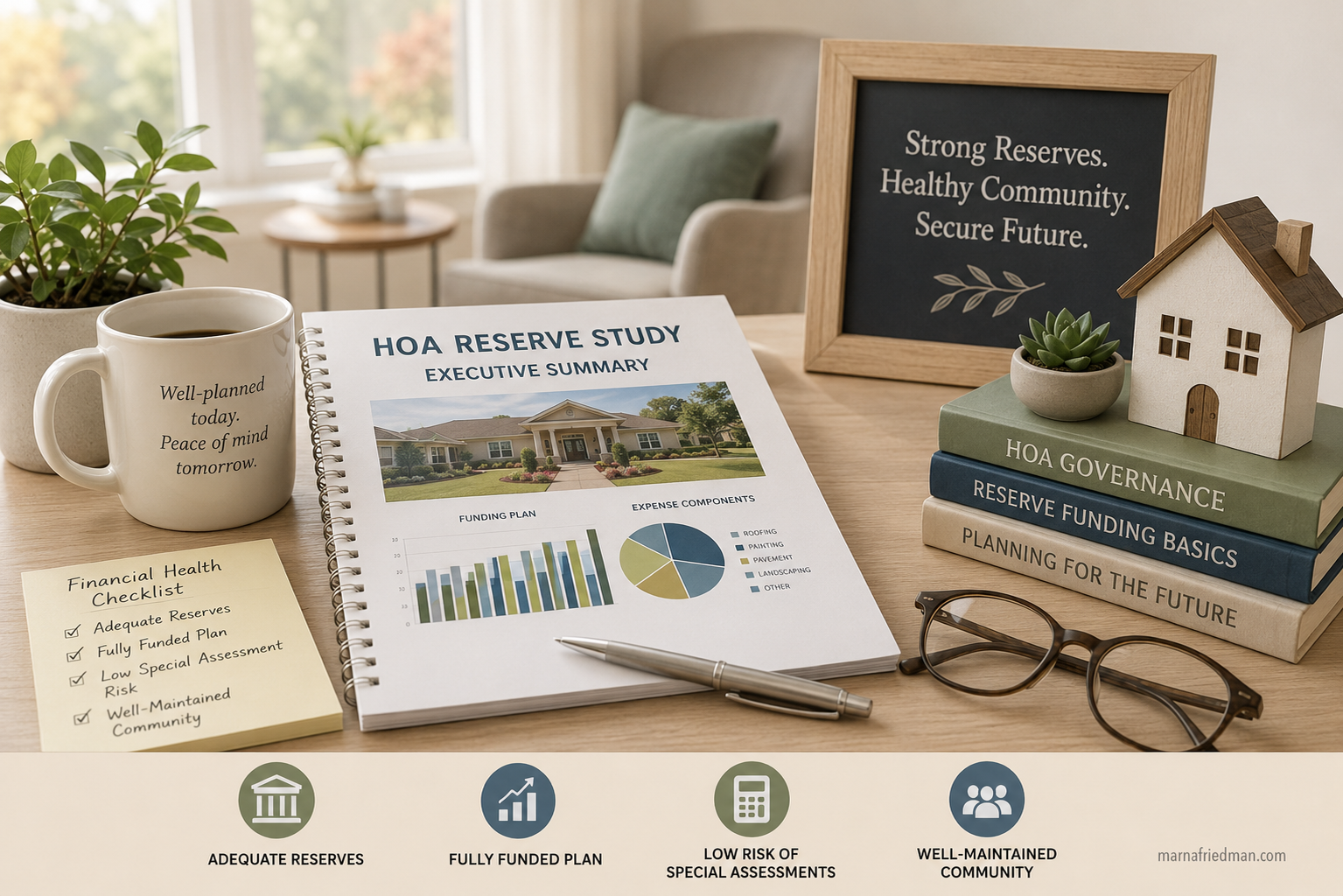
An HOA reserve study is one of the most important documents to review before buying in a 55+ active adult community, and one of the least-read. The reserve study tells you whether the community's HOA has enough money set aside to cover the major repairs and replacements coming over the next 20 to 30 years, and whether current dues are sustainable or heading toward a special assessment. Communities that look great on tour can have underfunded reserves that turn into surprise costs. Communities that seem to have high dues may actually be doing the responsible thing. Reading the reserve study helps you tell the difference. Here's what to look for in a 55+ community HOA reserve study.
A plain-language guide to reading a reserve study in a 55+ active adult community, and what strong financial health looks like on paper.
Key Takeaways
- Reserve studies show funding for major long-term repairs.
- Underfunded reserves signal future special assessments.
- Percent-funded ratio is the headline number to read.
- Age of the community affects reserve needs.
- Ask for the current study during due diligence.
"When I help clients tour 55+ communities across Cobb and Cherokee counties, the conversation about HOA finances is where the community's real story shows up. Amenities and staging tell you what the community looks like; reserves tell you whether it can stay that way."
Marna Friedman, REALTOR®, Atlanta Communities
What is a reserve study?
A reserve study is a professional analysis of a community's major long-term capital assets and the funding needed to maintain them over their expected life cycle. Typically prepared by a specialist firm every three to five years, a study covers:
- Inventory of common-property assets: pools, clubhouse, fitness center, roads, roofs, HVAC, tennis and pickleball courts, walking trails, retaining walls, entry gates, ponds, and any other HOA-owned infrastructure.
- Life expectancy of each asset: how long before major replacement is needed.
- Current replacement cost: in today's dollars.
- Future funding requirements: annual contribution schedule to be prepared when replacements come due.
- Current reserve balance: how much the HOA has saved.
- Percent-funded ratio: current reserves as a percentage of the ideal reserve level.
The reserve study is a snapshot of long-term financial health. Reviewing it is one of the highest-leverage due diligence steps for a 55+ community purchase.
What does "percent funded" mean and what's a good number?
The percent-funded ratio is the study's headline number. General industry benchmarks:
- Above 70% funded: generally considered strong; low risk of special assessment.
- 30% to 70% funded: the majority of HOAs sit here; adequate but not comfortable.
- Below 30% funded: weak; higher risk of special assessment or dues increase.
- Below 10% funded: critical; significant financial exposure.
Higher is better, but the trajectory matters as much as the current level. A community at 45% funded with a plan to reach 70% in five years is in different shape than one at 45% funded and declining. Ask about the funding trend, not just the current number. See my what HOA dues cover post for related context.
Reserve study fundamentals at a glance
The table summarizes what to read for.
| Element | What to read for |
|---|---|
| Percent funded | Above 70% strong; below 30% weak |
| Study date | Should be within last 3-5 years |
| Preparer credentials | Reserve Specialist (RS) designation preferred |
| Asset inventory | Realistic and complete |
| Life expectancies | Match industry standards |
| Replacement costs | Current dollars, not old estimates |
| Funding plan | Clear schedule; no surprises |
| Reserve balance trend | Growing or stable, not declining |
None of these individually tell the full story; together they do.
Why does community age affect the study?
Age matters because major assets have life cycles that come due in waves:
- Very new communities (0-5 years old): reserve needs are modest; assets are new. But new communities often have low reserves because they haven't been collecting long. The developer's transition affects the picture significantly.
- Middle-aged communities (5-15 years old): reserves should be steadily building; a well-run HOA is preparing for major replacements in the 15 to 25 year window.
- Established communities (15+ years old): some major replacements have happened or are near; reserves should reflect that history.
- Older communities (25+ years old): ongoing major replacement cycles; reserve funding is critical.
A weak reserve position in a very new community may reflect early-collection timing rather than mismanagement. A weak reserve position in an established community is more concerning. Age matters when reading the number.
What are the highest-cost items in a typical reserve study?
Common expensive line items in a 55+ community reserve study:
- Roads and parking: asphalt overlay every 15 to 25 years; major reconstruction beyond that.
- Clubhouse roof and HVAC: 20 to 30 year cycles; expensive at replacement.
- Pool decking and resurfacing: pools require regular resurfacing (10 to 15 years) and periodic major work.
- Tennis and pickleball court resurfacing: every 4 to 8 years depending on surface.
- Retaining walls and hardscape: variable but significant when they need repair.
- Fitness equipment replacement: 7 to 12 years.
- Landscape major work: tree replacement, irrigation systems, entry features.
- Gate and access system: if community is gated.
Whether these items are properly funded is what the study tells you.
What questions should you ask about HOA finances?
Direct questions during due diligence:
- Can I see the current reserve study?
- What's the percent-funded ratio and how has it trended?
- When was the last major reserve project completed, and what's next?
- Have there been any special assessments in the last 5 years?
- What are current HOA dues, and what's the history of dues increases?
- How is the operating budget doing separately from reserves?
- Are there any pending legal issues or major maintenance concerns?
- What percentage of homeowners are current on dues?
- How is the board structured and elected?
A well-run HOA will answer these directly and have documents ready to share. Reluctance to share is itself information. My questions to ask when touring post covers broader community questions.
What about a special assessment?
A special assessment is a one-time charge to homeowners to fund a specific expense not covered by regular dues or reserves. Types:
- Planned major project: a large replacement (say, all roads) partially funded by a specific assessment.
- Emergency: an unexpected event (storm damage, litigation cost) requiring quick funds.
- Underfunded reserve catchup: the reserves fell too low and the HOA needs to rebuild them faster than regular dues allow.
Special assessments can be significant, sometimes several thousand dollars per home. Any history of special assessments deserves discussion; multiple in short succession is a yellow flag. See my comparing 55+ communities checklist for a broader evaluation framework.
How do 55+ communities in NW Metro Atlanta typically stack up?
Communities across Cobb, Cherokee, and Paulding counties vary in HOA structure and reserve strength:
- Newer master-planned communities: often well-organized with professional management and formal reserve studies from year one, though reserves themselves may still be building.
- Established 55+ communities in Cobb County: longer track records, larger membership; more historical data on assessment history and financial management.
- Cherokee County active adult communities: mix of newer and mid-age communities; growing amenity sets sometimes come with higher dues to fund reserves.
- Paulding County active adult offerings: generally newer overall; ask about developer transition status and how long the HOA has been resident-controlled.
- Attached vs. detached homes: attached-home communities have shared exterior maintenance which changes reserve needs; detached communities have less common infrastructure.
Communities within the same brand or from the same developer aren't always in the same financial shape; each is its own HOA. Compare specific communities, not general brand reputations. Working with a REALTOR® who has walked several of these communities helps put any one study in context.
Frequently Asked Questions
Is the HOA required to have a reserve study?
Georgia law does not universally require HOAs to conduct reserve studies, but many governing documents and lender requirements make them effectively standard. Reserve studies are a professional best practice and most well-run HOAs conduct them regularly.
Can I get the reserve study before making an offer?
Often yes. Some HOAs share it openly; others provide it during due diligence after contract. Ask early. If you can review it before offering, you have better information for your decision.
What if the reserve study is outdated?
Reserve studies should be updated every 3 to 5 years. An older study is less reliable but still informative. A community that hasn't updated in 10 years signals less rigorous HOA management.
Does a well-funded reserve mean higher dues?
Sometimes yes, though not always. Well-funded reserves reflect years of consistent contribution. A community with lower dues and weak reserves may actually have higher total lifetime costs due to special assessments; a community with higher dues and strong reserves has fewer surprises.
Should the reserve study alone drive my decision?
No, but it should be part of the picture. Amenities, home features, location, and community culture all matter too. A strong reserve position with an otherwise wrong-fit community isn't the answer, but weak reserves in an otherwise-perfect community deserve real weight.
Considering a 55+ community in NW Metro Atlanta?
Financial health is part of what makes a community sustainable long-term. I help buyers read HOA documents and evaluate communities across NW Metro Atlanta. Read my 55+ Active Adult Guide, my community comparison checklist, or reach out to plan community tours.
Marna Friedman is a licensed REALTOR® with Atlanta Communities Real Estate Brokerage serving NW Metro Atlanta. This article is general guidance, not accounting or legal advice; consult qualified professionals for your specific situation. Reserve study standards and Georgia HOA regulations change; verify current requirements. Equal Housing Opportunity.
Check out this article next