General Real Estate · NW Metro Atlanta
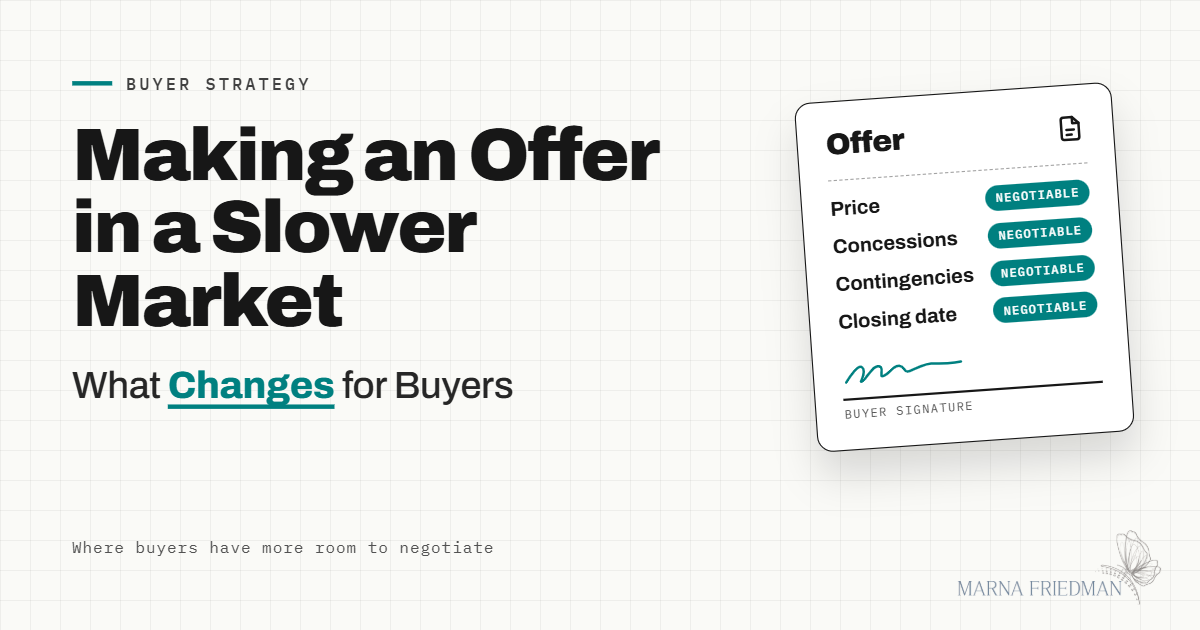
Making an offer in a slower market is a different exercise than making one in a hot market. The pressure dynamics shift. Multiple offers are rare. Sellers have time to think. Buyers have room to negotiate. And the strategies that work in a seller's market can backfire when supply exceeds demand. For buyers in NW Metro Atlanta considering purchases during a slower stretch, understanding how to approach offers, what to ask for, and when to walk away produces better outcomes than importing habits from a different market. Here's a practical guide.
Key Takeaways
- Slower markets reward patient, strategic offers.
- Pricing can start below asking in many cases.
- Contingencies and terms become more negotiable.
- Days on market gives buyers meaningful leverage.
- Walking away is a real option, not just a bluff.
"The buyers I work with in slower markets across Cobb and Cherokee counties who get the best outcomes are the ones who treat each offer as a strategic calculation rather than an emotional commitment. The emotion has to come after the decision, not during the negotiation."
Marna Friedman, REALTOR®, Atlanta Communities
How is a slower market different from the buyer's perspective?
Several dynamics change in meaningful ways:
- Fewer competing offers: most homes face zero to one competing offers rather than multiple bids.
- Longer days on market: homes sit for weeks or months rather than days.
- Seller flexibility: sellers who've been on the market longer have more incentive to negotiate.
- Inventory choice: buyers can be selective rather than taking the first available option.
- Contingency acceptance: sellers more likely to accept standard contingencies rather than demanding waivers.
- Repair negotiations easier: post-inspection repair requests less likely to be refused.
- Closing timeline flexibility: sellers often accept buyer's preferred timeline.
- Pricing room: initial offers below asking price are more common and often accepted or counter-offered reasonably.
None of this means buyers can be aggressive without consequence; it means the strategic calculation is different. See my buyers page for the broader framework.
How should you think about your initial offer?
Several considerations shape the right initial offer:
- Days on market: a home that's been sitting for 60+ days signals seller flexibility.
- Pricing history: prior price reductions, if any, indicate seller willingness to negotiate.
- Local comps: what have comparable homes sold for recently. See my home valuation tools for context.
- Condition relative to asking price: homes needing significant work support more aggressive initial offers.
- Market trajectory: is the specific submarket softening further or stabilizing.
- Your genuine walk-away number: know this before you make any offer.
- Negotiation room: leave meaningful space between initial offer and walk-away threshold.
A good initial offer is strategically positioned, not arbitrarily low. Lowball offers that signal unseriousness get ignored or rejected without counter.
Offer components to think about
The table shows how key offer components shift in slower markets.
| Component | Faster market norm | Slower market opportunity |
|---|---|---|
| Initial offer price | At or above asking | Reasonable below asking |
| Earnest money | Higher to show commitment | Standard amounts work |
| Due diligence period | Shortened or waived | Standard 7-14 days |
| Financing contingency | Shortened | Standard protection |
| Appraisal contingency | Often waived | Standard contingency expected |
| Closing timeline | Fast; seller preference wins | Buyer preference workable |
| Seller concessions | Rare | Often negotiable |
| Repair requests after inspection | Limited; often refused | More likely accepted |
The components work together. A smart offer uses several of these levers rather than relying solely on price.
What terms should you ask for in a slower market?
Beyond price, several terms create real value:
- Seller-paid closing costs: can reduce buyer's cash needed at closing. Often negotiable in slower markets.
- Home warranty paid by seller: modest cost, meaningful buyer protection.
- Flexible closing date: aligned with your own sale timing or lease expiration.
- Appliances and fixtures included: specific items you want included should be in writing.
- Repair agreements: after inspection, more negotiating room than in hot markets.
- Rate buydown contribution: sellers may contribute toward buyer's rate buydown as a concession.
- Repairs completed before closing: or credits for the buyer to handle them.
- Rent-back arrangements: if seller needs time after closing, this can be structured favorably for the buyer too.
Each term represents real value. Negotiating holistically across the offer is more effective than focusing solely on price.
What's the mindset that produces the best outcomes?
Patterns from successful slower-market buyers:
- Patient: willing to wait for the right home and the right terms.
- Strategic: each offer calculated against alternatives, not driven by scarcity.
- Willing to walk away: the walk-away option is real, not performative.
- Not emotionally over-committed: able to make rational decisions throughout.
- Prepared with pre-approval and alternatives: ready to move when terms align.
- Working with experienced representation: an agent who understands market dynamics.
- Clear on priorities: what matters most and what's negotiable.
The mindset is what sellers and listing agents read on the other side of the table. Serious, patient, prepared buyers get taken seriously. Fickle or anxious buyers often get ignored.
What should you watch out for?
Several patterns can trip up buyers in slower markets:
- Overreading market softness: not every home will accept a lowball offer; specific submarkets stay stronger than overall averages.
- Missing the right home while waiting: prolonged market analysis can mean watching the right home sell to someone else.
- Lowball offers that burn bridges: some initial offers signal unseriousness and get the buyer written off entirely.
- Not factoring in seller circumstances: a motivated seller may negotiate aggressively; a seller with no urgency may hold firm.
- Over-negotiating minor terms: fighting hard over small items can derail deals over larger issues.
- Losing a good home over small amounts: walking from a right-fit home over a few thousand dollars is a common regret.
- Missing the market shift: markets turn; waiting for better terms can mean missing the window entirely.
Market dynamics change. Strategy that works in October may not work in April.
How does a slower market affect specific home types?
Different categories respond to market softness differently:
- Luxury homes: often see pricing pressure first and most meaningfully in slower markets.
- New construction: builders have significant inventory flexibility; incentives expand.
- 55+ communities: typically more stable; the buyer pool is less speculative.
- Entry-level homes: often stay stronger because buyer demand remains high regardless of market direction.
- Mid-tier homes: typically see moderate softening in slower markets.
- Specific submarket variations: walkable areas and amenity-dense neighborhoods often hold value better than less-differentiated inventory.
Your target category affects how slow-market dynamics play out. See my new construction, 55+ guide, and luxury homes guide for category-specific context.
How do slower markets affect timing within NW Metro Atlanta?
Slower markets don't play out identically across NW Metro Atlanta's submarkets, and understanding where opportunities concentrate helps buyers position effectively:
- Cobb and Cherokee resale inventory: established neighborhoods with mid-tier pricing often see modest softening but tend to stabilize relatively quickly. Buyers find pricing opportunities on homes with longer days on market.
- Paulding Cedarcrest corridor: golf community inventory in slower markets can see meaningful opportunities, particularly on homes sellers have been slow to price-correct.
- New construction communities: builders in slower markets expand incentives aggressively; buyers typing new construction during soft periods often get the best combination of pricing and incentives.
- Luxury pockets: often most sensitive to slowdowns; buyers in the luxury tier can find durable value during quieter stretches.
- 55+ communities: typically more stable through market cycles because the buyer pool is less speculative; the opportunities are usually at the margins.
- In-town walkable submarkets: often hold value better than less-differentiated inventory even in slower markets.
Market strategy benefits from local specificity. Generic "the market is slow" guidance misses the submarket-level dynamics. See my area guide for broader submarket context.
Frequently Asked Questions
How far below asking should I start?
Depends heavily on specifics. Market conditions, days on market, pricing history, condition, and local comps all factor. In a slower market with a home that's been sitting, a reasonable initial offer might be 3-5% below asking; in some situations more or less. Your agent helps calibrate.
Should I include an escalation clause?
Rarely useful in slower markets. Escalation clauses are tools for competing in multiple-offer situations. When no competing offers exist, an escalation clause can give the seller unnecessary leverage.
What if the seller rejects without countering?
Unusual in slower markets. Rejection without counter typically means the offer was too far below the seller's expectations. Discuss with your agent whether to come back with a revised offer or walk away.
How long should I give the seller to respond?
Standard is 24-48 hours. In slower markets, a slightly longer window (72 hours) can be reasonable, giving the seller time without being open-ended.
What's the difference between asking for seller concessions vs. a lower price?
Mechanically different. Seller concessions typically reduce buyer's cash at closing but not loan amount or long-term interest. A lower price reduces the loan amount and ongoing costs. Discuss with your agent and lender which structure serves you better.
Considering a home purchase in NW Metro Atlanta?
Offer strategy in any market benefits from experienced representation. I help buyers navigate from search through close, calibrating strategy to current market conditions. Read my buyers page, my contingencies explained post, or reach out to talk through your specific purchase.
Marna Friedman is a licensed REALTOR® with Atlanta Communities Real Estate Brokerage serving NW Metro Atlanta. Market conditions and offer strategy vary by situation; this article is general guidance. Consult qualified professionals for your specific situation. Equal Housing Opportunity.
Check out this article next