New Construction · NW Metro Atlanta
The model home is designed to make the builder look as good as possible. Every finish, every furnishing, every design detail is optimized for the walk-through. The actual quality of what the builder delivers to buyers often differs from what the model represents. For NW Metro Atlanta buyers evaluating new construction across Cobb, Cherokee, Paulding's Cedarcrest corridor, and Forsyth counties, learning to evaluate builder quality beyond the model home protects against surprises after closing. Here's a practical framework for serious evaluation.
Key Takeaways
- The model home shows the builder at their best, not their average.
- Finished homes with real residents tell the truer story.
- Online reviews need thoughtful interpretation.
- Warranty history and claim handling are leading indicators.
- Local reputation often matters more than national brand.
"The buyers I work with across Cherokee and Forsyth who are most satisfied with their new construction outcomes are the ones who did real builder research before committing. Model home tours alone are the equivalent of judging a restaurant by its menu photos."
Marna Friedman, REALTOR®, Atlanta Communities
Why does the model home mislead?
Several structural reasons the model is a biased sample:
- Built to showcase: models get the best craftsmanship because builders know they drive sales.
- Fully upgraded finishes: models typically include extensive upgrades, not the base finishes buyers get at standard pricing.
- Professional staging: furnishings and decor create emotional appeal that doesn't reflect living reality.
- Hidden flaws absent: models have been inspected and corrected; buyer homes may have issues the model doesn't display.
- Mechanical systems lightly used: model HVAC, plumbing, and electrical have fewer years of actual use.
- Aesthetic optimization: models are designed for photography and tours, not for daily living function.
None of this means models are intentionally deceptive. They're marketing tools, and marketing tools present products favorably. The buyer's job is to see beyond the marketing. See my touring model homes post for related context.
What should you look at instead?
Several information sources give a truer picture:
- Finished homes in the community: ask the builder to show you recently completed buyer homes, not just the model. The variance tells you about consistency.
- Homes under construction: visiting during construction reveals quality decisions you can't see in finished homes.
- Resale listings of builder's prior homes: look at how homes from the same builder in nearby communities are faring years later.
- Direct conversations with current residents: ask the builder for permission to speak with recent buyers.
- Online reviews: read patterns, not individual anecdotes.
- Builder warranty complaints: state licensing bodies and consumer protection agencies may have records.
- Local contractor and inspector knowledge: trades and inspectors who have worked on the builder's homes have perspectives worth hearing.
- Industry recognition: awards and recognitions can be useful signals, though not definitive.
Multiple sources together produce a reliable picture. Single sources individually can mislead. See my common builder blunders post for red flags.
Evaluation sources at a glance
The table shows typical sources and what they reveal.
| Source | What it reveals | Reliability |
|---|---|---|
| Model home | Best-case presentation | Low for average quality |
| Finished buyer homes (toured) | Real quality variance | Moderate to high |
| Homes under construction | Behind-the-walls decisions | High for structural quality |
| Resale listings of prior builds | Multi-year quality trajectory | High for longevity |
| Direct resident conversations | Living-with-the-house experience | High for recent buyers |
| Online reviews | Pattern of complaints and praise | Moderate; read patterns |
| Warranty / regulatory records | Documented issues | High for formal complaints |
| Trade and inspector perspectives | Industry insider view | High when accessible |
Multiple sources together produce a reliable picture.
How do you read online reviews productively?
Reviews need interpretation, not just skimming:
- Look for patterns: five reviews mentioning the same issue (poor warranty response, specific construction problems, communication issues) matter more than one.
- Discount extremes in both directions: five-star raves and one-star furious reviews both skew. Three and four-star reviews often contain the most honest feedback.
- Read recent reviews: builders change management, crews, and quality over time. A great review from 2020 may not reflect 2026.
- Note the specific community: some builders perform differently in different communities based on local project management and crews.
- Watch for warranty experience: how builders handle issues after closing is often a stronger signal than how they handle sales before closing.
- Consider the reviewer: some patterns suggest fake reviews (both positive and negative). Reviewer history on the platform matters.
- Look across multiple platforms: Google, Yelp, builder-specific review sites, Facebook groups, local forums all contribute.
No single review tells the story. Patterns across many reviews do.
What should you look at in finished homes and construction?
Beyond general tour impressions:
- Trim and finish work consistency: look at corners, transitions, caulking lines across the home. Consistency reflects quality control.
- Door and window alignment: gaps, settling, operation. Problems here often indicate broader framing or settling issues.
- Floor condition: hardwood seams, tile grout, carpet installation.
- Paint and drywall quality: surface smoothness, line sharpness at edges, consistency across walls.
- Cabinet and millwork quality: door alignment, drawer operation, finish consistency.
- Mechanical and plumbing visible areas: clean installation of visible pipes, HVAC, electrical.
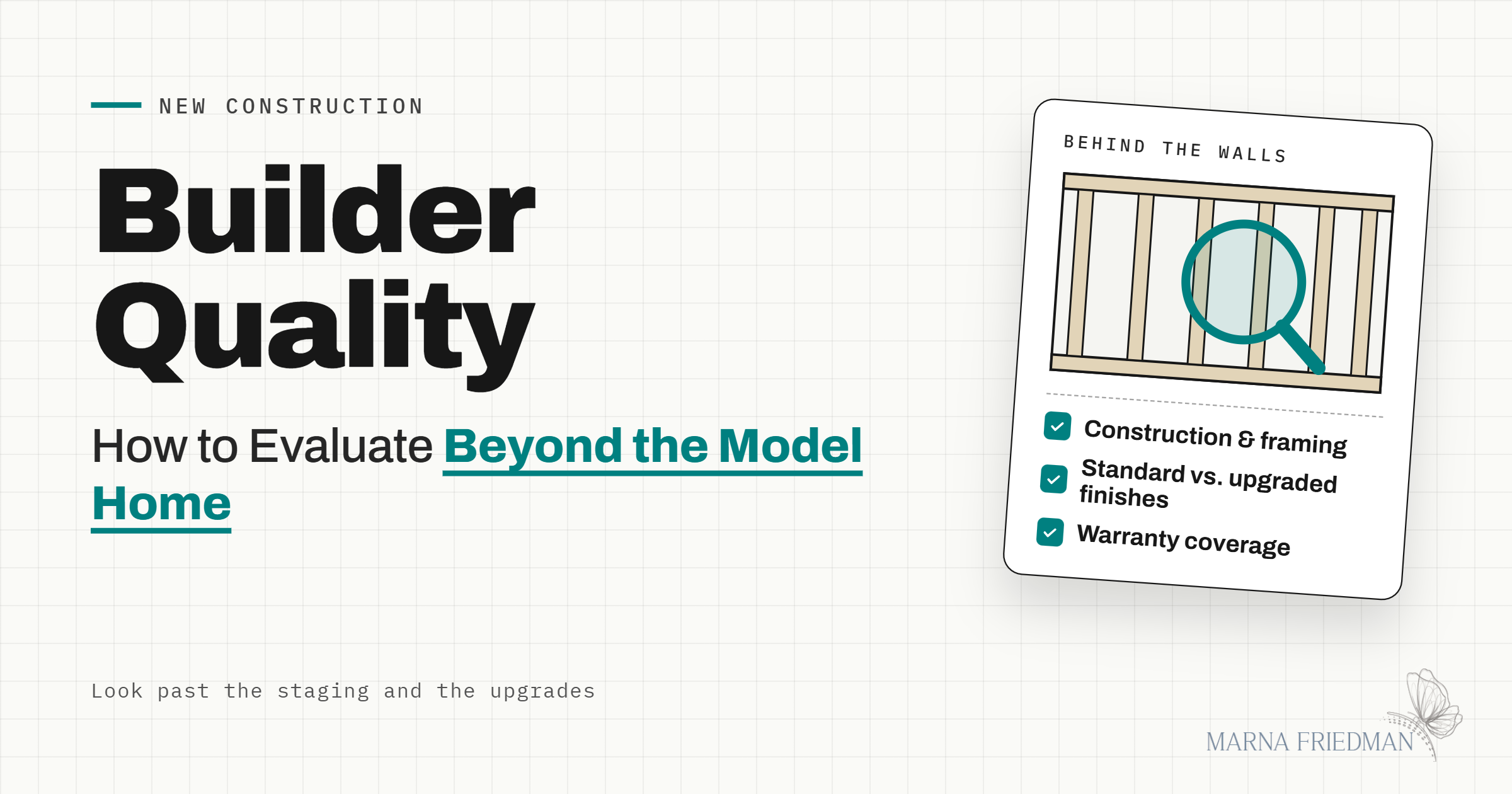
- Construction-stage visits: if visiting homes under construction, look at framing quality, weatherproofing, mechanical installation.
- Exterior details: siding alignment, trim consistency, roof condition, grading around the foundation.
You're looking for pattern, not perfection. Every home has small issues; consistent sloppiness is the warning sign.
What questions should you ask current residents?
If the builder facilitates conversations with current residents:
- How has your overall experience been living in the home?
- What issues have come up, and how did the builder handle them?
- How responsive has the warranty service been?
- Have you noticed anything that wasn't apparent at closing?
- How is the HOA functioning?
- Would you buy from this builder again?
- What would you tell a new buyer to prioritize evaluating?
- How is the community coming together as it fills in?
Residents who have lived in their homes 6 to 24 months provide the most useful perspective. See my New Construction Companion for how I guide buyers through builder vetting.
What are the warning signs that should slow you down?
Several patterns warrant extra caution:
- Consistent complaints about communication: buyer frustration during construction often predicts warranty frustration after.
- Warranty response complaints: builders who are slow or difficult on warranty claims typically continue that pattern.
- Multiple reports of specific recurring issues: if several residents mention the same problem, that problem is likely to appear in your home too.
- Rapid turnover in sales staff or project management: indicates possible organizational issues.
- Legal history: prior lawsuits or regulatory complaints worth understanding.
- Resistance to showing finished homes or allowing resident conversations: may indicate they have reason to limit buyer access.
- Pressure tactics or rushing decisions: builders confident in their product don't typically need high-pressure sales.
- Reluctance to put commitments in writing: verbal assurances disappear when problems arise.
Any one of these might have an innocent explanation. Multiple together deserve serious reconsideration.
How does builder vetting fit into the broader buying timeline?
Builder research should start before you fall in love with a specific home or community:
- Early research phase (before touring): initial online research, review of builders active in NW Metro Atlanta areas you're considering, baseline reputation assessment.
- Community tour phase: site visits to current and prior builder communities, conversations with sales teams, initial finished-home evaluation.
- Serious evaluation phase: deeper review of specific builder for a community you're seriously considering; resident conversations, warranty history, construction-phase visits.
- Contract phase: having clarity on builder quality informs contract negotiations, inspection decisions, and warranty expectations.
- Construction phase: independent construction-phase inspections at key milestones; ongoing communication monitoring.
- Pre-closing phase: thorough final walkthrough with knowledge of what to look for.
- Warranty year: active engagement during the first year ensures issues get caught and addressed under warranty.
Builder quality consideration continues through every phase, not just the initial decision. See my New Construction Companion for the broader timeline, and my dos and don'ts of buying new construction for additional buyer guidance.
Frequently Asked Questions
Are national builders better than local builders?
Not inherently. National builders have scale advantages (purchasing power, process standardization) but local builders often have better community relationships and more flexibility. Quality varies within both categories. Evaluate the specific builder, not the type.
What's the easiest way to verify builder reputation?
Walk a community they built 5+ years ago. See how homes are aging, how residents feel, and how the community has held up. Nothing simulates this; it's actual outcome data.
Should I hire a third-party inspector during construction?
Many buyers do, and it often pays off. Independent inspection at key construction phases (foundation, pre-drywall, pre-closing) catches issues that are easier to fix during construction than after. Your buyer's agent can recommend inspectors who do construction-phase inspection work.
How much does builder quality affect long-term value?
Significantly. Better-built homes hold value better, cost less in maintenance, and have lower repair rates. The difference between builders is often larger than the difference between communities for the same budget.
Can I get bad builder quality fixed under warranty?
Sometimes, but warranty response varies widely between builders. Reading warranty experience in reviews and talking to current residents gives you a sense of how a builder actually handles claims, not just what they promise.
Considering new construction in NW Metro Atlanta?
Vetting builders well is one of the areas where experienced buyer's agent representation matters most. I help buyers evaluate builders, communities, and the specific homes they're considering. Read my new construction guide, my Companion, or reach out before you commit to a builder.
Marna Friedman is a licensed REALTOR® with Atlanta Communities Real Estate Brokerage serving NW Metro Atlanta. Builder quality and reputation change over time; verify current reviews and recent builds for any specific builder. Information is deemed reliable but not guaranteed. Equal Housing Opportunity.
Check out this article next