
General Real Estate · NW Metro Atlanta
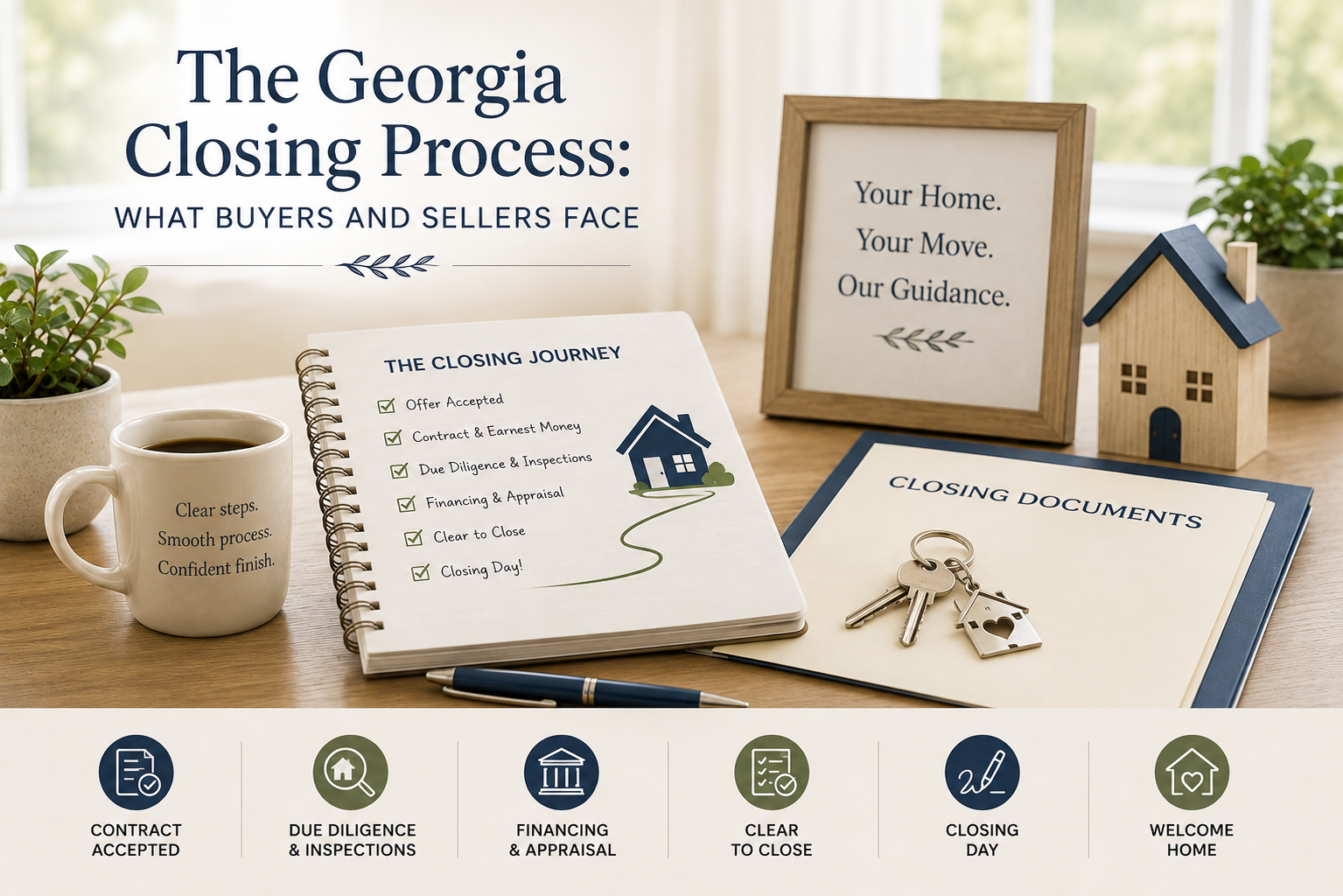
Georgia is one of about a dozen "attorney states" for real estate closings. Every residential closing in Georgia is handled by a licensed attorney, not just a title company or escrow officer as in many other states. That structure changes what buyers and sellers should expect from the closing process, from the day the contract is signed through the day keys change hands. If you're moving to Georgia from a different state, or if you haven't closed here in a while, the details are worth understanding. Here's a plain-language guide to how Georgia real estate closings work, what buyers and sellers each do, and what happens at the table.
A practical guide to Georgia's attorney-based closing process: timelines, roles, documents, and what happens on closing day.
Key Takeaways
- Georgia closings are handled by attorneys, not just title companies.
- The buyer typically chooses the closing attorney.
- Both parties usually attend closing in person or by proxy.
- Cashier's checks or wires are standard payment forms.
- Closings typically take 30 to 45 days from binding contract.
"Every Georgia closing I've been part of runs the same basic pattern, but every one has its own personality. Understanding the sequence and the roles beforehand makes the day itself much less stressful."
Marna Friedman, REALTOR®, Atlanta Communities
What makes Georgia closings different?
Georgia's status as an "attorney state" is the biggest structural difference. Practically, this means:
- An attorney handles the closing: conducts title search, prepares documents, disburses funds, and files paperwork.
- The buyer typically selects the attorney: though this varies by contract and market convention.
- Both parties sign at the attorney's office: most commonly, though remote or split closings can be arranged.
- The attorney represents the lender: which is worth understanding. The attorney's primary duty is to the lender, not to either party directly.
- Title insurance is provided: owner's title policy is standard and worth having.
- Attorney fees are part of closing costs: these vary by attorney but are generally competitive within a market.
None of this makes Georgia closings unusually complex; the process is streamlined and predictable. It's just different from Southern California or Texas or many other markets. See my closing day process post for more detail.
What's the typical timeline?
From binding contract to closing:
- Day 1 (Binding Agreement Date): contract goes under contract; earnest money delivered.
- Days 1-10: due diligence period; inspections, review of disclosures, other investigations.
- Days 5-20: loan application, underwriting, appraisal ordered and completed.
- Days 10-30: title search, survey (if needed), commitment for title insurance.
- Days 25-35: final loan approval, clear to close.
- Days 30-45: closing.
Some deals close faster (cash deals can close in 2 to 3 weeks; some VA loans take longer). New construction has its own timeline tied to build completion. Delays happen; underwriting, appraisal issues, and title problems are the most common reasons.
Closing timeline at a glance
The table shows what typically happens when.
| Timing | Buyer | Seller |
|---|---|---|
| Contract acceptance | Deliver earnest money; start inspections | Prepare disclosures; coordinate access |
| First week | Inspections, loan application | Respond to inspection requests |
| Weeks 2-3 | Appraisal, underwriting | Complete agreed repairs; prepare to move |
| Weeks 3-4 | Wire funds; review closing disclosure | Payoff current mortgage; utility transfers |
| Closing day | Sign closing documents; get keys | Sign deed and settlement; receive proceeds |
| Post-closing | Move in; receive recorded documents | Move out (if not already); confirm final utilities |
The rhythm is predictable, though any single step can push into the next if delays occur.
What does the buyer do?
Beyond the offer and negotiation, the buyer's closing responsibilities include:
- Deliver earnest money: promptly after contract; typically 1% to 5% of purchase price.
- Complete loan application: if financing.
- Schedule and attend inspections: home inspection, and any specialty inspections (radon, WDI, HVAC, roof, etc.).
- Review inspection results and negotiate: repair requests, credits, or price adjustments if warranted.
- Get insurance: homeowner's insurance policy before closing.
- Complete lender requirements: documentation, verifications, condition satisfactions.
- Review closing disclosure: from lender at least 3 days before closing.
- Wire funds: for down payment and closing costs; wire fraud is a real risk, so verify wire instructions carefully.
- Do the final walkthrough: the day of or day before closing.
- Attend closing: sign documents, receive keys.
The lender drives the pace on financed purchases. Cash purchases move faster but still follow the general framework.
What does the seller do?
Seller responsibilities in a typical closing:
- Complete disclosures: Georgia's Seller Property Disclosure Statement and any additional disclosures.
- Coordinate access: for inspections and appraisal.
- Respond to inspection requests: negotiate repairs, credits, or acceptance as-is.
- Complete agreed repairs: before closing, with receipts documented.
- Coordinate mortgage payoff: your lender's payoff quote goes to the closing attorney.
- Prepare to move: plan the physical move to complete before or at closing.
- Handle utilities: transfer or discontinue service.
- Attend closing: sign the deed and settlement documents.
- Receive proceeds: typically wired to your account within a day of closing.
Sellers who prepare well upfront often close smoother than those who scramble in the final weeks.
What happens on closing day?
The actual closing usually takes 1 to 2 hours at the attorney's office. Sequence:
- Arrival and identification: photo ID for all parties.
- Review of settlement statement: the closing disclosure detailing all funds moving.
- Deed and mortgage documents: extensive stack; the attorney explains each.
- Verification of wire funds: both incoming (buyer) and disbursement (seller).
- Signatures: often 30 to 50 signatures across all documents.
- Key exchange: at end of closing, typically.
- Recording: the attorney records the deed and mortgage at the county courthouse.
Buyer and seller can attend together or in separate sessions; the attorney usually accommodates whichever works. My closing day process post has more detail.
What can go wrong and how to prevent it?
Common delay sources and prevention:
- Underwriting delays: respond to lender requests immediately; the fastest closings have organized buyers.
- Appraisal below contract: prevention is pricing right; response is renegotiation or additional cash to close.
- Title issues: often unearthed by the title search; may require attorney work to resolve.
- Inspection surprises: discuss expectations early; realistic buyers and sellers close faster.
- Wire fraud: verify wire instructions by phone with a known number; never trust email-only instructions.
- Last-minute lender conditions: some conditions come up close to closing; be responsive.
- Insurance shopping: get quotes early; some homes are harder to insure than others.
Most closings that miss their target date do so by a few days. Major failures are less common but do happen. Preparation and communication reduce the odds.
What about closings in October, November, and December?
End-of-year closings have their own considerations:
- Holiday timing: lenders, appraisers, inspectors, and attorneys have limited availability around Thanksgiving and from mid-December through New Year. Build extra time into the schedule.
- Property tax and homestead exemption: closing before December 31 vs. January 1 affects property tax reporting and homestead exemption timing in Georgia. Discuss with your attorney and tax advisor if timing is close.
- Insurance and utility transitions: holidays can slow utility company response; start these steps earlier than usual.
- Movers and services: movers, cleaners, and painters get booked heavily in late December; schedule several weeks in advance.
- Year-end lender push: some lenders push to close before year-end to hit annual targets; others slow down. Ask early about the pace at your lender.
- Post-holiday appraisal backlog: appraisers often have January backlogs from December delays; a January close date may push into February in some cases.
None of these prevent an end-of-year closing; they just require earlier planning and more communication between all parties. Buyers and sellers who start the process 45 to 60 days out from a target end-of-year close date have the smoothest experience.
Frequently Asked Questions
Who picks the closing attorney?
The buyer typically picks in Georgia, though contract terms and lender requirements affect this. Discuss the choice with your agent; some attorneys are known for particular market segments or lender relationships.
Do I have to attend closing in person?
Usually yes, though remote closings are increasingly possible with mail-away documents, notary services, and electronic signatures for certain documents. Discuss options early if you can't attend.
How much are closing costs typically?
For buyers: usually 2% to 5% of purchase price, including lender fees, title insurance, attorney fees, and other closing charges. For sellers: usually 6% to 10% including agent fees, transfer taxes, and any negotiated concessions. Actual costs vary; get an estimate from your lender or agent.
What happens if closing gets delayed?
Depends on the reason and the contract. Most contracts allow short extensions when both sides agree. If delays extend beyond the contract, either party may have exit rights. Discuss with your agent and attorney if delays develop.
Are Georgia closings faster or slower than other states?
Comparable to most; 30 to 45 days is standard for financed closings, faster for cash. The attorney-based structure isn't slower than title-company closings when both are functioning normally.
Considering buying or selling in NW Metro Atlanta?
Understanding the process before you're in it is worthwhile. I help clients navigate closings from contract through the key exchange. Read my closing day process, my closing costs post, or reach out to talk through your specific transaction.
Marna Friedman is a licensed REALTOR® with Atlanta Communities Real Estate Brokerage serving NW Metro Atlanta. This article is general guidance, not legal or financial advice; consult qualified attorneys and lenders for your specific situation. Equal Housing Opportunity.
Check out this article next