55+ Active Adult · NW Metro Atlanta
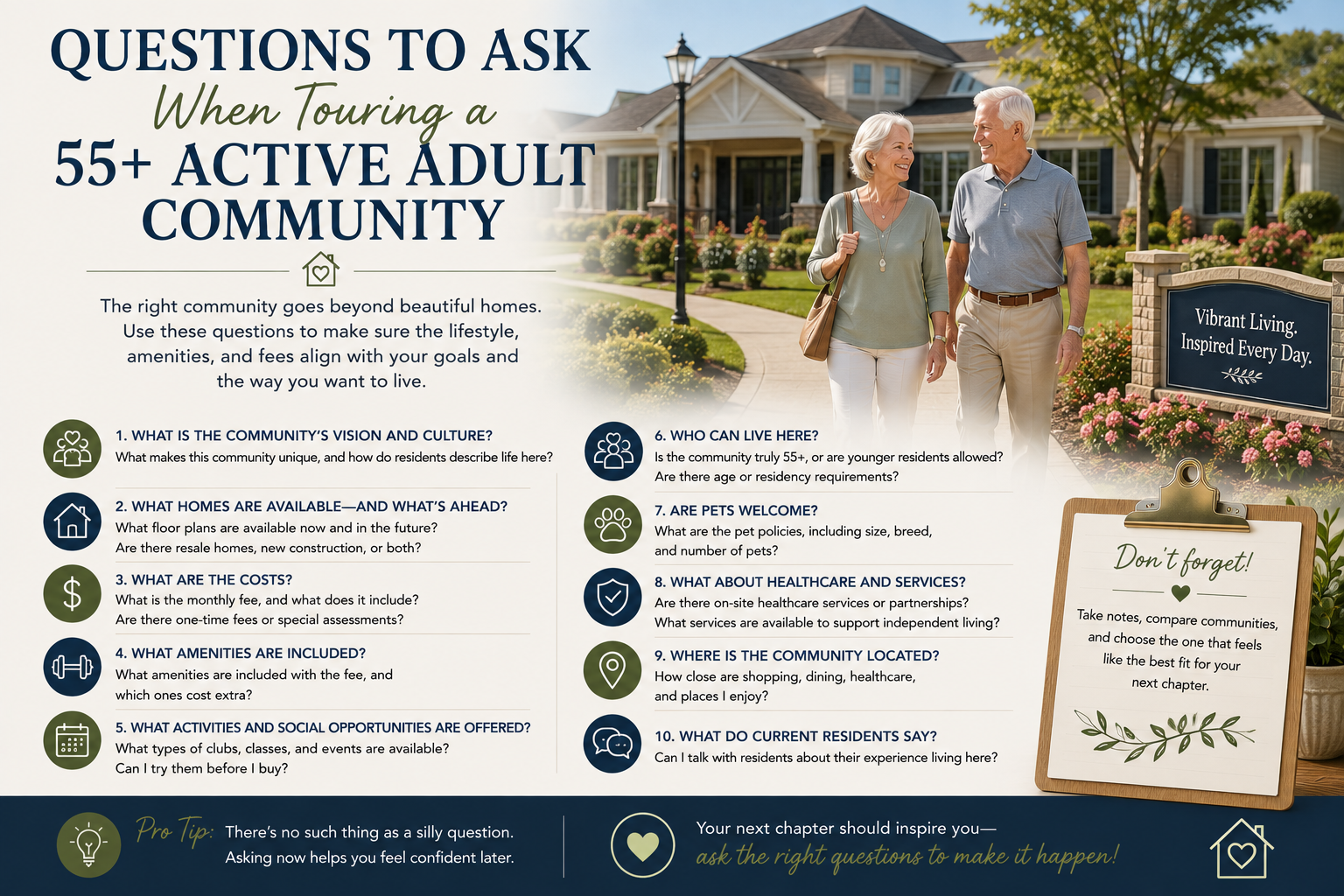
The questions that matter on a 55+ community tour fall into six groups: the community's legal age-restricted status, the HOA's finances and coverage, the amenities as they exist today, the rules that touch daily life, the homes themselves, and what living there actually feels like. Bring the list in writing, ask the same questions at every community, and the comparison makes itself.
Sales offices are good at presenting; your job on tour day is to ask the questions the presentation does not volunteer. After touring these communities with clients across Cherokee, Cobb, and Paulding counties for years, here is the question list I hand buyers before we get in the car.
Key Takeaways
- Ask every community the same written question list so answers are directly comparable.
- Verify legal 55+ status under HOPA and get the occupancy rules in writing, not in conversation.
- Press on HOA finances: dues history, reserve study, and any assessments in the past five years.
- Distinguish built amenities from planned ones, with written timelines for anything unfinished.
- Talk to residents away from the sales office; ask what they would change.
"Sales offices from Canton to Acworth are good at what they do. My question list exists so the tour answers your priorities, not just the presentation's."
Marna Friedman, REALTOR®, Atlanta Communities
Which questions establish the community's legal status?
Start here, because everything else depends on it. Ask: Is this community legally age-restricted under the Housing for Older Persons Act, and may I see the written age-restriction policy? What are the exact occupancy rules, minimum age, younger spouse or partner provisions, rules for other younger occupants, and extended guest stays? How is the restriction verified and enforced, and what happens in inheritance situations?
A legally qualified 55+ community will answer all of this readily and point you to the covenants where it lives in writing. Vague answers, or marketing language like "active adult lifestyle" without an enforceable restriction, tell you the community may be age-targeted rather than age-restricted, a distinction with real consequences that I explained in age-restricted vs. age-targeted. Federal guidance on HOPA is available through HUD.
What should you ask about the HOA and money?
The association runs the lifestyle, so its health is your question set's center of gravity: What are the current monthly dues, and exactly what do they cover, lawn care, exterior items, trash, gates, amenities, programming? How have dues changed over the past five years? May I see the current budget and the most recent reserve study? Have there been special assessments in the past five years, and is any assessment or major project under discussion now? Are there capital contribution or initiation fees at purchase? Who manages the association, professional management or self-managed, and how do residents participate in governance?
Healthy communities answer with documents, not reassurance. The coverage question matters doubly because it changes your real monthly cost of living, the arithmetic in what 55+ HOA dues cover.
Which questions sort the amenities and rules?
| Topic | Ask this | Listen for |
|---|---|---|
| Amenities | Which amenities are complete today, and what is the written timeline for the rest? | Specific dates vs. "coming soon" |
| Programming | Is there a lifestyle director? Which clubs and events actually recur? | A current calendar, not a launch brochure |
| Leasing | What are the rental rules and any caps? | Clear policy; heavy rentals change community feel |
| Daily rules | Pets, parking, RVs and golf carts, exterior changes, fences, guest stays? | Rules you can live with, in writing |
| Build-out | How many phases remain, and how long will construction continue? | Honest timeline for noise, traffic, and dues effects |
What should you ask about the homes?
Whether you are touring resale or new construction, the home questions are the same at their core: Which floor plans are single-level or primary-on-main? What accessibility features are standard, wider doorways, step-free entries, zero-entry showers, and what can be added? What do lawn care and exterior maintenance responsibilities look like for this specific home type? For new construction, add the standard-versus-upgrade question for everything you see in the model, the build timeline, and the deposit structure; my 55+ new construction guide and single-level living features cover the details worth pressing on.
For resale, ask about the home's dues tier if the community has several, any transfer fees, and what recent sellers' homes sold for relative to asking, which your agent can verify independently.
How do you learn what the community actually feels like?
The sales office answers questions; residents answer the real ones. Walk the amenity areas where permitted and talk to the people you meet: How long have you lived here? What do you love, and what would you change? Does the activity calendar match reality? How is the HOA to deal with? Then test the location against your own week, drive to your medical providers, grocery store, place of worship, and the people you see most, at the times you would actually drive, exactly as the comparison framework in comparing 55+ communities lays out.
Visit twice: a weekday morning for the ordinary rhythm, and an event or weekend evening for the community at its most social. Communities in our area, including Soleil Belmont Park and Crescent Pointe at Great Sky, welcome return visits; treat that welcome as part of your data.
What everyday-logistics questions round out the visit?
A community can pass every document test and still fit a life poorly, which is why the last question set is about ordinary days. Ask how daily practicalities work: where mail and packages arrive and how deliveries are handled at gated entrances, how guests visit and park, what internet providers serve the community and how service has been, and what the cellular coverage is like inside the homes, small questions with daily consequences. Ask what is actually nearby in minutes, not miles: groceries, pharmacies, medical offices and the hospital systems residents use, and the drives you would repeat weekly, then verify by driving them at your real hours.
Ask, too, about the money mechanics of a purchase there beyond the dues themselves: any one-time capital contribution or transfer fees at closing, how amenity access transfers with a resale, whether any memberships are separate from the HOA, and what the move-in process involves, from truck scheduling to gate registration. Communities handle these differently, and knowing before contract beats discovering at closing.
Then close the loop the way any good interview ends: ask the sales office or listing agent what question buyers most often wish they had asked, request the documents you have not yet seen in writing, and take notes before you leave the parking lot while impressions are fresh. Between visits, compare your notes against the checklist rather than against the memory of the nicest clubhouse, because the community you choose will be the backdrop of ordinary Tuesdays for years, and ordinary Tuesdays are exactly what these questions are designed to reveal.
None of this needs to feel adversarial, and at well-run communities it never does. The best sales teams respect a prepared visitor, residents enjoy being asked, and the questions themselves signal that you are choosing seriously, which is exactly the kind of neighbor every community hopes to gain. Bring the list, take the notes, and let the answers, not the brochure, cast the deciding vote. Brochures retire to a drawer; the answers are what you live with, season after season, which is precisely why they deserve a written list, an honest hearing, and a second visit before anything gets signed.
Frequently Asked Questions
What is the single most important question to ask on a 55+ tour?
Ask to see the written age-restriction policy and the occupancy rules. It confirms legal HOPA status and opens the covenants, which is where every other rule you will live under is recorded.
Should I bring my own agent to a 55+ community tour?
Yes, and register your agent from the first visit, especially at new construction communities where the on-site team represents the builder. Your agent's job is to verify what the tour presents.
How do I check an HOA's financial health?
Request the current budget, the reserve study, and the assessment history for the past five years. Adequate reserves and steady, explained dues changes indicate a well-run association.
What should I ask residents, specifically?
What they love, what they would change, whether the activity calendar matches reality, and how responsive the HOA is. The second question gets the honest answers.
How many visits before deciding?
At least two per finalist community, at different times, plus a document review between them. A decision this long-term deserves more than one guided hour.
A good tour is an interview, and the community should pass it on paper as well as in person. If you are beginning the search across NW Metro Atlanta's age-restricted communities, start with my 55+ active adult guide and community directory, then reach out. I will bring the question list; you bring the Saturday.
Marna Friedman is a REALTOR® with Atlanta Communities serving NW Metro Atlanta. Age-restricted communities operate under the Housing for Older Persons Act; confirm each community's current status, rules, dues, and amenities directly before purchasing. Equal Housing Opportunity.
Check out this article next