55+ Active Adult · NW Metro Atlanta
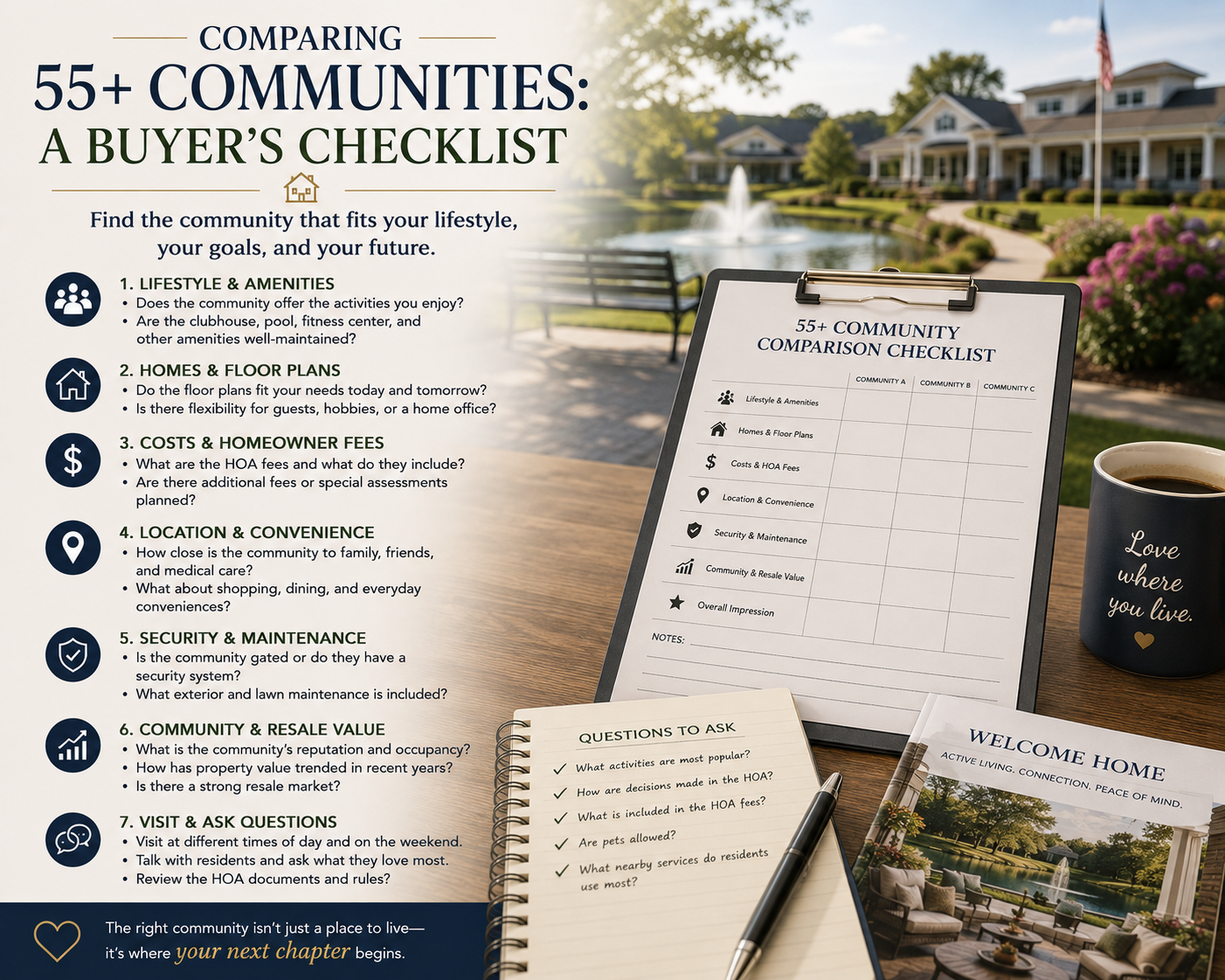
To compare 55+ communities well, evaluate each one across the same six categories: legal age-restricted status, the homes themselves, amenities as built (not as promised), HOA dues and what they cover, location relative to your life, and the feel of the community day to day. Score them side by side on paper and the right choice usually announces itself.
NW Metro Atlanta has a growing roster of age-restricted communities, and touring several is easy; comparing them rigorously is the part most buyers skip. After years of working these communities with clients, here is the checklist I use, category by category.
Key Takeaways
- Confirm each community's legal 55+ status under HOPA first; "age-targeted" marketing is not the same as age-restricted.
- Compare amenities that exist today against amenities that are planned, with dates, for communities still building.
- Line up HOA dues against exactly what they cover; a higher fee that includes lawn care and exterior work can cost less in practice.
- Weigh location against your actual weekly patterns: healthcare, worship, shopping, and the people you visit most.
- Visit each finalist at least twice, at different times, and talk to residents beyond the sales office.
"Clubhouses do the selling on community tours from Canton to Acworth. The checklist exists because budgets, covenants, and governance decide your experience long after the tour."
Marna Friedman, REALTOR®, Atlanta Communities
Is the community legally age-restricted?
Start here, because it defines everything else. A true 55+ community qualifies under the federal Housing for Older Persons Act (HOPA), generally meaning at least 80 percent of occupied homes include a resident 55 or older, with published policies demonstrating that intent. A legally qualified community can enforce its age requirement; an "age-targeted" neighborhood that merely markets a low-maintenance lifestyle cannot.
Ask each community directly for its age-restriction policy and how it is enforced, and read the covenants, which also govern younger spouses, extended guest stays, and inheritance situations. My post on age-restricted vs. age-targeted communities explains the distinction, and HUD publishes HOPA guidance at hud.gov. Communities in our area such as Soleil Belmont Park and Crescent Pointe at Great Sky operate as age-restricted; confirm current status during your process.
How do the homes themselves compare?
Floor plans matter more here than almost anywhere, because these homes are chosen for how they will live over many years. Compare: primary-suite-on-main or fully single-level layouts; door widths, step-free entries, and zero-entry showers; kitchen and laundry placement; storage, since these homes often replace much larger ones; garage size, including golf cart space where relevant; and outdoor living that is enjoyable without being burdensome. My guide to single-level living features details what to look for.
Also note who built or is building each community, whether resale and new construction are both available, and the construction quality signals you can see: siding materials, trim work, and how the earliest-built streets are aging.
What should the amenity and dues comparison include?
Amenities drive the lifestyle, and dues pay for it, so evaluate them together. For each community, list the clubhouse facilities, pools (indoor, outdoor, or both), fitness space, courts (pickleball counts are a real differentiator now), trails, and gathering spaces, and mark each item as built or planned. In a community still under development, ask for completion timelines in writing and how amenity funding works if build-out slows.
Then set the monthly dues beside the coverage list: lawn care, exterior maintenance items, trash, gates, amenity operations, reserves, and social programming vary widely. A community with higher dues that covers your lawn and some exterior upkeep can genuinely cost less per month than a cheaper one that covers little; the arithmetic is in what 55+ HOA dues typically cover. Ask about the reserve study and any recent special assessments; a healthy reserve fund is the quiet sign of a well-run association.
What does a side-by-side comparison look like?
| Category | What to record for each community | Red flags |
|---|---|---|
| Legal status | HOPA-qualified 55+? Occupancy rules in covenants | "Age-targeted" marketed as restricted |
| Homes | Plans, levels, accessibility features, storage, garage | Only two-story plans; narrow halls and steps |
| Amenities | Built vs. planned, with dates; condition of existing | Vague timelines; aging facilities without reserves |
| Dues and HOA | Monthly amount, coverage list, reserves, assessments | Thin reserves; recent surprise assessments |
| Location | Drive times to healthcare, shopping, worship, people you see weekly | Everything you do is 40 minutes away |
| Community life | Clubs, calendar, resident conversations, weekday feel | Empty clubhouse; calendar that exists only on paper |
How do you evaluate the intangibles?
Two communities can match on paper and feel completely different in person. Visit each finalist at least twice: once on a weekday morning to see ordinary rhythm, once during an event or busy evening. Walk the amenity spaces unescorted where permitted, and talk to residents you meet; ask what they would change, which is the question that gets honest answers. Look at the activity calendar for what actually recurs, not what launched once.
Location deserves the same honesty. Map your real week, medical appointments, groceries, worship, the people you visit, against each community, and drive the routes at the times you would actually drive them. A community that wins on amenities but loses 30 minutes to everything you do will be the wrong choice within a year.
What belongs in the budget beyond the dues line?
Dues comparisons are necessary and insufficient, because the true monthly cost of each finalist community includes everything the dues do not cover. Build a simple side-by-side for each: dues, plus lawn or exterior items excluded from them, plus utilities typical for the home type, plus insurance, which varies more than expected between detached homes, townhomes, and condominium structures, plus any club, golf, or activity costs that are optional on paper but essential to the life you are actually buying. Two communities with identical dues can sit a meaningful distance apart once the full column adds up.
Think about the exit while choosing the entrance, too. You are buying into a resale market as well as a community, so ask how quickly homes have been selling, whether rental caps and age-verification practices are protecting the community's character, and what the remaining build-out implies: buying early in a new community often means better selection and years of construction, while buying into a completed one means certainty at resale-market pricing. None of these answers is disqualifying by itself; each is a data point for the comparison table.
Finally, pressure-test the decision against time. The right community at move-in should still fit five and ten years on, which is where single-level living, home and community accessibility, and the depth of nearby services earn their place on the checklist. A community that fits this year's calendar but not next decade's realities is a partial answer, and this is precisely the comparison where an unhurried second and third visit pays for itself.
Bring the finished comparison to your agent and your own advisors before deciding, not after, because a second set of eyes on the full-cost column and the exit factors catches what enthusiasm skips. The community that survives that review, the checklist, the budget math, and the ten-year test, is the one to choose with confidence. And once chosen, choose it wholeheartedly; the comparison work exists precisely so that move-in day arrives without second-guessing. That peace of mind is the checklist's real product, and it is worth every visit it took to earn. Communities change slowly; a decision made this carefully holds up as they do.
Frequently Asked Questions
How many 55+ communities should I tour before deciding?
Three to five gives real perspective without exhaustion. Tour broadly once, then return to your top two or three for deeper visits and document review.
What documents should I review before choosing?
The covenants and age-restriction policy, current budget and reserve study, dues coverage list, any pending special assessments, and, for new construction, the amenity completion plan.
Do all 55+ communities have the same rules about younger residents?
No. Communities set occupancy rules within HOPA's framework. Many permit a younger spouse or partner when one occupant meets the age requirement; specifics live in each community's covenants.
Is new construction or resale better in a 55+ community?
Each has strengths: new construction offers current plans and selections, resale offers established streetscapes and known dues history. Many communities offer both; see building new in a 55+ community.
How do I know if an HOA is financially healthy?
Review the reserve study and budget, and ask about assessments over the past five years. Adequate reserves and steady, explained dues increases indicate discipline; chronically low dues can signal deferred trouble.
The right 55+ community fits your home preferences, your budget, and your actual week, and the checklist exists to test all three. If you are comparing communities across Cherokee, Cobb, and Paulding counties, start with my 55+ active adult guide and the community directory, then reach out and we will tour with the checklist in hand.
Marna Friedman is a REALTOR® with Atlanta Communities serving NW Metro Atlanta. Age-restricted communities operate under the Housing for Older Persons Act; confirm each community's current legal status, rules, dues, and amenities directly before purchasing. Equal Housing Opportunity.
Check out this article next