
55+ Active Adult · NW Metro Atlanta
The workable way to sort a home you have lived in for decades is small, early, and systematic: start months before any listing date, work in short regular sessions rather than heroic weekends, run every item through the same four decisions (keep, give, sell, let go), and move room by room in order of emotional difficulty, easiest first. Paired with the right professional help at the right moments, that method turns the most dreaded part of a later-life move into a long series of very doable afternoons.
Nearly every move I help with into a 55+ community begins with this project, and it is the part clients fear most and, months later, describe as the most satisfying. The house does get sorted; the only question is whether it happens calmly on your schedule or frantically on a contract's. This is the calm version, drawn from years of walking NW Metro Atlanta homeowners through it, and it pairs with the transaction-side planning in selling your longtime home to move to a 55+ community.
Key Takeaways
- Start months ahead and work in short, scheduled sessions; momentum beats marathon weekends every time.
- Four decisions cover everything: keep, give, sell, let go. Deciding is the work; touching things twice is the trap.
- Order rooms by emotional weight: storage and utility spaces first, the memory-dense rooms last, when your decision muscles are strong.
- Measure the next home early; the floor plan makes half your furniture decisions for you.
- Professional help exists for every stage, estate-sale companies, haul-away services, and move managers, and knowing when to call each is part of the plan.
"Thirty years in a Marietta or Woodstock home leaves layers, and layers take time. Start with one closet this month, not the garage the week before listing; momentum beats willpower every time."
Marna Friedman, REALTOR®, Atlanta Communities
Why does starting early change everything?
Because the real constraint is decisions, not boxes. A home holds tens of thousands of items after a few decades, and each one you touch asks a small question; ask them all in one exhausting month and the questions get answered badly, with regret in both directions, treasures let go in fatigue and clutter kept by default. Spread the same questions across six months of two-hour sessions and each one gets a real answer. Early starting also decouples the sorting from the selling: you can begin long before you have chosen a community or a listing season, and everything you finish is banked progress no matter how the timeline moves.
There is a market payoff hiding in the calm, too. A sorted home stages beautifully, photographs cleanly, and pre-inspects without surprises behind the stored boxes, all the preparation dividends I covered in maintenance that pays off before selling and room-by-room staging. Sellers who sorted early routinely walk into their listing weeks with the hard work done and only styling left.
How does the four-decision method work?
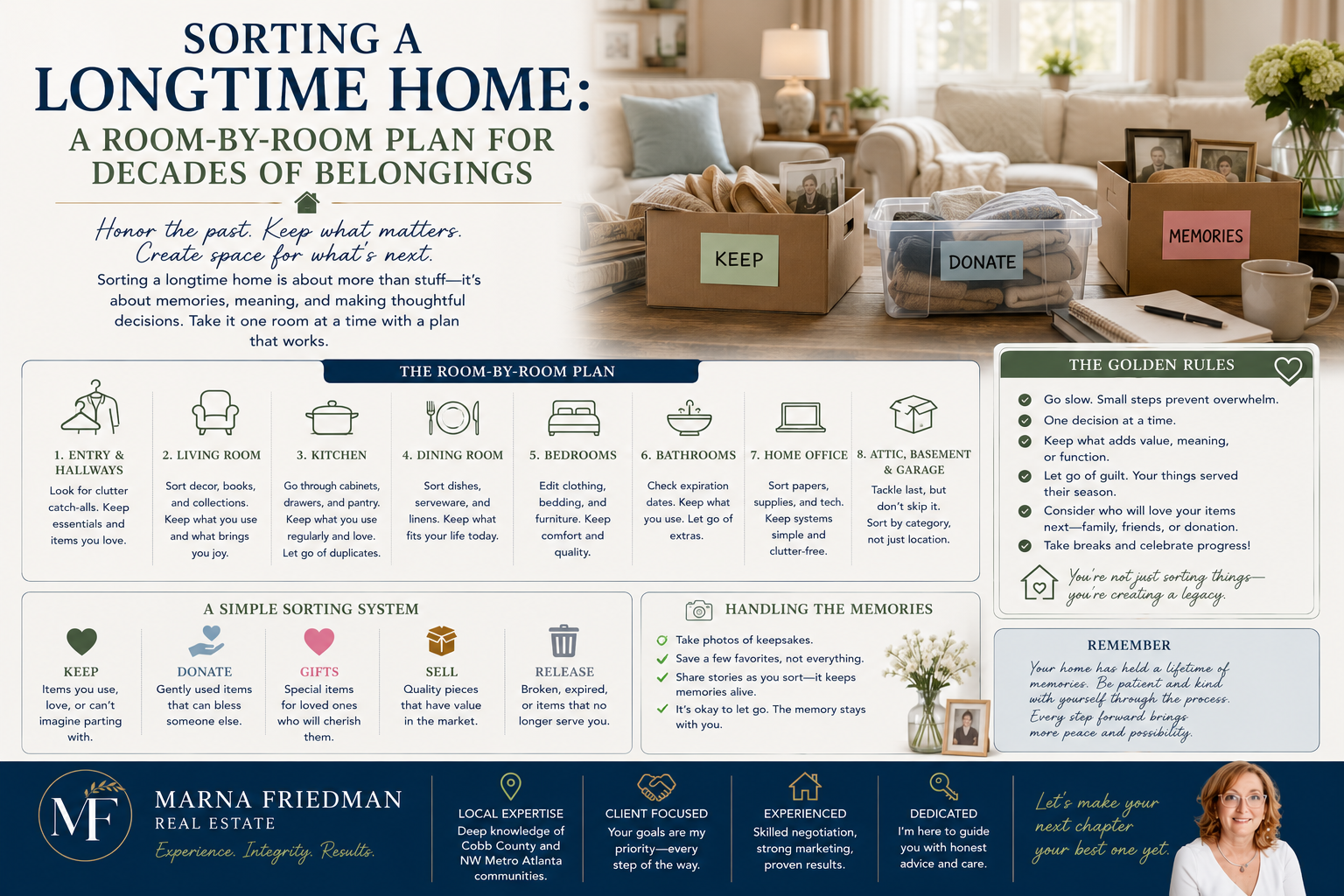
Every item gets exactly one of four verdicts, decided the first time you hold it. Keep means it moves with you, and the next home's floor plan referees this pile, so get the plan and measurements early, whether you are heading to a single-level home in a community like Soleil Belmont Park or anywhere else; the pile has to fit real rooms. Give splits two ways: specific items to specific people, offered now rather than someday, and general donation runs on a regular schedule so bags leave the house weekly. Sell is for items with genuine market value, gathered in one place for a later decision about method. Let go is everything else, and a scheduled haul-away at the project's milestones keeps this pile from becoming a garage exhibit.
Two rules protect the method. Decide once: an item picked up and put back down undecided will be picked up again, so make the call while it is in your hand, and give yourself a single small "maybe" box per room, not per shelf. And photograph liberally: for many memory-heavy items, a good photograph keeps the memory while the object moves on, and a digitizing session for papers and pictures shrinks whole cabinets into something that fits anywhere.
What room order makes the project easiest?
| Stage | Rooms | Why this order |
|---|---|---|
| 1. Warm-up | Laundry, linen closets, bathrooms, pantry | Low sentiment, fast wins, builds the habit |
| 2. Volume | Garage, basement, attic, storage rooms | Biggest space gains; mostly practical decisions |
| 3. Living space | Kitchen, living and dining rooms, guest rooms | Furniture and duplicates; the next home's plan decides much of it |
| 4. Personal | Primary bedroom, closets, home office and papers | Higher sentiment; your decision skills are practiced now |
| 5. Memory | Photos, keepsakes, collections, heirloom boxes | Saved for last on purpose; unhurried, often shared with loved ones |
The order is the strategy: by the time you reach the rooms that hold your history, you have months of practice deciding and a clear picture of the home you are moving toward. Many clients invite relatives into stage five deliberately, an afternoon with the photo boxes becomes a visit worth having, and specific treasures find their next homes in person.
When should professionals join the project?
Three kinds of help earn their fees at predictable moments. Haul-away and donation-pickup services belong throughout, scheduled at each stage's end so progress leaves the house. Estate-sale and consignment professionals enter once the sell pile has shape: a good estate-sale company evaluates honestly, handles pricing and the sale itself, and typically clears remainders afterward, one coordinated solution for the entire category, worth interviewing two or three as you would any contractor, with the vetting habits from hiring home professionals. Move managers, specialists who plan and run later-life moves end to end, are the full-service option: sorting help, floor-planning the new home, packing, and settling in. For moves without nearby helping hands, or on compressed timelines, they are frequently the best money in the whole transition.
My role sits alongside all of it: I keep a vetted local bench of these professionals across Cobb, Cherokee, and North Fulton, sequence their work against the sale calendar, and make sure the sorting timeline and the market timeline meet on the date we chose together, the coordination model I described in what it takes to serve a 55+ move well.
How do you handle the hard moments?
There will be items that stop the afternoon, and that is not a failure of the method; it is the house doing what houses do. A few practices help. Give the hardest items an appointment instead of an ambush: set them in the maybe box and return with a cup of coffee and no deadline. Distinguish the memory from the object out loud; often the story, told once to someone who listens, does the keeping, and the object can travel on. Let the next home argue for you: a smaller, brighter, easier home is a reason, and picturing the specific rooms, unburdened, is the best motivation the project has. And take the wins: every cleared shelf is real progress toward a move you chose, and clients consistently tell me the lightness on the far side surprised them.
Above all, keep the pace yours. This project rewards steadiness, not speed, and the whole point of starting early is that no afternoon ever has to be rushed.
Frequently Asked Questions
How long does it take to sort a longtime home?
Plan on several months of regular short sessions for a home held twenty or more years. Starting well before any listing date keeps every session unhurried and decouples the sorting from the sale calendar.
What is the four-decision method?
Every item gets one verdict the first time you touch it: keep, give, sell, or let go. One small maybe box per room is the only exception, and it gets a scheduled second visit.
Should I sort before or after choosing my next home?
Start before; finish after. Early stages need no floor plan, and once you have chosen the next home, its measurements make the furniture and keep-pile decisions largely for you.
Are estate sales worth it?
For homes with substantial sellable contents, often yes: a good company prices, runs the sale, and clears remainders in one coordinated project. Interview more than one and understand fees and what happens to unsold items.
What is a move manager?
A specialist who plans and runs later-life moves end to end: sorting support, floor-planning the new home, packing, movers, and setup. They are especially valuable on compressed timelines or when helping hands are far away.
What should I do with decades of photos and papers?
Digitize the bulk and keep the treasures. Scanning services turn cabinets into files, and a curated box of true keepsakes travels easily to the new home.
The house took decades to fill and does not need decades to sort; it needs a method, a head start, and the occasional professional. When the project and the move it serves are ready for a timeline, reach out, and my 55+ active adult guide covers the destination side of the journey.
Marna Friedman is a REALTOR® with Atlanta Communities serving NW Metro Atlanta. Service providers vary in offerings and fees; interview and verify any professional you engage. Age-restricted communities operate under the Housing for Older Persons Act. Information is deemed reliable but not guaranteed. Equal Housing Opportunity.
Check out this article next