
New Construction · NW Metro Atlanta
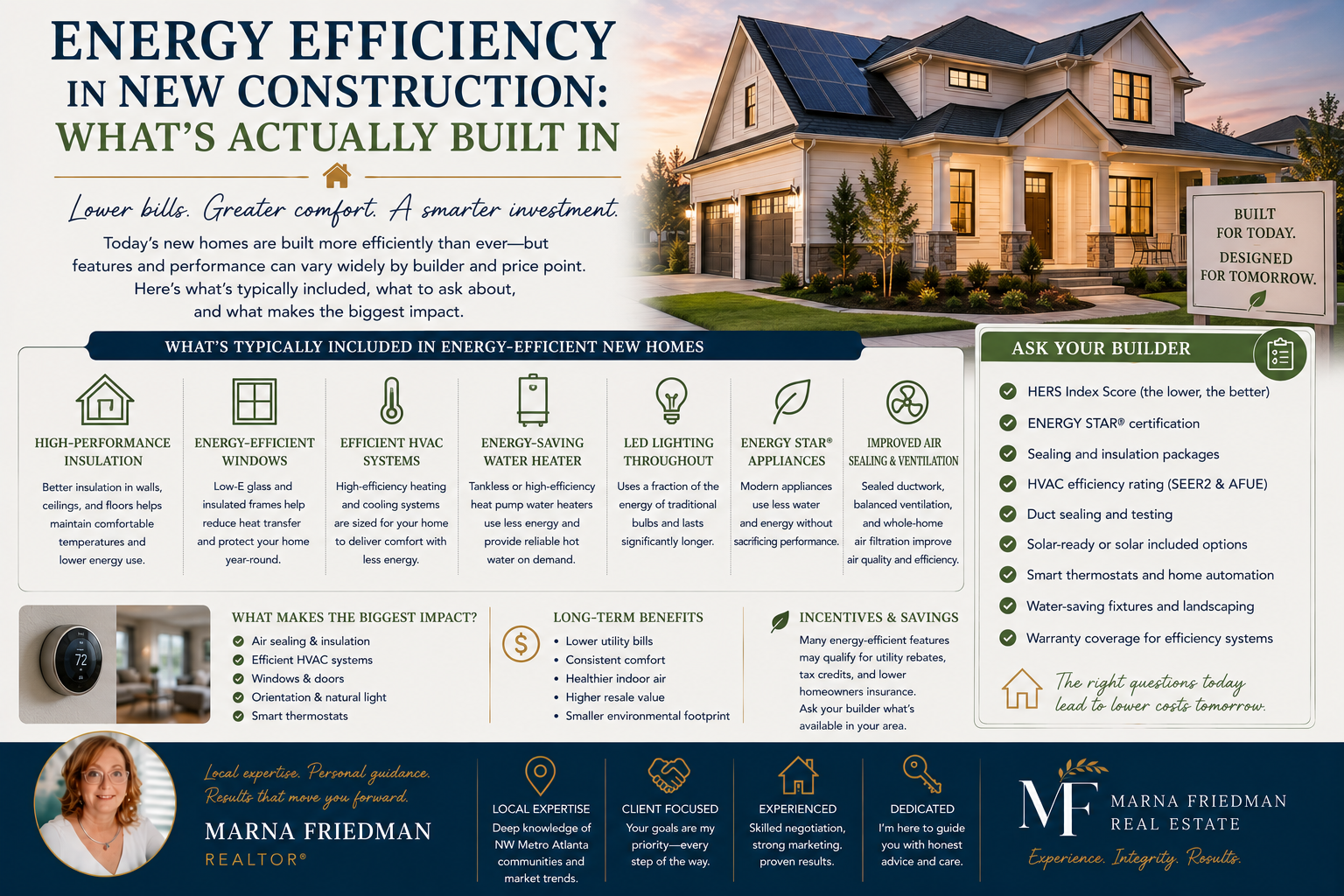
New homes are meaningfully more efficient than older housing as a baseline, because modern energy codes require insulation levels, air sealing, window performance, and equipment efficiencies that most existing homes never had. The buyer's job is not to wonder whether a new home is efficient but to find out how efficient this builder builds: what the standard package actually includes, whether performance is tested and rated rather than assumed, and which upgrades genuinely pay in Georgia's cooling-dominated climate. Those answers vary more between builders than most shoppers expect, and they are all discoverable with the right questions.
Utility costs come up in nearly every new construction conversation I have across NW Metro Atlanta, usually as a happy surprise for buyers arriving from older homes. This guide explains what code delivers automatically, where builders differ, what the ratings mean, and how to shop the efficiency story with the same discipline as the granite and the floor plan.
Key Takeaways
- Modern energy codes set a real baseline: insulation, air sealing, window performance, and equipment efficiency standards that make new homes cheaper to run than older ones.
- Builders differ above the baseline; the standard features sheet and direct questions reveal who builds to code minimum and who builds beyond it.
- Third-party ratings and certifications, such as HERS scores and ENERGY STAR certification where offered, replace marketing language with measured performance.
- In Georgia's climate, cooling performance rules the bills: attic insulation, air sealing, duct location and sealing, and window selection matter most.
- Efficiency upgrades follow the same rule as all options: things inside the walls and systems are build-time decisions; gadgets can come later.
"In Georgia's cooling season, the attic and the ducts decide the bill. Buyers touring models from Woodstock's I-575 corridor out to Dallas should ask about blower door results before they ask about the granite."
Marna Friedman, REALTOR®, Atlanta Communities
What does energy code give you automatically?
Georgia's residential construction follows state-adopted energy code requirements, which means every permitted new home is built to standards covering the building envelope, insulation levels for attics, walls, and floors, limits on air leakage, and window performance, along with duct sealing requirements and minimum equipment efficiencies for heating, cooling, and water heating. The practical result is the gap buyers feel when they move from a decades-old home into a new one: the new house holds its temperature, drafts are rare, and the utility bills reflect both.
Code is a floor, not a ceiling, and that distinction is where shopping begins. Two builders can both truthfully say "built to current energy code" while delivering different real-world performance, because code compliance itself has flexible paths and because everything above minimum is a choice: more attic insulation, tighter air sealing practices, better windows, smarter duct design, higher-efficiency equipment tiers. The standard features discipline applies here exactly as it does to countertops: get the specifics in writing, insulation values, window ratings, equipment efficiency tiers, and compare builders on the sheet rather than the slogan.
What do the ratings and certifications actually mean?
Third-party verification is the difference between claimed efficiency and measured efficiency, and it comes in a few forms worth recognizing. A HERS rating, the Home Energy Rating System, scores a home's modeled energy performance on an index where lower is better and where the score comes from a certified rater's inspection and testing, including a blower door test that measures actual air leakage. Some builders rate every home, some rate representative homes, some do not rate at all; asking which is itself informative. ENERGY STAR certification for new homes is a federal program layer above code, requiring specific practices and third-party verification, offered by some builders as standard or optional. Beyond these sit various regional and proprietary programs; the common thread that matters is independent testing versus self-description.
For a buyer, the questions are simple: Is this home or this plan rated, by whom, and may I see the documentation? Was a blower door test performed, and what were the results? Ratings do not need translating into engineering to be useful, they let you compare homes and builders on one measured axis, and a builder proud of its numbers will hand them over happily. A builder vague about them is telling you something too, and both answers belong in the notebook alongside everything else from questions to ask a builder.
Which features matter most in Georgia's climate?
| Feature | Why it matters here | What to ask the builder |
|---|---|---|
| Attic insulation and ventilation | The attic is the front line of a cooling-dominated climate | Insulation level installed, and how the attic is ventilated |
| Air sealing | Leakage is humid outdoor air in summer, paid for twice | Whether blower door testing is performed, and typical results |
| Duct design and location | Leaky or unconditioned-space ducts waste cooling directly | Where ducts run, and how they are sealed and tested |
| Windows | Solar gain drives summer load, especially west exposures | Window performance ratings, and any orientation considerations |
| HVAC equipment and zoning | Efficiency tier and zoning shape comfort and cost, particularly on two stories | Standard equipment tier, upgrade options, and zoning approach |
| Water heating | A steady share of every bill | Standard water heater type and available upgrades |
The pattern in that table is deliberate: in this climate, envelope and ducts outrank gadgets. A tight, well-insulated home with sealed ducts in the right places outperforms a leaky one wearing premium equipment, which is why the unglamorous questions, insulation, sealing, testing, are the high-value ones.
Which efficiency upgrades are worth it at build time?
Apply the same build-now-or-later logic as every option decision. Envelope improvements, added insulation, upgraded windows, enhanced air sealing, are quintessential build-time choices: modest as line items during construction, disruptive or impractical to retrofit. Duct and system design choices, zoning, duct location, equipment tier, likewise belong to the build. Rough-ins are the quiet bargains: wiring or plumbing provisions for a future vehicle charger, or conduit runs that make later solar or technology additions easy, cost little inside open walls and real money after drywall.
On the later-works side: thermostats and monitoring devices install trivially after closing, appliances can be bought at retail on your schedule, and solar itself is a post-closing project for most buyers, one worth designing toward with roof orientation and rough-ins rather than necessarily buying through the builder. When an efficiency upgrade is offered at the design center, evaluate it like any option, what does it cost now versus later, and does it live inside the walls, and let the incentive structure inform where credits are best spent. Comfort deserves a vote too: many envelope upgrades pay first in evenness between rooms and quiet, with the utility savings as the running dividend.
How does efficiency show up in ownership and resale?
In ownership, it shows up monthly and in comfort you stop noticing, which is the best review a house can get. Protect the performance you bought: filters on schedule, the twice-yearly HVAC service from the year-round maintenance calendar, and attention at the final walkthrough to the efficiency-relevant details, insulation coverage visible from the attic access, registers flowing evenly room to room, exterior penetrations sealed. Keep the documentation, ratings, equipment specifications, any certifications, with the warranty papers, because it answers future questions twice: yours, and eventually a buyer's.
At resale, measured efficiency is a quiet advantage that is easy to present and hard to fake: utility cost history and rating documentation make a concrete story in a market where buyers increasingly ask. It will rarely headline a listing the way a kitchen does, but it steadily supports value in the category buyers describe as "the house just works," and homes with the paperwork earn the claim. New construction buyers get that story included; the point of this guide is making sure yours includes as much of it as the market offers.
Frequently Asked Questions
Are new homes really more energy efficient than older ones?
Yes, as a baseline: modern energy codes require insulation, air sealing, window performance, and equipment efficiencies most older homes lack. How far above that baseline a given builder goes is the shopping question.
What is a HERS rating?
A modeled energy performance score from a certified rater's inspection and testing, on an index where lower means more efficient. It lets you compare homes on measured performance rather than marketing language.
What is a blower door test?
A test that depressurizes the home to measure actual air leakage. It is the difference between claimed tightness and demonstrated tightness, and builders who test will share results.
Which energy upgrades matter most in Georgia?
Envelope and ducts: attic insulation, air sealing, duct sealing and location, and window performance, because cooling dominates our bills. Equipment tier matters after the envelope is right.
Should I buy solar through the builder?
Sometimes offered, rarely urgent: solar retrofits cleanly after closing, while roof orientation and inexpensive rough-ins at build time preserve the option. Evaluate any builder solar package against post-closing alternatives.
Do energy features help resale value?
They support it steadily rather than dramatically: documented ratings and reasonable utility history answer a question buyers increasingly ask, and they reinforce the well-built impression that carries value across the whole home.
Efficiency is one of new construction's genuine advantages, and the buyers who capture the most of it are simply the ones who asked for specifics. Bring the questions from this guide to every model home alongside the rest of your list, and if a new build anywhere in NW Metro Atlanta is in your plans, reach out, starting from how buying new construction works.
Marna Friedman is a REALTOR® with Atlanta Communities serving NW Metro Atlanta. Code requirements, builder practices, programs, and offerings vary and change; confirm current specifics in writing with the builder and relevant programs. Information is deemed reliable but not guaranteed. Equal Housing Opportunity.
Check out this article next